
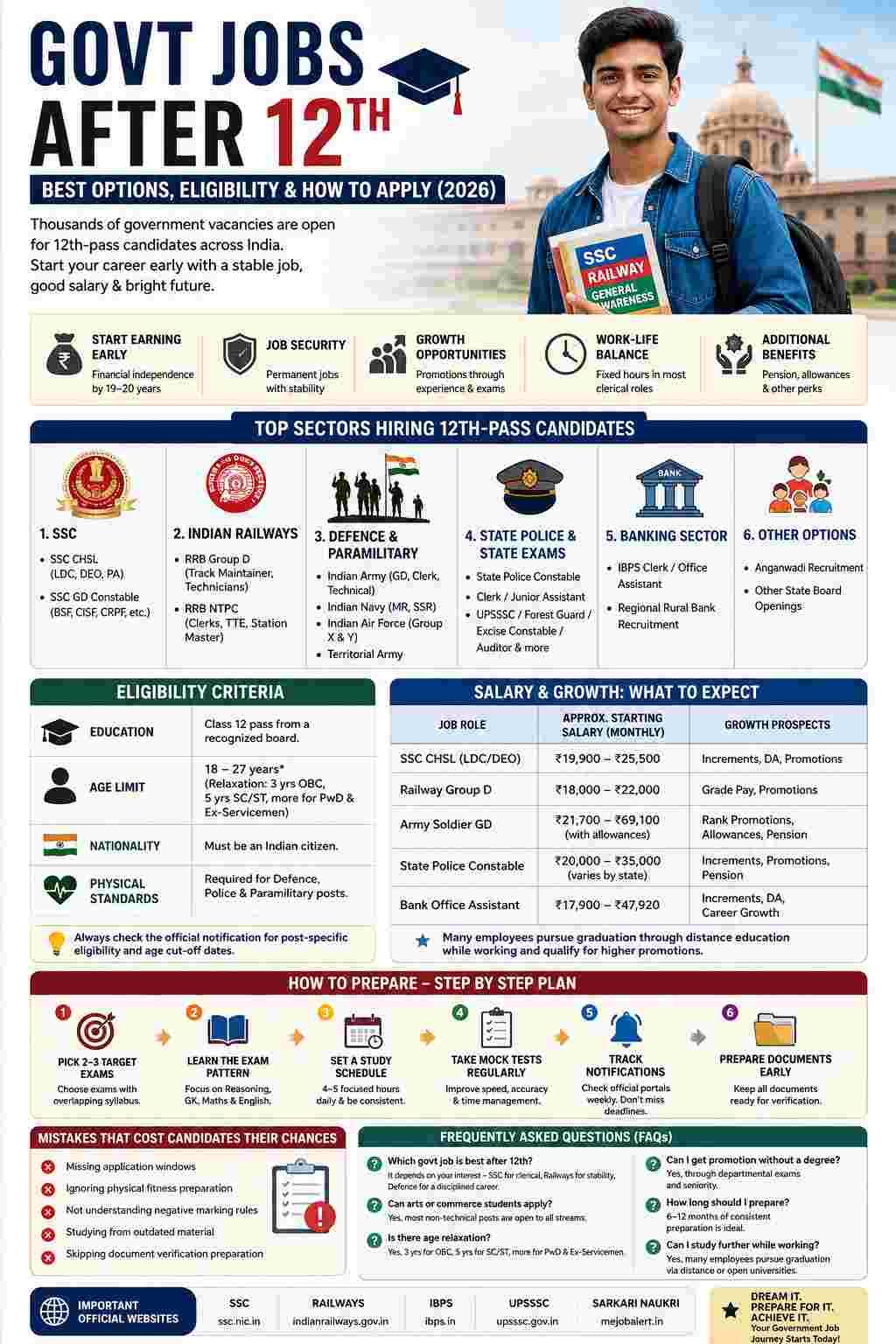
Meta Description: Confused about govt jobs after 12th? Here’s a real breakdown of the best sectors, eligibility rules, salaries, and how to actually start applying today.
If you’ve just finished Class 12 and you’re not sure whether to jump straight into a job or spend three more years in college first, you’re not alone. Thousands of students face this exact fork in the road every year — and a surprisingly large number of them choose government jobs, because honestly, the numbers make sense.
SSC, Indian Railways, the defence forces, and various state boards together open tens of thousands of vacancies every year for candidates who’ve cleared only their 12th — no degree needed. That’s a real career, with a real salary, years before your classmates even graduate.
This article walks you through what’s actually available, who qualifies, what the pay looks like, and how to prepare without wasting a year figuring it out the hard way. Let’s get into it.
Table of Contents
- Why a Govt Job After 12th Makes Sense
- Top Sectors Hiring 12th-Pass Candidates
- Eligibility Criteria You Need to Check
- Salary and Growth: What to Actually Expect
- How to Prepare — A Realistic Step-by-Step Plan
- Mistakes That Cost Candidates Their Chances
- FAQs
- Final Thoughts
Why a Govt Job After 12th Makes Sense
Let’s be honest — government jobs aren’t glamorous, but they’re stable in a way that most private-sector entry roles simply aren’t. And for an 18-year-old trying to build a future, stability counts for a lot.
Here’s what actually draws students toward this path:
- You start earning years earlier. No waiting for a degree — you can be on payroll by 19 or 20.
- Job security is real. Once you’re confirmed, layoffs aren’t really a thing.
- Pension and retirement benefits are still attached to most government posts, unlike a lot of private jobs.
- You can grow without going back to college. Departmental exams let you move up the ladder using experience and effort, not just degrees.
- Fixed hours in most clerical roles mean an actual work-life balance, something private-sector freshers rarely get in year one.
If you’re also weighing more flexible or remote options as a backup, it’s worth browsing flexible schedule jobs near you or remote jobs that don’t need experience — but for most 12th-pass students, the government route still offers the better long-term deal.
Top Sectors Hiring 12th-Pass Candidates
Here’s where the real opportunities are right now.
1. SSC (Staff Selection Commission)
SSC runs two major exams that don’t ask for a degree:
- SSC CHSL — hires for Lower Divisional Clerk, Data Entry Operator, and Postal Assistant posts.
- SSC GD Constable — recruits into forces like BSF, CISF, and CRPF.
For a full rundown of what’s open this year, check this list of latest government jobs for 12th-pass candidates in 2026.
2. Indian Railways
Railways is still one of India’s biggest employers, and it hires 12th-pass students under two main tracks:
- RRB Group D — track maintainers, technicians, helpers.
- RRB NTPC — clerks, ticket examiners, station masters.
If you want the full picture, this complete Railway recruitment guide for freshers breaks down the process end to end, and there’s also a version specifically for 10th-pass candidates if that applies to someone in your family.
3. Defence and Paramilitary Forces
If you’re physically fit and like the idea of structure and discipline, this is worth a serious look.
- Indian Army — Soldier GD, Clerk, and Technical entries after 12th.
- Indian Navy — MR and SSR sailor recruitment.
- Indian Air Force — Group X (technical) and Group Y (non-technical).
- Territorial Army — a lesser-known option worth exploring if you want part-time defence service alongside a civilian career; here’s a detailed guide on Territorial Army recruitment.
4. State Police and State-Level Exams
Almost every state runs its own recruitment cycles for:
- State Police Constable posts
- Clerk and Junior Assistant roles
- State-equivalents of SSC exams
If you’re in UP specifically, there’s a dedicated breakdown of government jobs after 12th in Uttar Pradesh, including UPSSSC-specific openings like Forest Guard, Excise Constable, and Auditor/Assistant Accountant posts. Candidates near Ghaziabad or Noida can also check the Ghaziabad Police Constable Bharti 2026 eligibility or Noida government job vacancies for something closer to home. If you want a broader nationwide view, this roundup of state government jobs in 2026 covers most major states in one place. There’s also a general list of 12th-pass police recruitment openings for 2026 if policing specifically interests you.
5. Banking Sector
You can enter banking without a degree too, in specific roles.
- IBPS Clerk / Office Assistant posts in select regional banks.
- Regional Rural Bank recruitment, which often accepts 12th-pass candidates.
Since IBPS and SBI both run clerk recruitment cycles, it’s worth reading this comparison of IBPS Clerk vs SBI Clerk 2026 before deciding which to prioritize, and bookmarking the upcoming bank exams calendar for 2026 so you don’t miss a window.
6. Other Notable Options
A few posts don’t fit neatly into the categories above but are worth knowing about — like Anganwadi recruitment, which is a solid entry point for many candidates, especially in semi-urban and rural areas.
Bottom line: apply across multiple boards at once. Don’t put all your effort into a single exam when SSC, Railways, and state boards often run parallel cycles.
Eligibility Criteria You Need to Check
Before you spend months preparing, confirm you actually qualify. Requirements vary slightly by exam, but here’s the general pattern.
General Eligibility
- Education: Class 12 pass from a recognized board. Stream usually doesn’t matter unless the post is technical.
- Age: Generally 18–27 years, with relaxation of 3 years for OBC candidates and 5 years for SC/ST candidates, plus additional relaxation for PwD and ex-servicemen categories.
- Nationality: Indian citizenship is required for nearly all posts.
- Physical standards: Height, chest measurement, and endurance tests apply for defence, police, and paramilitary roles.
Stream Matters More Than You’d Think — Sometimes
Most clerical and administrative posts don’t care which stream you studied. But technical roles — Railway Technician, IAF Group X, and similar — usually want Physics and Maths from your 12th.
If you took a diploma route instead, there are dedicated openings too — see government jobs for diploma mechanical students, govt jobs for diploma civil engineering, or best government jobs after ITI electrician if that’s more your path. And if you’re wondering what’s possible with even less formal education, this piece on govt jobs after 10th might help a younger sibling or friend.
Always double-check the eligibility section of the actual notification before you invest months into preparation — small details like age cutoff dates shift every cycle. The SSC official website publishes every notification directly, and it’s worth checking weekly during exam season.
Salary and Growth: What to Actually Expect
Here’s the part everyone actually wants to know — how much does it pay?
| Job Role | Approximate Starting Salary (Monthly) |
|---|---|
| SSC CHSL (LDC/DEO) | ₹19,900 – ₹25,500 |
| Railway Group D | ₹18,000 – ₹22,000 |
| Army Soldier GD | ₹21,700 – ₹69,100 (with allowances) |
| State Police Constable | ₹20,000 – ₹35,000 (varies by state) |
| Bank Office Assistant | ₹17,900 – ₹47,920 |
These starting figures might look modest next to some private-sector offers, but they climb steadily through annual increments, dearness allowance revisions, and promotions. And unlike most private jobs, you don’t need a fresh degree to move up — departmental exams do the job.
Pro Tip: A lot of working government employees complete their graduation through distance or open universities while on the job. That opens the door to higher-grade promotional exams down the line, so you’re not stuck choosing between earning and studying.
If your target is specifically higher-paying posts from the start, this list of government jobs with salary above ₹50,000 is worth a look, though most of those need a degree or a few years of experience.
How to Prepare — A Realistic Step-by-Step Plan
Preparation is genuinely where most candidates either pull ahead or fall behind. Here’s a plan that actually works.
Step 1: Pick 2–3 Target Exams, Not Ten
Spreading yourself across every exam notification you see is a recipe for burnout. Pick exams with overlapping syllabi — SSC CHSL and a state clerk exam, for instance — so your prep serves more than one application.
Step 2: Learn the Exam Pattern Cold
Most 12th-pass level exams test the same four areas:
- General Intelligence & Reasoning
- General Awareness / GK
- Quantitative Aptitude
- English Language
Step 3: Set a Study Schedule You Can Actually Stick To
- Aim for 4–5 focused hours a day if you’re preparing full-time.
- Rotate subjects daily instead of grinding one topic for a week straight — it helps retention more than people expect.
- Solve previous years’ papers early so you know what “hard” actually looks like for that exam.
Step 4: Take Mock Tests — Regularly, Not Occasionally
Mock tests aren’t just practice. They train your speed and accuracy under real time pressure, and that’s usually what separates a good score from a great one on exam day.
Step 5: Track Notifications Like It’s Your Job
Government exam calendars shift constantly, and a missed deadline is the most avoidable mistake in this whole process. Check official portals weekly, or bookmark a running list like Sarkari Naukri 2026 so nothing slips past you.
Step 6: Get Your Application Documents Ready Early
Once you clear an exam, the next hurdle is the interview or document verification stage — and this is where a lot of candidates stumble simply because they didn’t prepare their resume or basic answers in advance. It’s worth reading up on how to write a resume and practicing common interview questions like how to answer “tell me about yourself” well before you need them. And later, once you’re comparing offers or promotion tracks, knowing how to negotiate salary genuinely comes in handy — yes, even in some government contexts with allowances and postings.
Mistakes That Cost Candidates Their Chances
Even genuinely hardworking students lose opportunities over small, avoidable errors. Watch for these:
- Missing application windows because they weren’t tracking notifications properly.
- Ignoring physical fitness prep for police or defence roles until it’s too late to train properly.
- Not understanding negative marking rules, leading to unnecessary point loss from guessing.
- Studying from outdated material instead of the latest official syllabus.
- Skipping document verification prep, which causes otherwise-qualified candidates to get rejected at the final stage.
None of these are talent problems — they’re organization problems. And they’re completely avoidable if you treat the process seriously from day one.
FAQs
Which govt job is best after 12th?
It really depends on your interests. SSC CHSL suits people who want clerical, office-based work. Railway NTPC offers strong long-term stability. Defence services suit those who want a physically active, disciplined career path instead.
Can arts or commerce students apply for govt jobs after 12th?
Yes, absolutely. Most non-technical posts across SSC, Railways, and police departments don’t require a specific stream. Only technical roles typically ask for a Science background.
Is there age relaxation for reserved categories?
Yes — generally 3 years for OBC candidates and 5 years for SC/ST candidates, with further relaxation available for PwD candidates and ex-servicemen.
Do these jobs offer promotion without a degree?
Yes. Most departments allow promotion through departmental exams and seniority, so you can move up the pay scale without going back to college for a fresh degree.
How long should I prepare before attempting SSC or Railway exams?
Most focused candidates need 6–12 months of consistent preparation, though it varies depending on your starting level and how many hours you can realistically put in daily.
Can I study further while working a govt job after 12th?
Yes, and many people do exactly this — completing graduation through distance or open universities while working, which then qualifies them for higher promotional exams later.
Final Thoughts
A govt job after 12th isn’t a fallback option — for a lot of students, it’s genuinely the smarter, faster route into a stable career. You get financial independence, real job security, and a growth path that doesn’t depend on going back to college, often years before your classmates finish their degrees.
So don’t sit on this. Pick 2–3 exams that fit your stream and interest this week, pull the latest syllabus, and build a study schedule you’ll actually follow. If you want a wider net, browse central government jobs that don’t require prior experience or the ongoing list of government jobs for fresh graduates for context on where these roles can eventually lead. Your first offer letter is closer than it feels right now — the only thing standing between you and it is starting today.
Suggested Tags/Keywords: govt jobs after 12th, government jobs after 12th, SSC CHSL eligibility, RRB Group D, 12th pass government jobs, sarkari naukri after 12th, defence jobs after 12th, state police constable recruitment, bank jobs after 12th, govt exam preparation tips