
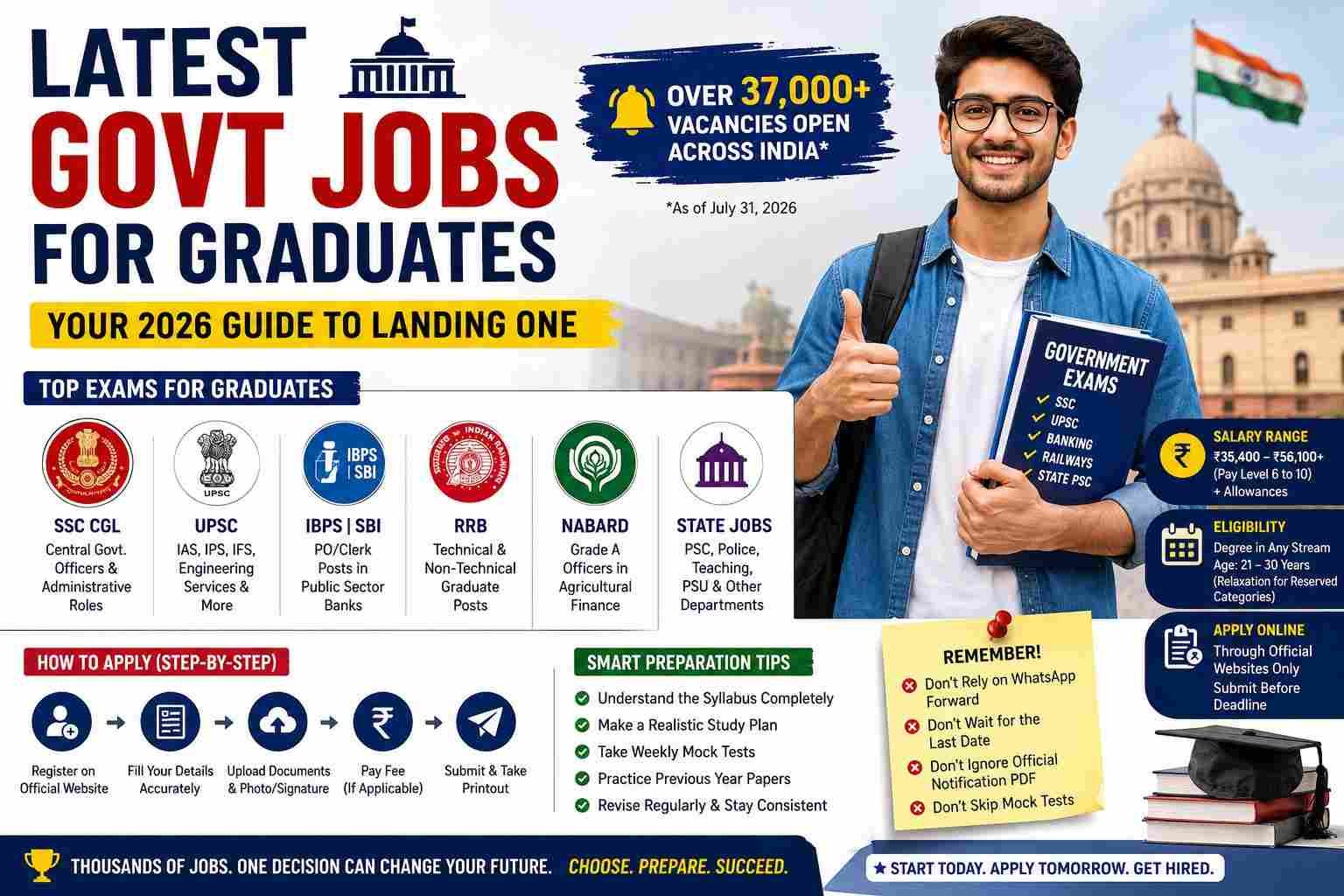
Looking for the latest govt jobs for graduates? Here’s a real, no-fluff guide to top exams, eligibility, salary, and how to actually get hired in 2026.
Let’s Start With the Good News
If you’ve spent the last few weeks refreshing job portals and feeling like nothing’s out there — take a breath. That’s not actually true right now. As of late July 2026, there are over 37,000 government vacancies open across India, posted by more than 1,200 different recruiting bodies as of Jul 31, 2026, this list presents exciting job opportunities with more than 37,445 government job vacancies and 306 recruitment options available for application, gathered from 1,229 recruitment organizations across every location. All Government Jobs That’s a lot of doors, not a closed one.
So this guide isn’t going to throw generic advice at you like “apply early” and call it a day. We’ll walk through exactly which latest govt jobs for graduates are worth your time right now, what you need to qualify, what the pay actually looks like, and how to apply without messing up your form five minutes before the deadline.
What We’ll Cover
- Why graduates still chase govt jobs in 2026
- The exams actually worth your attention right now
- Eligibility — the stuff people always get wrong
- What the salary really looks like
- How to apply (step by step)
- A prep strategy that doesn’t burn you out
- Mistakes that quietly kill applications
- FAQs
- Final word
Why Graduates Still Chase Govt Jobs in 2026
Private sector salaries can look shinier on paper, sure. But ask anyone who’s worked a government job for five years, and they’ll tell you what actually kept them there — the stability, the pension, the fact that you’re not worried about a sudden layoff email at 9 PM on a Sunday.
There’s also a career ladder that’s actually predictable. You know roughly when you’re due for a promotion, what the next pay band looks like, and where you’ll land in ten years. That kind of certainty is rare these days, and it’s exactly why lakhs of graduates sit for these exams every single year.
If you’re weighing this against private-sector options, it’s worth reading our breakdown on government jobs for fresh graduates before you commit your prep time to one path.
The Exams Actually Worth Your Attention Right Now
Let’s cut through the noise. Here’s where the real opportunity is sitting.
Central Government Options
- SSC CGL — This is the one most graduates start with, and for good reason. SSC is the single largest recruiter for graduate and 12th-pass office jobs, FreeJobAlert with openings across Income Tax, Excise, CBI, and dozens of other central departments.
- UPSC Civil Services — The big one. This covers IAS, IPS, IFS, Engineering Services, CDS, NDA, CAPF Assistant Commandant, Combined Medical Services, and Combined Geo-Scientist exams. FreeJobAlert
- IBPS PO/Clerk and SBI PO — Solid entry points into public sector banking, and honestly less competitive than people assume once you know the pattern. If you’re torn between the two, check out our comparison on IBPS Clerk vs SBI Clerk.
- RRB Recruitment — Railways release both technical and non-technical graduate posts throughout the year. Our railway recruitment guide for freshers breaks down what’s currently open.
- NABARD Grade A — Niche, but a strong pick if agricultural finance interests you.
State-Level Options
Don’t sleep on these — state jobs often have less competition per seat than central ones.
- State PSC exams, run separately by each state
- Police SI/ASI recruitment
- Lecturer and teaching posts — for example, Punjab recently opened 1,013 Lecturer positions through an online application, FreeJobAlert and these roll out constantly across different states
- PSU and departmental roles — AVNL, for instance, recently announced 1,213 Executive and Non-Executive posts FreeJobAlert
For a state-by-state breakdown, our state government jobs 2026 page is updated regularly and worth bookmarking.
A quick tip that actually matters: notifications for these roles come out almost every single day. The smartest move is to bookmark a page that updates daily and set alerts so you’re not the person who finds out about a deadline the day after it closes. FreeJobAlert
Eligibility — The Stuff People Always Get Wrong
Before you spend hours filling out a form, run through this checklist.
- Your degree — most graduate-level exams just need a bachelor’s degree in any discipline from a recognised university. FreeJobAlert Your specific subject rarely matters unless the post says otherwise.
- Age — generally 21 to 30 years, with relaxation for reserved categories as per government rules. Mahendras.org
- Still finishing your degree? You might still be able to apply. A lot of exams let final-year students apply provisionally, as long as they can show proof of the degree later. FreeJobAlert
- Category-based relaxation — upper age limits usually sit between 27 and 32 for unreserved candidates, with 3 years relaxation for OBC-NCL and 5 years for SC/ST. FreeJobAlert
If you’re a 12th-pass candidate weighing your own options separately, we’ve got a dedicated guide on latest government jobs for 12th pass in 2026 too.
What the Salary Really Looks Like
Nobody wants to prep for months only to find out the pay doesn’t match the effort, so let’s be straight about numbers.
Most graduate-level posts fall between Pay Level 6 and Pay Level 10 of the 7th Pay Commission, with basic pay starting anywhere from ₹35,400 to ₹56,100. FreeJobAlert That’s just the base — allowances, DA, and annual increments push the actual take-home noticeably higher over time.
One thing worth clearing up: the 8th Pay Commission is still in consultation and hasn’t finalized any new figures, FreeJobAlert so if you’ve seen posts claiming confirmed salary hikes for 2026, take them with a grain of salt. Check the official 7th Pay Commission pay matrix on the Ministry of Finance website if you want the real numbers.
If your target is specifically a higher-paying role, our list of government jobs with salary above ₹50,000 might help you narrow down which exams to prioritize.
How to Apply (Without Messing It Up)
The process itself isn’t complicated — but small errors here are exactly what get applications rejected.
- Register directly on the official recruiter’s website. Never through a random third-party link someone shared on WhatsApp.
- Fill in your degree, university, and marks accurately.
- Upload your documents — degree certificate, marksheets, category certificate, photo, and signature FreeJobAlert — in the exact format specified.
- Pay the application fee if there is one.
- Submit well before the deadline. Not the night before.
One habit that saves people a lot of grief: always cross-check the official notification PDF yourself before you apply. Good listing sites publish the post count, qualification, and closing date straight from that PDF the same day it’s released FreeJobAlert — but the official notification is still the final word, not a summary someone else wrote.
Once you land the interview stage, it’s worth prepping properly — our guides on how to write a resume and how to answer “tell me about yourself” cover the parts most candidates underprepare for.
A Prep Strategy That Doesn’t Burn You Out
You don’t need a 12-hour study schedule to crack these exams. You need consistency.
- Read the full syllabus once, properly, before you touch a single mock test.
- Build a study plan you can actually stick to — not the ambitious one you’ll abandon by week two.
- Take a mock test weekly and actually review your mistakes, not just your score.
- Go through previous years’ papers to spot the questions that repeat.
- Revise on a schedule instead of cramming everything in the final ten days.
If banking exams are on your radar, our upcoming bank exams calendar for 2026 is a handy one to keep open in another tab while you plan.
Mistakes That Quietly Kill Applications
- Relying on a third-party summary instead of reading the actual notification PDF
- Scrambling for documents the night before the deadline
- Applying without double-checking your age or category eligibility
- Skipping mock tests and jumping straight to full-length papers
- Believing salary or vacancy numbers you saw on a WhatsApp forward
FAQs
What are the latest govt jobs for graduates in 2026?
Right now, the biggest opportunities are in SSC CGL, UPSC Civil Services, IBPS PO/Clerk, RRB technical posts, State PSC exams, and various PSU roles. New notifications drop almost daily.
What’s the age limit for govt jobs after graduation?
Generally 21–30 years, with 3–5 years of relaxation for reserved categories depending on the specific post.
Can I apply if I’m still in my final year?
Yes, in most cases. A lot of exams accept provisional applications from final-year students, as long as you can produce your degree proof later.
What salary can I expect as a fresh graduate in a govt job?
Basic pay usually starts between ₹35,400 and ₹56,100 a month under Pay Levels 6–10, not counting allowances.
Which govt exam is easiest for graduates?
There’s no universal “easiest” — but SSC CGL and IBPS Clerk are often seen as more approachable in terms of syllabus. Your actual result still comes down to how well you prepare.
Where should I actually apply?
Only through the official recruiting body’s website — SSC, UPSC, IBPS, or your state’s PSC portal. Never through a third-party site asking for a “processing fee.”
Final Word
The latest govt jobs for graduates aren’t hiding — they’re sitting on official portals right now, thousands of them, waiting for someone to actually apply. The graduates who land these jobs usually aren’t the smartest in the room; they’re the ones who picked two or three exams that matched their eligibility, stuck to a study plan, and didn’t miss deadlines because they were relying on some random forwarded message. Pick your exam this week. Bookmark the official site. Start today, not “next Monday.”
latest govt jobs for graduates, sarkari naukri 2026, SSC CGL, UPSC civil services, IBPS PO, state government jobs, govt job eligibility, government job salary, graduate government jobs, govt job application process