
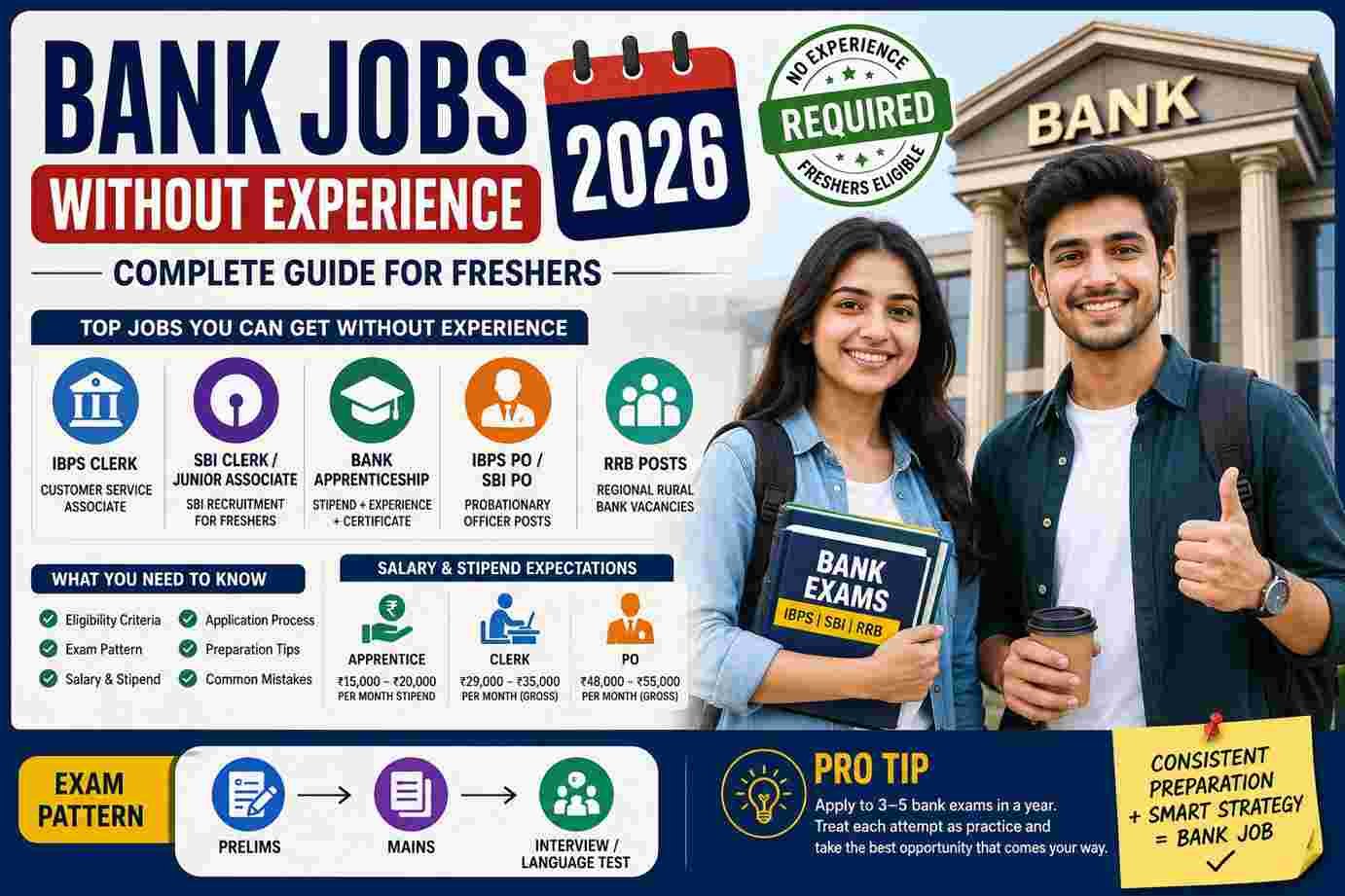
Want bank jobs without experience in 2026? Here’s exactly where freshers get hired — IBPS, SBI, apprenticeships, and private banks — with real steps to apply.
Every year, banks in India post tens of thousands of vacancies that don’t ask for prior work experience — just eligibility, a written exam, and sometimes an interview. If you’ve been told banking is only for people with connections or years on their resume, that’s simply not true. In 2026 alone, public sector banks have already announced over 25,000 vacancies across clerk, PO, and apprentice roles, and that number keeps climbing as the year goes on.
This guide breaks down where freshers actually get hired, what the exams and eligibility look like, and how to build a real plan instead of randomly applying and hoping for the best.
Table of Contents
- Why Banks Hire Freshers With Zero Experience
- Best Bank Jobs You Can Get Without Experience
- Eligibility Criteria You Need to Know
- How the Bank Exam System Actually Works
- Salary and Stipend Expectations
- Step-by-Step: How to Apply
- Mistakes That Cost Freshers Their Shot
- FAQ
Why Banks Hire Freshers With Zero Experience
Banks don’t expect you to walk in already knowing how their systems work. What they’re actually testing is whether you can learn fast, handle numbers accurately, and deal with customers without losing your patience.
That’s why almost every entry-level banking role — clerk, apprentice, or junior associate — is built around training you after you’re selected, not before. The written exam and interview exist to filter for aptitude and reliability, not banking experience.
There’s also a structural reason openings keep showing up. Thousands of existing bank employees retire, get promoted, or transfer every year, and those seats need refilling. Combine that with the sheer size of India’s public banking sector, and you get a hiring cycle that genuinely runs almost year-round if you know where to look. Bookmark a running sarkari naukri 2026 list so you don’t miss a notification window.
Takeaway: Banks hire freshers because their entire entry-level hiring system is designed around training people from scratch — your lack of experience isn’t a red flag here.
Best Bank Jobs You Can Get Without Experience
1. IBPS Clerk (Customer Service Associate)
This is the most common entry point into public sector banking. IBPS conducts a single common exam that places selected candidates across 11+ public sector banks as clerks. No prior banking background is needed — just graduation and age eligibility.
2. SBI Clerk / Junior Associate
SBI runs its own recruitment separately from IBPS, with its own prelims, mains, and language proficiency test. If you’re deciding between the two, it’s worth reading a proper breakdown of IBPS Clerk vs SBI Clerk before you start preparing, since the syllabus weightage and competition levels genuinely differ.
3. Bank Apprenticeship Programs
This is probably the fastest legal way into a bank branch with no experience at all. SBI, Union Bank, Central Bank of India, and several others run apprenticeship drives every year — Union Bank alone opened 1,865 apprentice posts in 2026, and Central Bank released 4,500 seats for FY 2026-27. These aren’t permanent jobs, but they pay a stipend, give you real branch exposure, and count as an advantage when you later apply for clerk exams.
4. IBPS PO / SBI PO (Probationary Officer)
If you’re a graduate aiming higher than clerk-level, PO roles are open to freshers too — no work experience is required, only a degree and the right age bracket. It’s more competitive, but it’s still a fresher-eligible exam.
5. Regional Rural Bank (RRB) Posts
RRBs recruit through IBPS as well, often with slightly relaxed eligibility and less competition than the big public sector bank drives, making them a solid option if you’re just starting out.
Takeaway: Whether you’re a fresh graduate or still building your resume, there’s a bank entry point that matches where you currently stand — apprenticeships and clerk roles included.
[INTERNAL LINK: Check the full bank exam schedule — Upcoming Bank Exams Calendar 2026 (PDF)]
Eligibility Criteria You Need to Know
Requirements vary slightly by bank and post, but here’s the general pattern:
- Clerk/Apprentice roles: Graduation in any stream from a recognized university, age usually between 20–28 years
- PO roles: Graduation with a minimum aggregate (varies by bank), age typically 20–30 years
- Age relaxation: SC/ST/OBC/PwBD and other reserved categories get relaxation as per government norms
- Language requirement: Proficiency in the local/regional language is often mandatory, especially for SBI
If you haven’t completed graduation yet, don’t assume banking is off the table entirely — several PSU and cooperative bank drives, along with broader government jobs after 12th, open doors earlier than people expect.
Takeaway: Most bank jobs need graduation, not experience — check the specific notification for exact percentage and age cutoffs before assuming you’re ineligible.
How the Bank Exam System Actually Works
Unlike a typical job application, bank recruitment in India runs through structured exams, not resumes and interviews alone.
- IBPS conducts common exams for clerk, PO, and SO posts across participating public sector banks, plus RRBs. This is what most people mean when they say “I’m preparing for bank exams.”
- SBI runs its own separate exam cycle for clerk and PO posts, independent of IBPS.
- RBI conducts its own recruitment for Grade B officers and assistants — a smaller, more specialized track.
Each of these follows a similar pattern: Prelims → Mains → Interview (for PO-level posts) or Prelims → Mains → Language Test (for clerk-level posts). Notifications open at fairly predictable times each year, so serious aspirants track all three calendars and apply wherever they’re eligible, rather than betting everything on one exam.
Pro Tip: Don’t wait for “the right exam.” Most successful candidates apply to 3–5 bank exams a year and take whichever result comes through first — treating each attempt as practice for the next.
[EXTERNAL LINK: IBPS official website — for authentic notifications and exam calendars]
[EXTERNAL LINK: SBI Careers portal — for SBI-specific clerk, PO, and apprentice notifications]
Takeaway: Bank exams aren’t one single test — they’re a system of overlapping opportunities, and applying broadly genuinely increases your odds.
Salary and Stipend Expectations
Here’s a realistic look at what freshers can expect to earn:
| Role | Approximate Pay |
|---|---|
| Bank Apprentice (SBI/Union Bank/Central Bank) | ₹15,000 – ₹20,000/month stipend |
| IBPS/SBI Clerk (starting) | ₹29,000 – ₹35,000/month gross |
| IBPS/SBI PO (starting) | ₹48,000 – ₹55,000/month gross |
| RRB Office Assistant | Comparable to clerk-level pay, varies by bank |
Keep in mind apprentices aren’t treated as regular employees — no PF, pension, or HRA — since the role falls under the Apprentices Act, 1961, not permanent bank employment. It’s a stepping stone, not the destination.
Once you do land an offer, don’t just accept the first number without checking what’s standard — a quick read on how to negotiate salary can help even in a fixed pay-scale environment where allowances and postings sometimes have room to discuss.
Takeaway: Apprenticeships pay modestly but buy you real experience; clerk and PO roles pay significantly more once you clear the exam.
Step-by-Step: How to Apply
- Pick your lane first. Decide whether you’re targeting apprenticeships (fastest entry, lowest pay) or clerk/PO exams (slower, higher long-term payoff).
- Track notifications weekly, not monthly. Banking notifications open and close fast, and missing a window means waiting for the next cycle.
- Check eligibility line by line — age, qualification percentage, and category relaxations — before you pay any application fee.
- Apply only through official bank/IBPS websites. Third-party portals sometimes carry outdated or expired links.
- Prepare your documents in advance — mark sheets, category certificates, ID proof — so document verification doesn’t trip you up later.
- Build a resume even for exam-based roles. Several private banks and apprenticeship drives still shortlist based on resumes before the interview stage, so it helps to know how to write a resume that highlights your academics and any relevant coursework properly.
- Practice your interview answers. PO and SO interviews often start with the basics — get comfortable with how to answer “tell me about yourself” so you’re not fumbling in the first two minutes.
Takeaway: Treat this like a system, not a one-off application — consistent tracking beats last-minute scrambling every time.
Mistakes That Cost Freshers Their Shot
- Waiting for “one perfect exam” instead of applying broadly. Serious aspirants apply to multiple exams every cycle.
- Treating apprenticeships as a guaranteed job. Banks are explicit that there’s no employment obligation after the apprenticeship period ends — use it to prepare for the next exam, not as your only plan.
- Skipping the fine print on eligibility. Age and percentage cutoffs are strict; a rejected application over a technicality is avoidable.
- Ignoring smaller drives. RRBs, cooperative banks, and regional PSU bank posts get far less attention than SBI or IBPS PO — and that means less competition for you. If you’re open to non-banking government roles too, central government jobs without experience is worth a look as a parallel track.
Takeaway: Most freshers lose out on strategy, not ability — fix the process, and your odds improve immediately.
FAQ
Can I get a bank job in India without any work experience?
Yes. IBPS Clerk, SBI Clerk, PO exams, and bank apprenticeship programs are all open to freshers straight out of graduation, with no prior work experience required.
What is the easiest bank job to get without experience?
Bank apprenticeship programs (SBI, Union Bank, Central Bank of India) tend to be the most accessible, since they’re specifically designed as entry-level training positions with relatively simpler selection processes.
Do I need a degree for bank jobs without experience?
For clerk, PO, and most apprenticeship roles, yes — graduation in any stream is generally required. Some cooperative and regional roles have lower qualification requirements, so check individual notifications.
How much do bank apprentices earn in 2026?
Most bank apprenticeship programs pay a stipend between ₹15,000 and ₹20,000 per month, along with a certificate that supports future clerk-exam applications.
Is a bank apprenticeship the same as a permanent bank job?
No. Apprenticeships run under the Apprentices Act, 1961, and banks are not obligated to offer permanent employment afterward. It’s best used as preparation and experience-building, not a final career stop.
How many bank exams should I apply for in a year?
Most serious candidates apply to 3–5 exams annually across IBPS, SBI, and RRB drives, rather than relying on a single attempt.
Conclusion
Bank jobs without experience aren’t a myth in India — they’re one of the most structured, predictable entry points into a stable career, provided you understand how the system actually works. Start by picking one lane — apprenticeship or exam prep — track the notification calendar closely, and apply consistently instead of waiting for the “right” opportunity.
Bookmark this page, check the bank exam calendar today, and get your first application in before the next window closes.