
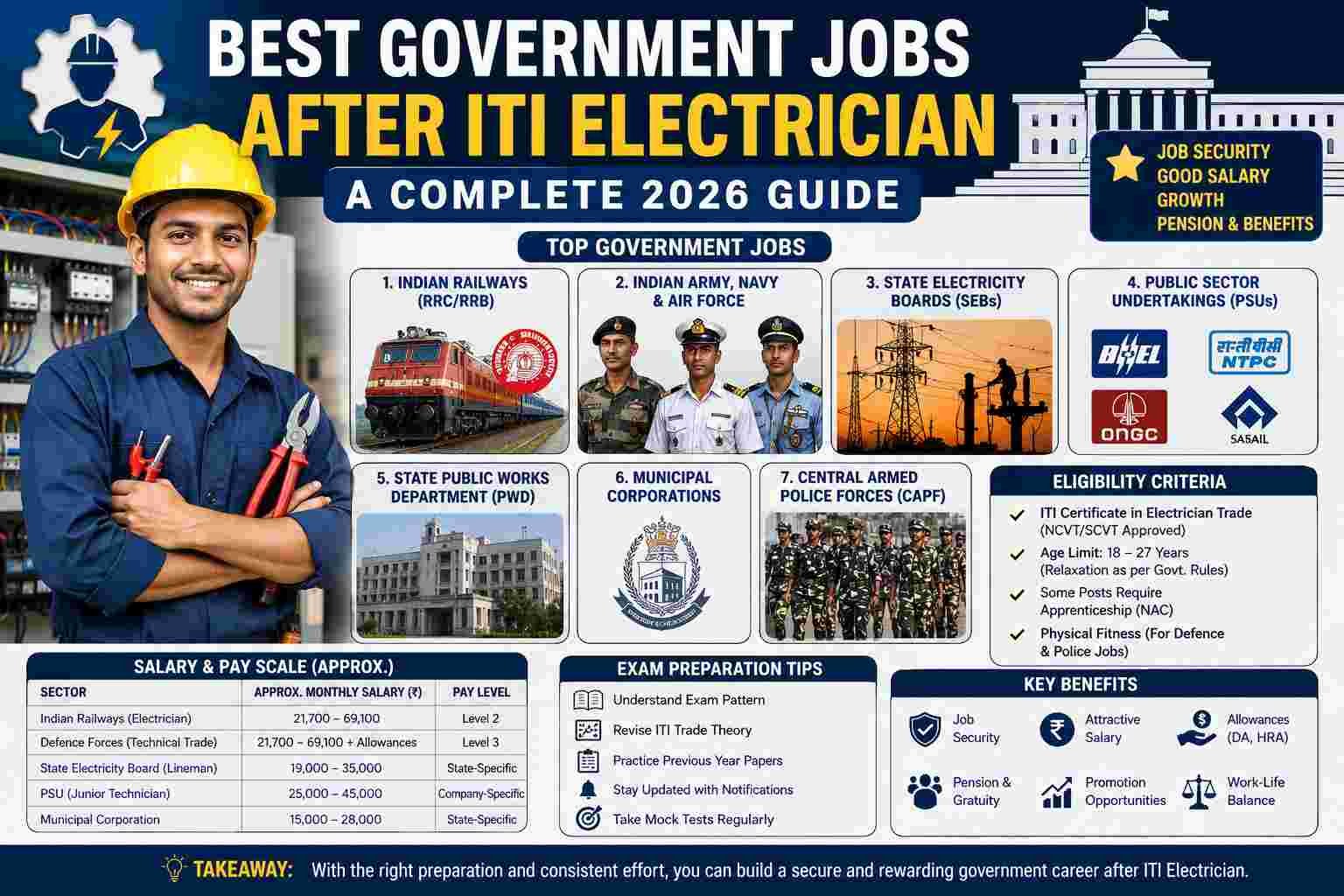
Discover the best government jobs after ITI electrician — railway, defence, SEB & PSU roles, salary, eligibility & exam tips. Read the full guide now!
Every year, lakhs of students complete their ITI Electrician course hoping to land a stable, well-paying government job — and for good reason. Government electrician positions in India offer job security, attractive pay scales under the 7th Pay Commission, pension benefits, and a clear path for career growth that most private-sector roles simply can’t match.
If you’ve just finished your ITI or are about to, you’re probably wondering which government departments actually hire electricians, what the eligibility criteria look like, and how to prepare for the exams. This guide breaks down the best government jobs after ITI electrician, covering everything from railways and defence to state electricity boards, so you can make an informed decision about your next career move.
Table of Contents
- Why Choose a Government Job After ITI Electrician
- Top Government Jobs After ITI Electrician
- Eligibility Criteria You Need to Know
- Salary and Pay Scale Comparison
- How to Prepare for Government Electrician Exams
- Common Mistakes to Avoid
- Other Career Resources Worth Exploring
- FAQs
- Conclusion
Why Choose a Government Job After ITI Electrician
Government jobs consistently rank among the most sought-after career paths for ITI Electrician graduates, and the reasons go well beyond just a steady paycheck. As a result, understanding these benefits can help you decide whether to pursue government exams or explore the private sector first.
Here’s what makes these positions genuinely worth pursuing:
- Job security: Unlike private companies, government roles rarely see layoffs, even during economic downturns.
- Structured pay growth: Salaries increase through DA hikes, increments, and periodic Pay Commission revisions.
- Retirement benefits: Pension, gratuity, and provident fund schemes provide long-term financial security.
- Work-life balance: Fixed working hours and generous leave policies are common across most departments.
- Social respect: A government position, particularly in railways or defence, still carries significant prestige in Indian society.
If you’re weighing this path against other options, it’s also worth browsing government jobs for fresh graduates to see how ITI-based roles compare in terms of pay and entry barriers.
Takeaway: If long-term stability and structured growth matter to you, a government job after ITI electrician is one of the smartest career investments you can make.
Top Government Jobs After ITI Electrician
Let’s look at the departments and organizations that actively recruit ITI-qualified electricians every year.
1. Indian Railways (RRC/RRB)
The Railway Recruitment Cell (RRC) and Railway Recruitment Board (RRB) regularly release notifications for the Electrician Group C post, making Indian Railways one of the largest employers of ITI electricians in the country. You can check current openings directly on the official RRB recruitment portal.
Duties typically include maintaining signal systems, electrical equipment in coaches, and station-level electrical infrastructure. Furthermore, railway jobs come with additional perks like free or discounted travel passes, which is a benefit unique to this sector.
If you’re a fresher, our complete railway recruitment 2026 guide for freshers walks you through the entire application process step by step. Candidates who only have a 10th-pass certificate alongside their ITI can also check our railway recruitment guide for 10th pass candidates for additional entry-level openings.
2. Indian Army, Navy, and Air Force (Technical Trades)
The defence forces recruit ITI electricians into technical trades under roles like Tradesman Mate and Electrician (Technical). These positions offer not just a salary but also housing, medical care, and a chance to serve the nation.
Pro Tip: Defence recruitment often requires a physical fitness test alongside the written exam, so start training early — don’t wait until the notification drops.
3. State Electricity Boards (SEBs) / DISCOMs
Every state has its own electricity distribution company (like MSEDCL, UPPCL, or TANGEDCO) that hires Junior Lineman and Technician (Electrical) roles. In other words, if you want to work close to home, this is often your best bet.
These roles involve maintaining transformers, power lines, and substations — practical, hands-on work that directly uses your ITI training. For a broader look at openings across different states, check out our detailed roundup of state government jobs in 2026.
4. Public Sector Undertakings (PSUs)
Companies like BHEL, NTPC, ONGC, SAIL, and Coal India recruit ITI electricians as Trade Apprentices or Junior Technicians. PSU jobs are highly competitive but offer salaries and benefits comparable to central government positions.
If you don’t have prior work experience, don’t worry — many PSU and central roles are open to freshers. Take a look at our guide to central government jobs without experience to find openings you can apply for right now.
5. State Public Works Department (PWD)
State PWDs hire electricians for maintaining electrical systems in government buildings, hospitals, and schools. Consequently, this is a great option for candidates who prefer stable, local postings over transferable jobs.
6. Municipal Corporations
Urban local bodies recruit electricians to maintain street lighting, public infrastructure, and municipal buildings. While the pay scale is generally lower than central roles, competition is also comparatively less intense.
7. Central Armed Police Forces (CAPF)
Forces like BSF, CRPF, and ITBP occasionally recruit technical staff, including electricians, for maintaining electrical systems within their establishments. These vacancies are usually listed alongside other sarkari naukri 2026 notifications, so it’s worth checking regularly.
Takeaway: Railways and defence remain the top choices for salary and prestige, but SEBs and PSUs offer excellent regional and industry-specific opportunities.
Eligibility Criteria You Need to Know
Before applying, make sure you meet the basic requirements — these are fairly consistent across most departments, though minor variations exist.
- Educational Qualification: ITI certificate in Electrician trade from a recognized institution (NCVT/SCVT approved). You can verify your institute’s recognition status through the National Council for Vocational Training (NCVT) MIS portal.
- Age Limit: Typically between 18–27 years, with age relaxation for SC/ST/OBC and other reserved categories as per government norms.
- National Apprenticeship Certificate (NAC): Some roles, especially in PSUs, prefer or require candidates who’ve completed an apprenticeship.
- Physical Standards: Defence and police roles often have height, chest, and fitness requirements.
If you’re still deciding between an ITI and other qualification routes, it’s helpful to compare against government jobs after 12th and latest government jobs for 12th pass candidates in 2026, since eligibility criteria often overlap.
Takeaway: Most best government jobs after ITI electrician require only your ITI certificate and age proof, making them accessible even to fresh graduates.
Salary and Pay Scale Comparison
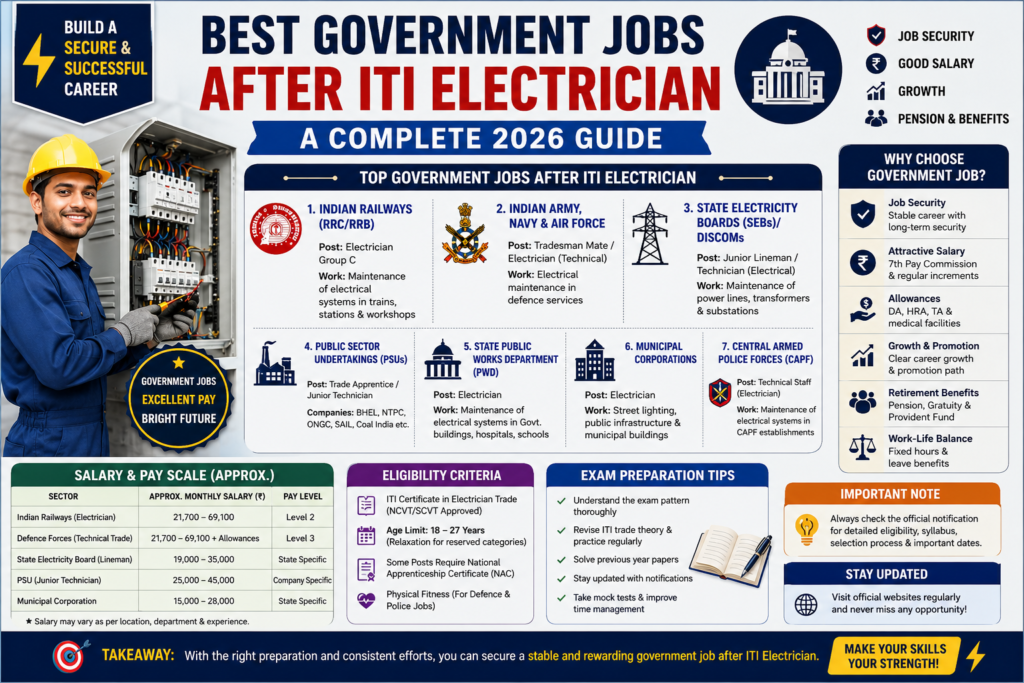
Here’s a general overview of what you can expect to earn (figures are approximate and vary by location, department, and experience):
| Government Sector | Approx. Monthly Salary (₹) | Pay Level |
|---|---|---|
| Indian Railways (Electrician) | 21,700 – 69,100 | Level 2 |
| Defence Forces (Technical Trade) | 21,700 – 69,100 + allowances | Level 3 |
| State Electricity Board (Lineman) | 19,000 – 35,000 | State-specific |
| PSU (Junior Technician) | 25,000 – 45,000 | Company-specific |
| Municipal Corporation | 15,000 – 28,000 | State-specific |
In addition to basic pay, most of these roles include Dearness Allowance (DA), House Rent Allowance (HRA), and medical benefits, which can significantly boost your take-home pay. Once you receive an offer, knowing how to negotiate salary effectively — even in government roles with fixed pay bands — can help you understand allowances and benefits you might be entitled to.
Takeaway: While railways and defence offer the highest ceiling salaries, SEBs and PSUs often provide faster promotions within the electrical trade itself.
How to Prepare for Government Electrician Exams
Cracking these exams isn’t just about knowing your trade — it’s about strategic preparation. Here’s a practical approach:
- Understand the exam pattern. Most exams include a written test (General Knowledge, Reasoning, Math, and Trade-specific questions) followed by a skill or physical test.
- Revise your ITI trade theory. Focus heavily on core electrician concepts like wiring systems, motors, transformers, and safety protocols.
- Practice previous years’ papers. This helps you understand the difficulty level and frequently repeated question patterns.
- Stay updated on notifications. Follow the National Career Service (NCS) portal, the government’s official employment exchange, since application windows are often short.
- Take mock tests. Simulating exam conditions builds speed and reduces exam-day anxiety.
- Prepare for the interview stage. Some roles include a personal interview round, so practicing how to answer “tell me about yourself” with examples can give you a real edge.
- Polish your application documents. A clean, well-structured application matters — learn how to write a resume that highlights your technical skills effectively.
Takeaway: Consistent daily revision combined with mock tests is the single most effective strategy for clearing government electrician exams.
Common Mistakes to Avoid
- Applying without checking eligibility carefully — this leads to rejected applications after you’ve already invested time.
- Ignoring physical fitness requirements for defence and police roles until the last moment.
- Ignoring regional/state-specific SEB vacancies while focusing only on central government jobs.
- Not keeping documents ready (caste certificate, NAC, domicile certificate) in advance, which can cause you to miss application deadlines.
Takeaway: Preparation isn’t just academic — staying organized with documents and deadlines is equally critical to landing the job.
Other Career Resources Worth Exploring
If a government exam doesn’t come through immediately, or you want to build additional income while you prepare, these resources can help you stay financially steady:
- Compare your ITI background with opportunities open to other technical graduates in our government jobs for diploma mechanical students guide.
- Explore banking sector alternatives with the upcoming bank exams calendar for 2026.
- If you need flexible income while preparing for exams, look into flexible schedule jobs near you or remote jobs with no experience required.
- Students can also explore how to earn money online without investment from mobile as a way to stay financially active during preparation.
Takeaway: Keeping a backup income plan while you prepare for government exams reduces financial pressure and helps you stay focused.
FAQs
1. What is the best government job after ITI electrician?
Indian Railways’ Electrician Group C post is widely considered among the best, thanks to its strong pay scale, job stability, and additional travel benefits.
2. Can I get a government job directly after ITI electrician without an apprenticeship?
Yes, most government exams accept a fresh ITI certificate, though some PSU roles prefer candidates with a completed National Apprenticeship Certificate (NAC).
3. What is the salary of an ITI electrician in government jobs?
Salaries typically range from ₹19,000 to ₹69,100 per month depending on the department, pay level, and location, plus allowances.
4. Is there an age limit for government electrician jobs?
Yes, the general age limit is 18–27 years, with relaxations available for reserved categories as per government rules.
5. Which government exam is easiest to crack after ITI electrician?
State Electricity Board (SEB) and municipal corporation exams generally see less competition compared to railways or defence, making them relatively easier entry points.
6. Do government electrician jobs offer promotions?
Yes, most departments offer structured promotion paths, moving from Technician to Senior Technician, Supervisor, and eventually Junior Engineer roles with experience and further qualifications.
7. How often do railways release ITI electrician vacancies?
RRB and RRC typically release notifications annually or biennially, so it’s important to check the official portal regularly.
Conclusion
Choosing the best government jobs after ITI electrician comes down to weighing what matters most to you — whether that’s the higher pay and prestige of Indian Railways and defence forces, or the local stability offered by State Electricity Boards and municipal corporations. Whichever path you choose, the demand for skilled electricians in the public sector isn’t slowing down anytime soon.
Start by shortlisting two or three departments that align with your goals, mark their exam dates, and begin focused preparation today. Your ITI certificate has already given you the technical foundation — now it’s time to turn it into a secure, rewarding government career.
3 thoughts on “Best Government Jobs After ITI Electrician: A Complete 2026 Guide”