
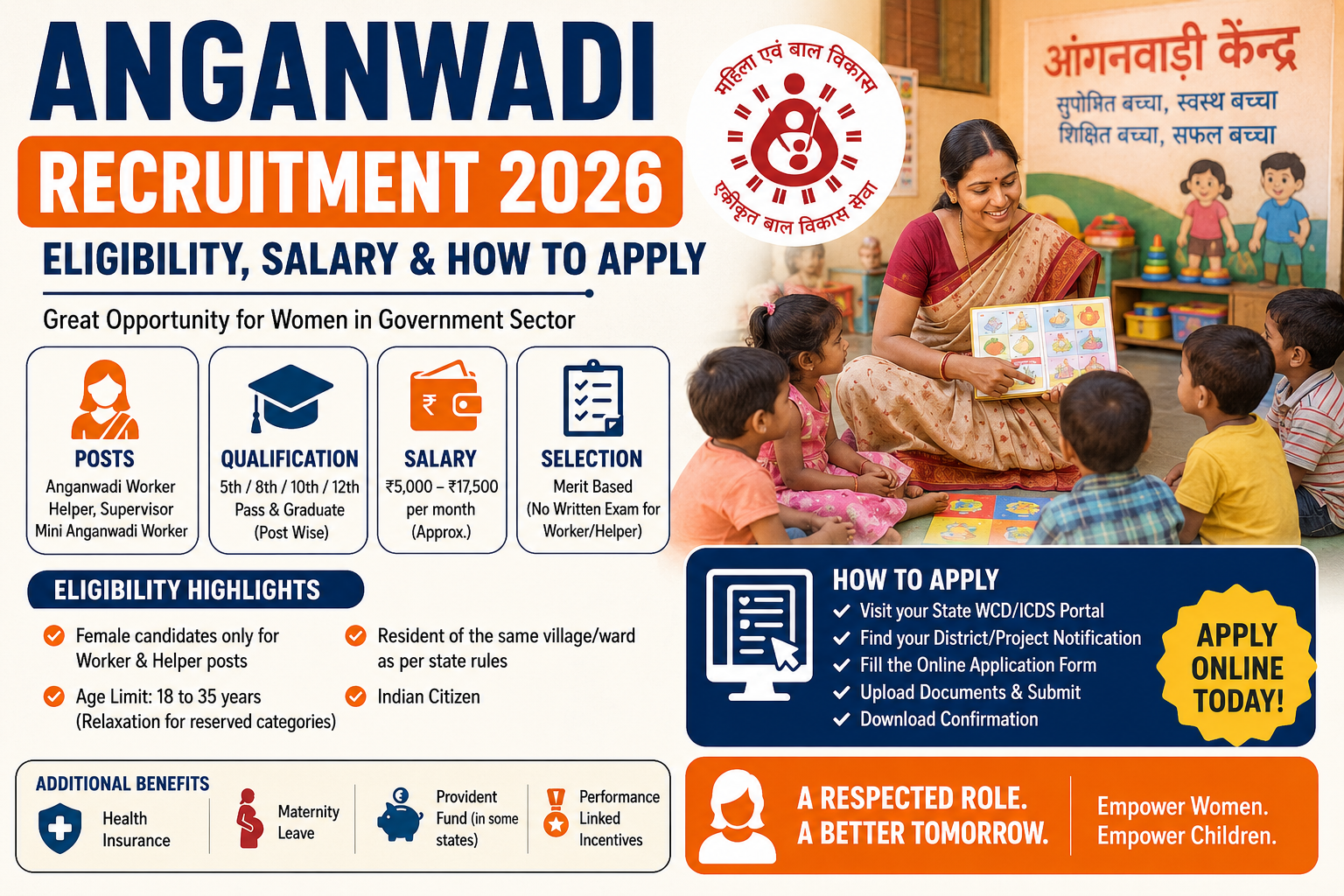
Meta Description: Anganwadi Recruitment 2026 is live! Check full eligibility criteria, salary details, and how to apply for Anganwadi jobs. Apply online today.
Introduction
If you’ve been searching for a stable, women-focused government job, the Anganwadi recruitment eligibility requirements for 2026 might be your easiest entry point into public service. Every year, the Ministry of Women and Child Development, through the Integrated Child Development Services (ICDS) scheme, releases thousands of vacancies across Indian states for Anganwadi Worker, Helper, and Supervisor posts — and 2026 is no different, with notifications rolling out state by state throughout the year.
Here’s the good part: unlike most government jobs, there’s usually no written exam for Worker and Helper posts. Selection is largely merit-based, built on your academic qualifications, which makes this one of the most accessible public-sector opportunities available right now. In fact, if you’re exploring state government jobs 2026 more broadly, Anganwadi recruitment is one of the few categories where a written exam isn’t standing between you and a government paycheck.
In this guide, you’ll get a clear breakdown of the Anganwadi eligibility criteria 2026, the latest Anganwadi worker salary structure, and a simple, step-by-step walkthrough of the Anganwadi online application form — so you can apply with confidence and avoid common mistakes that get applications rejected.
Table of Contents
- What Is the Anganwadi Recruitment 2026?
- Anganwadi Vacancy 2026: Posts and Numbers
- Anganwadi Eligibility Criteria 2026
- Anganwadi Qualification Requirements by Post
- Anganwadi Worker Salary and Honorarium Structure
- Anganwadi Selection Process Explained
- How to Apply for Anganwadi Jobs Online
- Documents Required for Anganwadi Application Process
- Common Mistakes to Avoid
- FAQs
- Conclusion
What Is the Anganwadi Recruitment 2026? {#what-is-anganwadi-recruitment-2026}
Anganwadi centers are community-level childcare and nutrition hubs set up under the ICDS scheme, which has operated across India for decades under the Ministry of Women and Child Development. Each center needs a Worker (who runs the center and handles pre-school education and nutrition tracking), a Helper (who assists with daily operations and outreach), and, at the block level, a Supervisor who oversees multiple centers.
The Anganwadi recruitment eligibility process for 2026 is being run independently by each state’s Women and Child Development (WCD) department. As a result, exact vacancy numbers, salary figures, and deadlines vary from state to state — but the core eligibility framework stays largely consistent nationwide. If this is your first time applying for a public-sector role, it’s worth browsing our broader guide to sarkari naukri 2026 to understand how state-level recruitment cycles generally work.
Takeaway: Anganwadi jobs are state-administered, so always check your specific state’s WCD/ICDS portal for the most accurate, localized notification.
Anganwadi Vacancy 2026: Posts and Numbers {#anganwadi-vacancy-2026}
Vacancy counts are being released in phases throughout 2026, with different states publishing notifications at different times. Broadly, the recruitment drive covers three main posts:
- Anganwadi Worker (AWW) – Center in-charge, handles teaching and nutrition delivery
- Anganwadi Helper (AWH) – Assists the Worker with daily center operations
- Anganwadi Supervisor – Oversees a cluster of Anganwadi centers within a project area
- Mini Anganwadi Worker – A scaled-down role for smaller centers in low-population areas
States like Uttar Pradesh, Bihar, Telangana, Andhra Pradesh, Odisha, Punjab, Karnataka, Tamil Nadu, and Maharashtra have all released or announced Anganwadi vacancy 2026 notifications, with individual state vacancy counts ranging from a few hundred to several thousand posts, depending on district-level requirements. If you’re based in Uttar Pradesh specifically, it’s worth also checking our roundup of government jobs after 12th in Uttar Pradesh, since several state departments release parallel notifications around the same time.
Pro Tip: Vacancy numbers for Worker and Helper posts are usually specific to your own village or ward. In most states, you can only apply for a center within your local residential area — so don’t expect to relocate for these roles.
Takeaway: Vacancy numbers fluctuate by state and district, so track your local ICDS project office notification rather than relying on national headline figures.
Anganwadi Eligibility Criteria 2026 {#eligibility-criteria}
Before you prepare your application, confirm you meet the baseline Anganwadi eligibility criteria 2026. While states set their own detailed rules, most follow this common structure.
Nationality and Residency
- You must be an Indian citizen.
- Most states require you to be a permanent resident of the same district or village where the Anganwadi center is located — this is a strict rule for Worker and Helper posts in several states.
Gender
- Anganwadi Worker and Helper posts are reserved exclusively for female candidates in almost every state.
- Supervisor posts may occasionally be open to other genders depending on the state notification, though female candidates are typically prioritized.
Age Limit
- The general age range is 18 to 35 years, though this varies by state and post.
- Age relaxation of 5–10 years is commonly available for SC/ST/OBC and other reserved categories, in line with standard central government jobs without experience norms that many public-sector roles follow.
Marital Status
- Some states give preference to married women or widows, particularly for Worker posts, as part of the scheme’s original community-outreach design.
Takeaway: Local residency is often the single most overlooked Anganwadi recruitment eligibility rule — verify this first before investing time in your application.
Anganwadi Qualification Requirements by Post {#qualification-requirements}
Academic qualification requirements differ significantly across posts, so match your education level to the correct role before applying.
| Post | Minimum Qualification |
|---|---|
| Anganwadi Helper | 5th or 8th pass (varies by state) |
| Anganwadi Worker | 10th pass (12th pass required in some states like UP) |
| Mini Anganwadi Worker | 8th or 10th pass |
| Anganwadi Supervisor | Graduate degree from a recognized university |
In several states, a higher qualification can act as a tiebreaker during merit-list preparation, even when it’s not the strict minimum requirement. In other words, a 12th-pass candidate applying for a Worker post that requires only 10th pass may still score better in the merit ranking. If you’re a 10th-pass candidate weighing your options, our guide to latest government jobs for 12th pass in 2026 can help you compare Anganwadi against other entry-level government roles. Graduates eyeing the Supervisor post might also want to browse government jobs for fresh graduates for a wider set of options at your qualification level.
Pro Tip: Always read the full official PDF notification, not just summary articles — states occasionally update qualification requirements for a specific recruitment cycle, and outdated information can cost you an eligible application.
Takeaway: Apply for the post that matches your qualification exactly — over- or under-qualifying can affect your merit-list ranking or eligibility outright.
Anganwadi Worker Salary and Honorarium Structure {#salary-structure}
Here’s something important to understand upfront: Anganwadi Workers and Helpers are technically paid a monthly honorarium, not a fixed government salary. This honorarium has two components — a fixed contribution from the Central Government and an additional top-up from the State Government, which is why the Anganwadi worker salary varies so widely by state.
Approximate Monthly Honorarium (2026)
- Anganwadi Helper: Roughly ₹5,000–₹8,500 per month, depending on the state
- Anganwadi Worker: Roughly ₹9,000–₹13,500 per month in most states, with some states reporting figures up to ₹17,500
- Anganwadi Supervisor: A structured pay scale, often in the range of ₹5,200–₹20,200 plus grade pay, since Supervisors are closer to regular government pay-scale employees
For example, Telangana’s 2026 notification structures Worker honorarium as a Central contribution of around ₹4,500 plus a State top-up of ₹9,000 or more, alongside a small performance-linked incentive. Uttar Pradesh, by comparison, has reported a Worker honorarium closer to ₹4,500–₹5,500 as its base Central component, with state additions applied on top. If your priority is higher take-home pay rather than a specific role, it may help to compare this against our list of government jobs with salary above ₹50,000 to set realistic expectations for where Anganwadi honorarium sits in the broader public-sector pay landscape.
Additional Benefits
Beyond the monthly honorarium, many states also provide:
- Health insurance coverage (in several states, up to ₹4 lakh under central schemes)
- Maternity leave benefits
- Provident fund access in select states
- Performance-linked incentives
Pro Tip: Because honorarium figures change with each state budget cycle, always cross-check the exact number in your district’s official notification rather than relying on last year’s figures or third-party estimates. You can verify current honorarium slabs directly on the Ministry of Women and Child Development’s ICDS portal.
Takeaway: The Anganwadi worker salary is honorarium-based and state-dependent — expect meaningful variation between, say, Maharashtra and Bihar, so check your specific state notification for accurate numbers.
Anganwadi Selection Process Explained {#selection-process}
The Anganwadi selection process is refreshingly straightforward compared to most government recruitment drives.
- No written exam for Worker/Helper posts in most states — selection is merit-based.
- Merit list preparation based on your qualifying marks (usually 10th or 12th percentage).
- Document verification to confirm your certificates, residency, and category proof.
- Interview or local screening (in some states) to assess communication skills and community suitability.
- Medical examination in certain states before final appointment.
For Supervisor posts, the process is more competitive — many states conduct a written examination covering general knowledge, reasoning, and child development topics, followed by an interview. If you reach the interview stage for a Supervisor post, it’s worth preparing with our guide on how to answer “Tell me about yourself” with examples, since interview panels for government roles often start with this exact question.
Takeaway: If you’re applying for Worker or Helper roles, focus your energy on keeping your academic documents error-free, since marks — not exam performance — usually decide your selection.
How to Apply for Anganwadi Jobs Online {#how-to-apply}
Wondering how to apply for Anganwadi jobs without missing a step? Follow this Anganwadi application process carefully:
- Visit the official portal — go to your state’s WCD/ICDS website or the direct link mentioned in your district’s official notification (the central reference point is wcd.nic.in).
- Find your district/project notification — recruitment is managed at the ICDS Project Office or district level, so search specifically for your area.
- Register with basic details — name, date of birth, mobile number, and email ID.
- Fill out the Anganwadi online application form — enter your educational, residential, and category details accurately.
- Upload scanned documents — as per the specifications given (usually JPEG/PDF, within a defined file size).
- Pay the application fee, if applicable — note that many states charge no fee at all for Worker and Helper posts, while Supervisor posts sometimes involve a nominal fee.
- Submit and download the confirmation — always save or print your submitted form and receipt for future reference.
- Track the merit list — check back on the same portal for merit-list announcements and further steps.
Pro Tip: Some states still accept offline applications at the local ICDS Project Office rather than through an online portal — this is common in rural and semi-urban districts, so don’t assume every state process is fully digital.
Takeaway: Double-check whether your state’s Anganwadi application process is online or offline before you start — applying through the wrong channel can delay or disqualify your candidacy.
Documents Required for Anganwadi Application Process {#documents-required}
Keep these documents ready and scanned in advance to avoid last-minute stress:
- Educational certificates (10th, 12th, or Graduation, as applicable to your post)
- Domicile or residence certificate
- Caste/category certificate (SC/ST/OBC/EWS, if applicable)
- Aadhaar card
- Recent passport-size photograph
- Scanned signature
- PwD certificate (if applicable)
Once your documents are ready, it’s also worth polishing your basic application materials — even a simple form benefits from the same attention to detail as a formal job application. Our guide on how to write a resume covers formatting and clarity tips that carry over well into filling government forms accurately.
Takeaway: Keep at least two backup scans of every document — corrupted uploads are one of the most common reasons applications get stuck mid-submission.
Common Mistakes to Avoid {#common-mistakes}
- Applying outside your residential area when the post requires local domicile
- Missing the exact qualification requirement — a mismatch (too high or too low) can disqualify you in some states
- Ignoring the application deadline — many district-level notifications have short application windows, sometimes under two weeks
- Submitting blurry or incorrectly sized documents
- Relying on outdated salary or vacancy figures from previous years instead of the current notification
Takeaway: Most rejected applications fail on avoidable technical errors, not eligibility — read your notification twice before hitting submit.
FAQs {#faqs}
Q1. What is the age limit for Anganwadi Recruitment 2026?
A: The general age limit is 18 to 35 years, though this can vary by state, with age relaxation typically available for reserved categories.
Q2. Is there a written exam for Anganwadi Worker and Helper posts?
A: In most states, no. Selection is merit-based, relying on your 10th or 12th percentage, followed by document verification. Supervisor posts often do involve a written exam.
Q3. What is the Anganwadi worker salary in 2026?
A: It varies by state, but most Anganwadi Workers receive a monthly honorarium in the range of ₹9,000 to ₹13,500, made up of Central and State government contributions. Some states report figures up to ₹17,500.
Q4. Can male candidates apply for Anganwadi jobs?
A: Anganwadi Worker and Helper posts are almost universally reserved for female candidates. Supervisor posts may have different eligibility depending on the state.
Q5. Is there an application fee for the Anganwadi online application form?
A: Most states do not charge a fee for Worker and Helper posts. Supervisor post applications may involve a nominal fee, which varies by state notification.
Q6. Do I need to be a resident of the specific area to apply?
A: Yes, in most states, Anganwadi Worker and Helper applicants must reside in the same village or ward as the center they’re applying to.
Q7. How can I check my state’s Anganwadi vacancy 2026 details?
A: Visit your state’s WCD or ICDS portal, or check with your local ICDS Project Office, since vacancies are announced at the district level.
Conclusion
The Anganwadi recruitment eligibility criteria 2026 make this one of the most accessible government employment opportunities available to women across India today — no written exam for most posts, minimal fees, and a merit-based selection process built around your existing academic qualifications. Whether you’re eyeing a Worker, Helper, or Supervisor role, the key to success is simple: confirm your local eligibility, gather your documents early, and apply through the correct state portal before the deadline closes.
Don’t wait for vacancy numbers to shrink. Head to your state’s official ICDS/WCD portal today, check your district’s latest notification, and get your Anganwadi online application form submitted while positions are still open in your area. And if Anganwadi isn’t the right fit, explore more options in our government jobs after 12th guide to find a role that matches your qualifications.
Suggested Tags/Keywords
Anganwadi Recruitment 2026, Anganwadi eligibility criteria 2026, Anganwadi worker salary, Anganwadi recruitment eligibility, How to apply for Anganwadi jobs, Anganwadi application process, Anganwadi vacancy 2026, Anganwadi selection process, Anganwadi qualification requirements, Anganwadi worker helper recruitment, Anganwadi online application form, ICDS recruitment 2026, WCD Anganwadi jobs, Anganwadi supervisor salary
1 thought on “Anganwadi Recruitment 2026: Eligibility, Salary & How to Apply”