
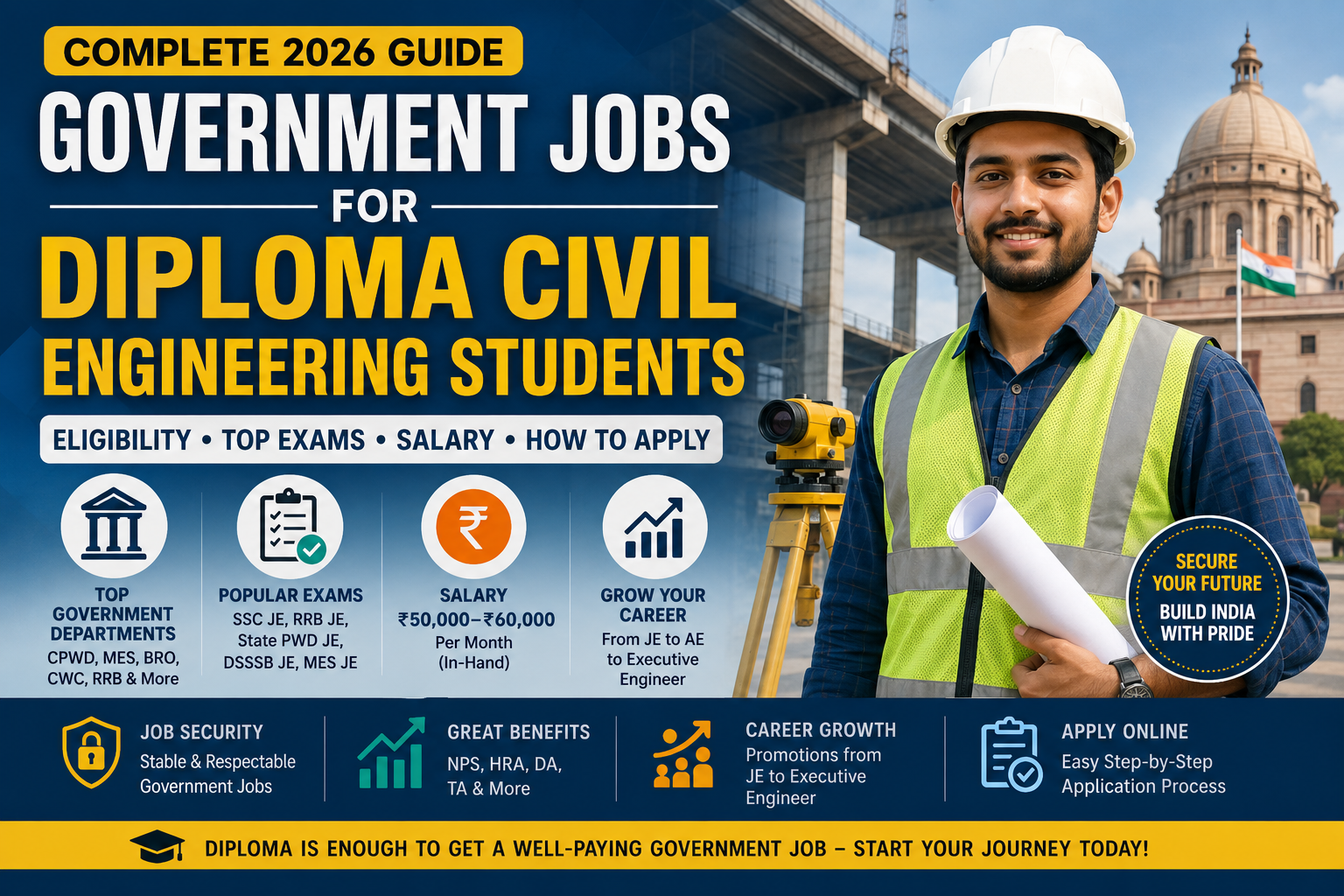
. Government Jobs for Diploma Civil Engineering Students: Complete 2026 Guide to eligibility, top departments, exam pattern, salary & how to apply. Start today!
If you’re holding a diploma in Civil Engineering and wondering whether a government job is actually within reach, here’s some good news: it is, and 2026 is shaping up to be one of the more active recruitment years in recent memory. In just one central recruitment cycle, over 1,700 Junior Engineer vacancies were announced across departments — and that’s before you count state PWDs, railways, defence organizations, and municipal bodies that hire diploma holders every year.
This guide breaks down everything you need to know about government jobs for diploma civil engineering students: which departments actually recruit you, what the exams look like, how much you’ll earn, and exactly how to apply. You’ll also get eligibility rules, a step-by-step application process, and answers to the questions most diploma holders ask before they start preparing. And if you want to see how these opportunities stack up against the rest of the sarkari naukri 2026 landscape, we’ll point you in the right direction there too.
Table of Contents
- Why Choose a Government Job After Diploma in Civil Engineering
- Eligibility Criteria for Diploma Civil Engineers
- Top Recruiting Departments and Organizations
- Popular Government Exams for Diploma Civil Engineers
- Exam Pattern and Syllabus Overview
- Salary and Pay Scale Breakdown
- Step-by-Step Application Process
- Preparation Tips to Crack These Exams
- FAQs
- Conclusion
1. Why Choose a Government Job After Diploma in Civil Engineering
A government job isn’t just about a steady paycheck. As a diploma holder, you get access to Group B and Group C technical posts that come with job security, structured promotions, and benefits most private-sector site jobs simply don’t offer.
Here’s what makes it worth pursuing:
- Job security that isn’t tied to project cycles or company performance
- Defined career growth, often from Junior Engineer to Assistant Engineer to Executive Engineer
- Pension and retirement benefits under the National Pension System (NPS)
- Work-life balance, with fixed hours compared to private construction sites
- Respect and recognition in your local community and professional circle
As a result, competition is intense — but so is the payoff. If you prepare strategically, a diploma is often enough to get you in the door for roles that graduates also compete for, and many of these posts fall under central government jobs without experience, meaning your diploma alone can qualify you without prior work history.
Takeaway: A civil engineering diploma qualifies you for genuine, well-paying government technical posts — you don’t need a full B.Tech to start this career path.
2. Eligibility Criteria for Diploma Civil Engineers
Before you shortlist exams, check whether you actually meet the baseline requirements. Most departments follow similar rules, though exact numbers vary by post.
Educational Qualification
- A 3-year diploma in Civil Engineering from a recognized/AICTE-approved polytechnic or institution
- Some posts (especially in CPWD-linked departments) may ask for additional relevant work experience alongside the diploma
Age Limit
- Generally between 18 and 30 years
- Some departments, such as CPWD, allow up to 32 years for certain posts
- Age relaxation applies for SC/ST (5 years), OBC (3 years), PwD candidates, and ex-servicemen, as per government norms
Nationality
- You must be an Indian citizen (specific nationality clauses vary slightly by organization and are confirmed in each notification)
Pro Tip: Eligibility is post-wise and department-wise, not exam-wise. Two posts under the same exam can have different age limits or experience requirements — always cross-check the specific post you’re applying for in the official notification before assuming you qualify.
Takeaway: Most diploma holders between 18–30 with a recognized civil engineering diploma are eligible for the majority of government JE-level posts.
3. Top Recruiting Departments and Organizations
Diploma civil engineers aren’t limited to one exam or one employer. Here are the biggest and most consistent recruiters:
Central Government Departments
- Central Public Works Department (CPWD) — one of the largest recruiters of Junior Engineers (Civil)
- Military Engineer Services (MES) — under the Ministry of Defence
- Central Water Commission (CWC)
- Border Roads Organisation (BRO)
- Farakka Barrage Project Authority
You can find the full, updated list of openings across these departments in our central government jobs without experience guide.
Railways
- Indian Railways (RRB) — recruits Junior Engineers (Civil) in large numbers for track, bridge, and building maintenance roles. If railways are your primary target, our Railway Recruitment 2026 complete guide for freshers walks through the full RRB process in detail.
State Public Works Departments
- Every state PWD conducts its own JE recruitment for road, building, and irrigation projects — this is often the most accessible route since state-level competition is usually lower than central exams. Check our state government jobs 2026 roundup for state-wise notifications.
Public Sector Undertakings (PSUs)
- Organizations like NHSRCL, NBCC, HUDCO, and various state housing boards periodically hire diploma-qualified JEs and Site Supervisors
Municipal and Urban Local Bodies
- Municipal corporations recruit for site supervision, building plan approval, and infrastructure maintenance roles
Takeaway: Don’t fixate on just one exam — diploma civil engineers have realistic shots across central, state, railway, and municipal recruiters, so applying broadly multiplies your chances.
4. Popular Government Exams for Diploma Civil Engineers
| Exam | Conducting Body | Post | Typical Pay Level |
|---|---|---|---|
| SSC JE | Staff Selection Commission | Junior Engineer (Civil) | Level 6 |
| RRB JE | Railway Recruitment Board | Junior Engineer (Civil) | Level 6 |
| State PWD JE | State Public Service Commissions | Junior Engineer / Assistant Engineer | Varies by state |
| DSSSB JE | Delhi Subordinate Services Selection Board | Junior Engineer (Civil) | Level 6 |
| MES JE | Military Engineer Services | Junior Engineer | Level 6 |
Furthermore, several states also run their own polytechnic-specific recruitment drives, so it’s worth tracking your state PWD or irrigation department website separately from national-level exams — our state government jobs 2026 page keeps this updated.
Takeaway: SSC JE and RRB JE are the two most-attempted national exams for diploma civil engineers, but state-level PWD exams often have better odds due to lower applicant volume.
5. Exam Pattern and Syllabus Overview
Most government exams for diploma civil engineers, including SSC JE, follow a two-stage structure:
Paper 1 (Computer-Based Test)
- Total marks: Around 200
- Format: Objective, multiple-choice
- Sections: General Intelligence & Reasoning, General Awareness, and General Engineering (Civil)
Paper 2 (Conventional/Descriptive)
- Total marks: Around 300
- Format: Conventional descriptive format, involving detailed answers, numerical problems, and diagrams
- Duration: Typically 2 hours
- Focus: In-depth, branch-specific civil engineering concepts
Core Civil Engineering Topics Usually Covered
- Building Materials
- Estimating, Costing, and Valuation
- Surveying
- Soil Mechanics
- Hydraulics and Irrigation Engineering
- Transportation Engineering
- Environmental Engineering
- Structural Analysis and RCC Design
Some state and railway exams merge both stages into a single objective paper, so always check the specific exam’s official pattern on the official SSC website or your respective recruitment board’s portal rather than assuming it mirrors SSC JE exactly.
Pro Tip: Diploma holders often underestimate Paper 2 because it’s descriptive. Practice writing full-length answers with labeled diagrams under time pressure — examiners award marks for clarity and correct labeling, not just the right final number.
Takeaway: Master the core civil engineering fundamentals from your diploma syllabus first; general awareness and reasoning are scoring sections, but engineering knowledge is what separates selected candidates from the rest.
6. Salary and Pay Scale Breakdown
This is usually the first question every aspirant asks — and rightly so. Here’s what you can realistically expect.
SSC JE (Civil) — Pay Level 6
SSC JE posts fall under Group B (Non-Gazetted), placed in Level 6 of the 7th Central Pay Commission pay matrix, with a basic pay range of ₹35,400 to ₹1,12,400. With allowances included, the approximate in-hand salary works out to around ₹50,000–₹60,000 per month, though this varies by city classification and applicable Dearness Allowance. That puts these roles comfortably among government jobs with salary above ₹50,000 — worth a look if pay is your main filter.
What’s Included in the Salary Package
- Basic Pay: Starting at ₹35,400
- Dearness Allowance (DA): Revised periodically by the government
- House Rent Allowance (HRA): Varies by city category (X/Y/Z)
- Transport Allowance (TA)
- NPS contribution for retirement benefits
State PWD and RRB JE Salaries
State PWD Junior Engineer salaries vary by state pay commission, typically ranging from ₹30,000 to ₹55,000 in-hand depending on the state’s pay matrix. RRB JE follows a similar Level 6 structure to SSC JE, with comparable allowances.
As a result, most diploma civil engineers entering government service through these routes can expect a starting in-hand salary in the ₹35,000–₹60,000 range, with steady increments through promotions to Assistant Engineer and beyond. Once you clear the exam and get an offer, it’s also worth knowing how to negotiate salary where allowances or posting location are flexible.
Takeaway: Beyond the headline basic pay figure, allowances and city-based HRA meaningfully boost your actual take-home salary — always check in-hand estimates, not just basic pay, when comparing exams.
7. Step-by-Step Application Process
Applying for these government exams follows a fairly standard pattern across departments:
- Complete One-Time Registration (OTR) on the official recruitment portal (e.g., ssc.gov.in, rrbcdg.gov.in, or your state PWD portal)
- Log in using your registered credentials
- Fill out the application form with accurate personal, educational, and category details
- Upload documents — scanned photograph, signature, and diploma certificate as specified
- Pay the application fee online (fee exemptions usually apply for women and reserved categories)
- Review and submit the form before the deadline
- Download the confirmation page and keep it safe for future reference
In other words, the process itself is straightforward — the real challenge is preparing well enough to clear the exam once you’re in. Always apply early; server load near deadlines is a common reason candidates miss out. It also helps to have a polished profile ready ahead of document verification and any personality tests down the line — our guide on how to write a resume is useful even for government roles that ask for a CV at the verification stage.
Takeaway: Keep your diploma certificate, category certificate, and a recent photograph/signature scan ready in advance so you’re not scrambling when a notification drops with a tight application window.
8. Preparation Tips to Crack These Exams
- Start with your diploma syllabus. Most of the technical portion overlaps directly with what you studied in your final two years.
- Practice previous year papers for your target exam to understand difficulty level and recurring topics.
- Build a general awareness habit. Read a daily newspaper or current affairs digest for 20–30 minutes.
- Don’t ignore Paper 2 (descriptive). Practice writing structured, diagram-supported answers, not just solving numericals mentally.
- Take timed mock tests at least twice a week in the final two months before your exam.
- Track multiple notifications simultaneously — applying to SSC JE, RRB JE, and your state PWD exam in the same cycle maximizes your chances without extra preparation cost.
- Prepare for document verification interviews. Some state PWD posts include a short personal round — if you’re new to this, our guide on how to answer “tell me about yourself” will help you sound confident and structured.
Takeaway: Consistent, syllabus-first preparation beats last-minute cramming — most successful diploma candidates spend 6–8 months preparing across both objective and descriptive sections.
Related Reading for Diploma & ITI Holders
If civil engineering isn’t your only option on the table, or you’re helping a friend from another branch, these guides might help:
- Government jobs for diploma mechanical students
- Best government jobs after ITI electrician
- Latest government jobs for 12th pass in 2026
FAQs
Q1. Can a diploma holder apply for SSC JE Civil?
Yes. A three-year diploma in Civil Engineering from a recognized institution is accepted for SSC JE, alongside a B.E./B.Tech degree, though some posts may require additional experience for diploma applicants specifically.
Q2. What is the salary of a government Junior Engineer (Civil) in 2026?
Junior Engineers under Pay Level 6 of the 7th CPC earn a basic pay of ₹35,400, with an approximate in-hand salary of ₹50,000–₹60,000 per month after allowances, though this varies by department and city.
Q3. Is there an interview round in SSC JE recruitment?
No. Selection is based purely on marks scored in Paper 1 and Paper 2 — there is no interview round in the SSC JE selection process.
Q4. Which is better for diploma civil engineers: SSC JE or State PWD exams?
Both are strong options. SSC JE offers central postings and nationwide pay parity, while state PWD exams often have lower competition and let you work closer to home. Applying to both improves your overall selection odds.
Q5. What is the age limit for diploma civil engineers applying to government jobs?
Age limits typically range from 18 to 32 years, with relaxations available for SC/ST, OBC, and other reserved categories as per government norms — always verify the exact limit for your target post.
Q6. Do I need work experience along with my diploma to apply?
Not always. Most posts accept a diploma alone, but some SSC JE notifications have required a three-year diploma plus two years of relevant experience for certain specific posts, so always check post-wise qualification carefully.
Q7. How many attempts can I make for SSC JE or RRB JE?
There’s generally no cap on attempts as long as you meet the age and eligibility criteria for that year’s notification — you can reapply every recruitment cycle until you age out.
Conclusion
Landing one of the many government jobs for diploma civil engineering students available in 2026 comes down to three things: knowing where to apply, understanding the exam pattern, and preparing consistently. Between SSC JE, RRB JE, state PWD recruitment, and municipal bodies, there’s no shortage of opportunity — the departments are hiring, the pay scales are competitive, and diploma holders are explicitly eligible for most of these roles.
Your next step is simple: pick your top two or three target exams from this guide, note their eligibility and expected notification dates, and start building your preparation timeline today. For a broader view of what’s opening up this year, browse our full sarkari naukri 2026 hub — the earlier you start, the stronger your position when the next notification drops.
Suggested Tags/Keywords
government jobs for diploma civil engineering students, diploma civil engineering government jobs 2026, SSC JE civil eligibility, RRB JE civil engineering, state PWD junior engineer recruitment, SSC JE salary 2026, government exam for diploma holders, junior engineer civil vacancy 2026, CPWD junior engineer recruitment, diploma civil engineer career guide