
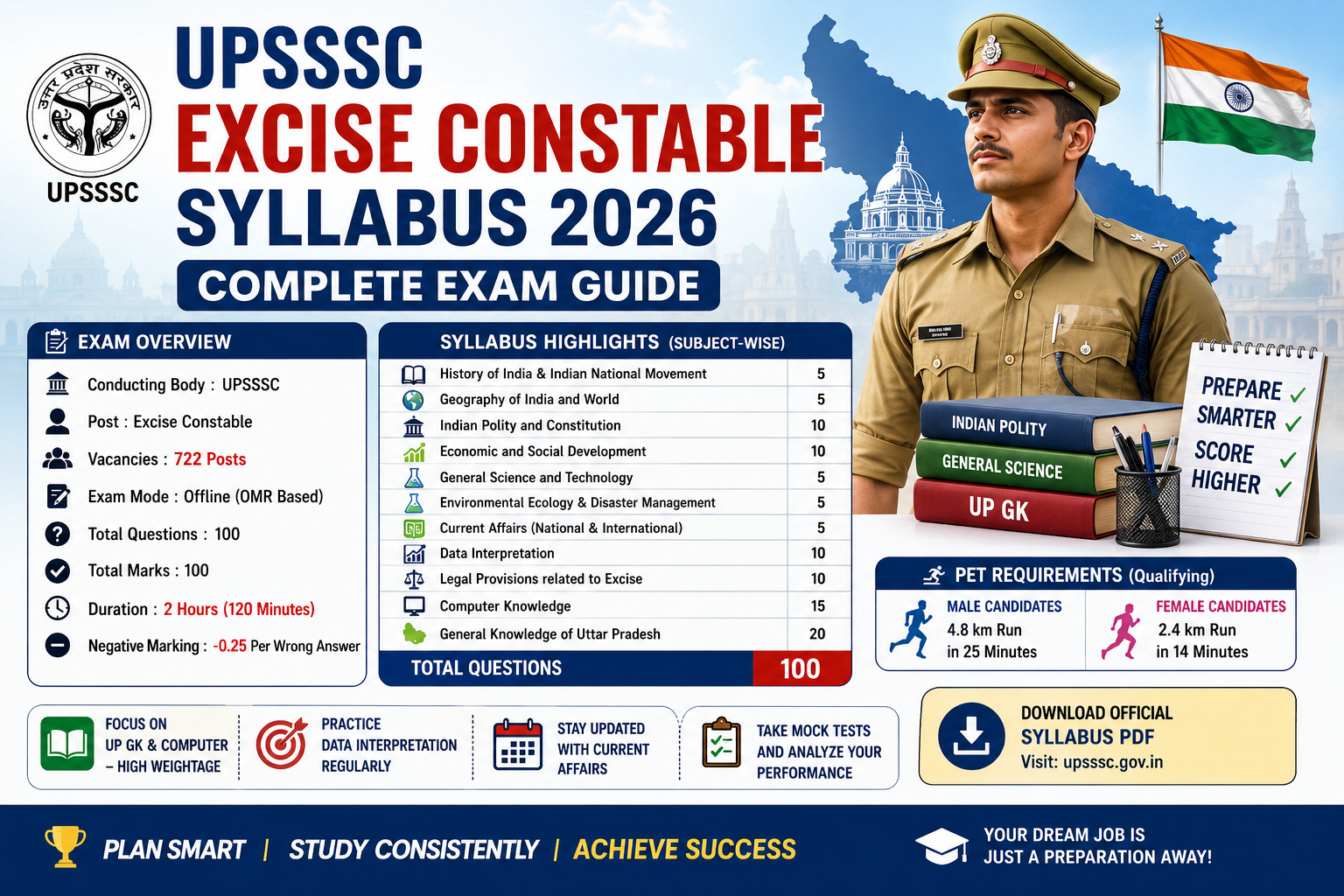
UPSSSC Excise Constable Syllabus 2026: full subject-wise topics, exam pattern, marking scheme & PDF download link. Start your prep smarter today!
Here’s a number that should grab your attention: with 722 posts up for grabs and a 100-mark written exam covering 11 different subject areas, the UPSSSC Excise Constable 2026 recruitment is shaping up to be one of the more competitive state-level exams this year. If you’re planning to appear for it, the UPSSSC excise constable syllabus 2026 is the single most important document you’ll read before you open a single book.
The Uttar Pradesh Subordinate Services Selection Commission (UPSSSC) released the official notification on 6 April 2026, and the syllabus that came with it tells you exactly what to study, how many questions to expect from each topic, and how the marking works. In other words, it’s your preparation blueprint.
This guide breaks down the entire UPSSSC excise constable syllabus 2026 — subject by subject — along with the exam pattern, marking scheme, physical test requirements, and a practical strategy to help you prepare with confidence. And if you’re exploring your options more broadly, this exam sits alongside several other government jobs after 12th in Uttar Pradesh worth keeping on your radar.
Table of Contents
- UPSSSC Excise Constable Syllabus 2026: Quick Overview
- Selection Process 2026
- Exam Pattern 2026: Marks, Duration & Marking Scheme
- UPSSSC Excise Constable Syllabus 2026: Subject-Wise Breakdown
- Physical Efficiency Test (PET) Requirements
- How to Prepare: A Practical Strategy
- Common Mistakes to Avoid
- FAQs on UPSSSC Excise Constable Syllabus 2026
- Conclusion
UPSSSC Excise Constable Syllabus 2026: Quick Overview {#overview}
Before diving into details, here’s the snapshot every candidate should know:
- Conducting body: Uttar Pradesh Subordinate Services Selection Commission (UPSSSC)
- Post: Excise Constable
- Vacancies: 722 posts
- Exam mode: Offline, OMR-based, objective type
- Total questions: 100
- Total marks: 100
- Duration: 2 hours (120 minutes)
- Negative marking: -0.25 for every wrong answer
As a result, this exam rewards accuracy over guesswork — a point we’ll return to later. You can verify all official figures directly on the UPSSSC official website, where the notification and syllabus PDF are published.
Takeaway: The UPSSSC excise constable syllabus 2026 is broad but predictable — once you know the weightage of each subject, you can prioritize your study time effectively.
Selection Process 2026 {#selection-process}
The UPSSSC Excise Constable Selection Process 2026 involves three stages:
- PET (Physical Efficiency Test) Score – Candidates are required to have a valid PET 2025 score, as this recruitment uses PET data instead of holding a fresh physical run for shortlisting.
- Written Examination – The main objective test carrying 100 marks.
- Document Verification / Physical Standard Test (PST) – Final verification of documents and physical standards before appointment.
Furthermore, candidates should note that clearing the written exam alone doesn’t guarantee selection — document verification and physical standards must also be met. If you’re weighing this against similar physically-demanding government roles, it’s worth comparing it with the Territorial Army Recruitment 2026 process as well.
Takeaway: Selection isn’t based on the written exam alone, so treat every stage — including your PET score — as equally important.
Exam Pattern 2026: Marks, Duration & Marking Scheme {#exam-pattern}
Understanding the exam pattern is just as important as knowing the syllabus itself. Here’s how the paper is structured:
| Parameter | Details |
|---|---|
| Exam Mode | Offline (OMR-based) |
| Question Type | Objective (MCQ) |
| Total Questions | 100 |
| Total Marks | 100 |
| Duration | 2 hours |
| Marks per correct answer | +1 |
| Negative Marking | -0.25 per wrong answer |
| Exam Level | Intermediate (10+2 standard) |
Pro Tip: With negative marking in place, 10 wrong guesses cost you 2.5 marks — often the difference between qualifying and missing the cutoff. Attempt only the questions you’re reasonably confident about.
Takeaway: A 2-hour window for 100 questions gives you roughly 72 seconds per question, so speed and accuracy both matter.
UPSSSC Excise Constable Syllabus 2026: Subject-Wise Breakdown {#subject-wise}
This is the core of the UPSSSC excise constable syllabus 2026 — the subject-wise question distribution, based on the official exam plan.
| Subject | Number of Questions |
|---|---|
| History of India & Indian National Movement | 5 |
| Geography of India and World | 5 |
| Indian Polity and Constitution | 10 |
| Economic and Social Development | 10 |
| General Science and Technology | 5 |
| Environmental Ecology & Disaster Management | 5 |
| Current Affairs (National & International) | 5 |
| Data Interpretation | 10 |
| Legal Provisions related to Excise | 10 |
| Computer Knowledge | 15 |
| General Knowledge of Uttar Pradesh | 20 |
Notice that Uttar Pradesh GK and Computer Knowledge together account for 35 of the 100 questions. As a result, these two sections deserve extra attention if you want to maximize your score.
History of India & National Movement
This section covers ancient, medieval, and modern Indian history, with a particular focus on the freedom struggle, key movements, and important leaders. Instead of rote memorization of dates, focus on understanding the sequence and significance of events.
Geography of India and World
Expect questions on physical geography, agriculture and natural resources, climate patterns, population and urbanization trends, and basic world geography.
Indian Polity and Constitution
This section tests your understanding of constitutional development, fundamental rights and duties, the Panchayati Raj system, and general governance and public policy.
Economic and Social Development
Topics include economic planning, poverty and unemployment, demographic trends, and government welfare schemes — both central and state-level.
General Science and Technology
You’ll face questions on basic physics, chemistry, and biology, along with everyday science applications and India’s achievements in technology.
Environmental Ecology and Disaster Management
This includes climate change, biodiversity, and the framework of disaster management authorities like NDMA and SDRF, along with related environmental protection laws. For deeper reference on this framework, the National Disaster Management Authority (NDMA) official website is a reliable source.
Current Affairs
National and international events, government policies, and recent developments in sports and awards fall under this category. Since current affairs changes weekly, this section needs continuous revision rather than one-time study.
Data Interpretation
This section tests analytical ability through graphs, charts, and statistical data. Regular practice with numerical reasoning is essential here, since this is often where candidates lose easy marks under time pressure.
Legal Provisions Related to Excise
A UP-specific and exam-specific section covering the UP Excise Act (1910 and its amendments), liquor regulation policies, and general administrative procedures related to the Excise Department. This is unique to this exam and won’t overlap with other competitive exams you may have prepared for.
Computer Knowledge
With 15 questions, this is one of the highest-weightage sections. It covers computer fundamentals, MS Word and Excel basics, internet and email usage, and basic cyber security concepts.
General Knowledge of Uttar Pradesh
Carrying the single highest weightage at 20 questions, this section covers UP’s history, geography and rivers, tourism and culture, and its administrative structure. In other words, this is the section you cannot afford to skip.
Takeaway: Since UP GK and Computer Knowledge together make up over a third of the paper, allocate your study time proportionally rather than spreading it evenly across all 11 subjects.
Physical Efficiency Test (PET) Requirements {#pet}
Although this recruitment uses your existing PET 2025 score rather than conducting a fresh test, it’s useful to know the benchmark:
- Male candidates: 4.8 km run in 25 minutes
- Female candidates: 2.4 km run in 14 minutes
This stage is qualifying in nature, meaning you either clear it or you don’t — there’s no additional scoring advantage for finishing faster.
Takeaway: If your PET 2025 score is already on record, your job now is to focus entirely on the written exam.
How to Prepare: A Practical Strategy {#preparation}
Here’s a step-by-step approach based on the syllabus weightage:
- Start with NCERT books (Classes 6–10) for History, Geography, Polity, and Science fundamentals — they build the base most competitive exam questions are drawn from.
- Dedicate separate time to UP GK. Since it carries 20 questions, treat it as a subject in itself rather than a footnote to general GK.
- Practice Computer Knowledge daily, especially MS Office basics and internet fundamentals — these are high-scoring, low-effort topics if practiced consistently.
- Revise current affairs weekly, ideally through a single trusted source, rather than jumping between multiple apps or channels.
- Solve Data Interpretation sets regularly to build speed under timed conditions.
- Take full-length mock tests at least twice a week in the final month to simulate the real 2-hour format.
If you’re also considering broader Sarkari Naukri options while preparing, it helps to browse the latest Sarkari Naukri 2026 listings and shortlist a few backup opportunities, such as similar 12th pass police recruitment 2026 drives running alongside this one.
Pro Tip: Since negative marking applies, use your mock test results to identify which subjects you consistently guess in — and slow down specifically there.
Takeaway: A focused, weightage-based study plan will always outperform an unstructured one, especially with a fixed 2-hour exam window.
Common Mistakes to Avoid {#mistakes}
- Ignoring UP-specific GK because it feels “too regional” — it’s actually the highest-weightage section.
- Skipping the Computer Knowledge section assuming it’s easy to cover later.
- Over-attempting questions without factoring in negative marking.
- Neglecting Data Interpretation practice, which often costs candidates time they can’t recover.
- Studying from outdated syllabus versions instead of the official 2026 notification.
- Not preparing your application documents in advance — a well-organized resume and clear personal details matter later during document verification. If you haven’t put one together yet, this guide on how to write a resume can help you get it ready.
Takeaway: Most candidates don’t lose marks due to lack of knowledge — they lose them due to poor time and risk management during the exam.
FAQs on UPSSSC Excise Constable Syllabus 2026 {#faqs}
1. What subjects are included in the UPSSSC excise constable syllabus 2026?
The syllabus includes History, Geography, Indian Polity, Economic and Social Development, General Science, Environment and Disaster Management, Current Affairs, Data Interpretation, Excise-related Legal Provisions, Computer Knowledge, and Uttar Pradesh GK.
2. How many questions are asked in the UPSSSC Excise Constable exam?
The written exam consists of 100 objective-type questions worth 100 marks in total.
3. Is there negative marking in the UPSSSC Excise Constable exam 2026?
Yes, 0.25 marks are deducted for every wrong answer, so guessing carries a real cost.
4. Which subject carries the highest weightage in the syllabus?
General Knowledge of Uttar Pradesh carries the highest weightage with 20 questions, followed by Computer Knowledge with 15 questions.
5. Do I need a PET score to apply for this recruitment?
Yes, candidates need a valid PET 2025 score to be eligible for the written examination stage.
6. What is the exam duration for UPSSSC Excise Constable 2026?
Candidates are given 2 hours (120 minutes) to complete the 100-question paper.
7. Is the UPSSSC excise constable syllabus 2026 different from previous years?
The core structure generally stays consistent year to year, though minor updates can occur, so always cross-check with the latest official notification on the UPSSSC official website.
8. Is the UPSSSC Excise Constable exam similar to other UPSSSC recruitments?
Yes, the pattern is broadly similar to other UPSSSC posts. For comparison, you can check the UPSSSC Forest Guard eligibility criteria 2026, which follows a comparable selection structure.
Conclusion
The UPSSSC excise constable syllabus 2026 isn’t just a list of topics — it’s a roadmap that tells you precisely where to invest your preparation time for maximum returns. With Uttar Pradesh GK and Computer Knowledge alone accounting for over a third of the paper, a weightage-based study plan combined with regular mock tests and disciplined revision can genuinely move the needle on your score.
Don’t wait until the last month to get organized. Download the official UPSSSC excise constable syllabus 2026 PDF today, map out a subject-wise study calendar, and start practicing under timed conditions right away. And if you’d like to keep your options open, take a look at other state government jobs 2026 and latest government jobs for 12th pass in 2026 — your future in the Excise Department starts with this first step, but it doesn’t have to be your only one.
Suggested Tags/Keywords
UPSSSC Excise Constable Syllabus 2026, UPSSSC Excise Constable Exam Pattern, UP Excise Constable Recruitment 2026, UPSSSC Excise Constable Subject Wise Syllabus, UPSSSC Excise Constable Written Exam, UP GK for Excise Constable, UPSSSC Excise Constable PET, UPSSSC Excise Constable Preparation Tips
4 thoughts on “UPSSSC Excise Constable Syllabus 2026: Complete Exam Guide”