
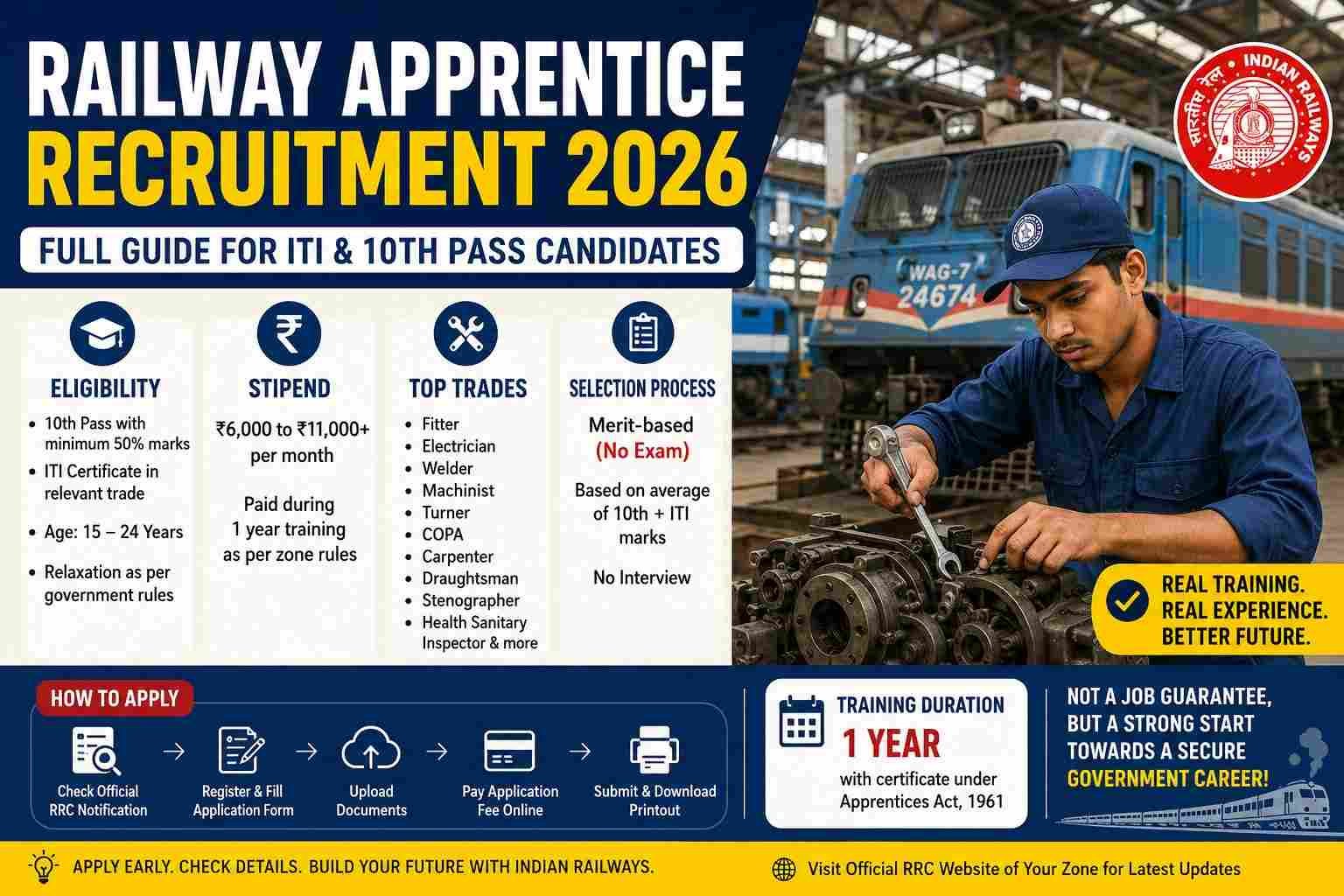
Planning to apply for railway apprentice recruitment in 2026? Get eligibility, stipend, trades, and application steps explained simply. Apply now.
If you’ve spent any time scrolling through Indian Railways job notifications, you’ve probably noticed how often “Apprentice” vacancies show up — and how many people apply for them. RRC Western Railway alone put out over 5,000 apprentice posts this year. Central Railway, North Central Railway, and Northeast Frontier Railway have all released their own separate drives too, adding up to tens of thousands of seats across the country.
That’s a lot of competition, but it’s also a genuine opportunity — especially if you’re a 10th pass or ITI-qualified candidate looking for your first real step into a government-linked career. The problem is, most people apply without actually understanding how the selection works, what the stipend really covers, or whether an apprenticeship leads anywhere afterward.
This guide clears that up. We’ll walk through eligibility, trades on offer, stipend numbers, the selection process, and what actually happens once your one-year training ends — so you can decide if railway apprentice recruitment is worth your time this year, and apply with a proper plan instead of guesswork.
Table of Contents
- What Railway Apprentice Recruitment Actually Means
- Who Can Apply
- Trades Available Under RRC Apprentice Schemes
- Stipend: What You’ll Actually Be Paid
- How Selection Works
- Step-by-Step: How to Apply
- Does an Apprenticeship Lead to a Permanent Railway Job?
- Mistakes That Get Applications Rejected
- FAQs
- Final Word
What Railway Apprentice Recruitment Actually Means {#what-it-means}
Here’s something a lot of candidates get wrong going in: an Act Apprentice position isn’t a job. It’s a training scheme, run under the Apprentices Act, 1961, where Indian Railways trains you in a technical trade for about a year and pays you a monthly stipend while you learn.
You’ll work inside actual railway workshops, production units, or maintenance divisions — not a classroom. By the end, you walk away with a government-recognised apprenticeship certificate that carries real weight when you apply for technical jobs later, whether that’s in another railway zone, a PSU, or a private manufacturing unit.
What it isn’t, though, is a guarantee of a railway job. Every official RRC notification says this plainly, and it’s worth repeating because a lot of applicants assume otherwise. Think of it as a paid, structured way to build your technical resume — not the finish line itself.
If you’re also weighing this against other entry-level government options, our guide on railway recruitment for freshers breaks down how apprenticeships compare to RRB’s other recruitment routes.
Who Can Apply {#who-can-apply}
Eligibility is fairly consistent across railway zones, though each RRC notification has its own specific numbers, so always cross-check the official PDF before applying.
Education:
- Passed 10th standard (Matriculation), usually with a minimum of 50% marks
- ITI certificate in the relevant trade from an NCVT or SCVT recognised institute
Age limit:
- Generally 15 to 24 years as on the closing date
- Relaxations apply for SC/ST (5 years), OBC (3 years), PwBD (10 years), and Ex-servicemen — check the specific notification for exact figures
A few things that catch people out:
- Candidates with pending 10th or ITI results usually aren’t eligible until results are declared
- Engineering diploma or degree holders are generally not allowed to apply for these apprentice posts — this scheme is specifically meant for ITI/10th-pass candidates
- Failed ITI candidates aren’t eligible either, even if they’ve completed the training period
If you’re a 10th pass candidate wondering what else is open to you besides apprenticeships, it’s worth reading through railway recruitment options for 10th pass candidates and this broader roundup of government jobs after 10th.
Trades Available Under RRC Apprentice Schemes {#trades-available}
Depending on which railway zone is recruiting, you’ll typically find openings across a wide spread of technical and non-technical trades:
- Fitter
- Electrician
- Welder
- Machinist
- Turner
- Carpenter
- Painter
- Plumber
- COPA (Computer Operator and Programming Assistant)
- Draughtsman (Civil)
- Stenographer
- Health Sanitary Inspector
Not every zone offers every trade in every cycle, and vacancy numbers per trade can shift quite a bit between notifications. If you already hold an ITI in electrical work, for instance, it’s also worth looking at government jobs after ITI electrician — apprenticeship is one route, but not the only one.
Diploma holders in civil or mechanical trades, meanwhile, generally fall outside this scheme, but have their own dedicated openings — see government jobs for diploma mechanical students and government jobs for diploma civil engineering for those paths instead.
Stipend: What You’ll Actually Be Paid {#stipend}
This is where a lot of confusion comes in, because the stipend is not the same as a railway employee’s salary. There’s no DA, no HRA, none of the allowances a permanent staff member gets. It’s a training stipend, and it’s paid under the rules of the Apprentices Act.
The exact amount depends on your zone, your qualification level, and sometimes which year of training you’re in. To give you a rough sense of the range across recent notifications:
| Railway Zone (2026 cycle) | Approx. Monthly Stipend |
|---|---|
| RRC Western Railway | ₹6,000 – ₹9,000 |
| RRC Central Railway | As per Railway Board norms (varies by trade) |
| RRC NFR (Northeast Frontier) | ₹9,600 (Year 1), rising to ₹11,040 by Year 3 |
A few practical points worth knowing:
- Payment is usually credited monthly, directly to your bank account
- It’s tied to attendance — missed training days can affect what you’re paid that month
- Figures differ by zone and by year, so treat any number you read online as approximate until you check the actual notification for your zone
Once you’re earning, it’s a good time to start thinking beyond the training period. Our guide on government jobs with salary above ₹50,000 is a useful benchmark for where a completed apprenticeship can eventually take you.
How Selection Works {#selection-process}
Here’s the part that surprises most first-time applicants: there’s no written exam and no interview for most RRC apprentice recruitments. Selection is purely merit-based.
The merit list is built from the average of your 10th standard marks and your ITI marks. That’s it. No aptitude test, no group discussion, no physical test in most cases.
A few tie-breaker rules apply if candidates end up with the same merit score:
- Older candidates generally get preference over younger ones
- If ages are also equal, whoever passed 10th standard earlier is preferred
Because there’s no exam to “prepare” for in the traditional sense, your actual preparation happens before you even apply — in the marks you already have. That’s exactly why it pays to apply for multiple zones where you’re eligible, since your merit percentage might clear the cutoff in one zone but not another depending on how competitive that particular drive is.
Step-by-Step: How to Apply {#how-to-apply}
- Find the right notification. Each railway zone (Western, Central, North Central, NFR, and so on) releases its own separate RRC apprentice notification, usually on the zone’s official RRC website. The Railway Recruitment Control Board (RRCB) maintains links to all official RRB and RRC boards, which is the safest starting point — don’t rely on unofficial aggregator sites for the actual application.
- Read the PDF properly, not just the headline numbers. Vacancy count, trade-wise breakdown, and cutoff dates all sit inside the detailed notification.
- Register with your basic details and a valid email ID.
- Fill in the application form carefully. Double-check your 10th and ITI marks — errors here are one of the most common reasons applications get rejected at verification stage.
- Upload the required documents — usually your matriculation certificate, ITI certificate and marksheet, category certificate if applicable, a passport-size photo, and signature.
- Pay the application fee online. It’s typically around ₹100 for General/OBC candidates, with SC/ST, PwBD, EBC (income below ₹50,000), and women candidates usually exempted — but this varies by zone, so confirm on the actual notification. Indian Railways has also consolidated applications for most CEN-based recruitments onto a single unified portal, rrbapply.gov.in, which is worth bookmarking even though standalone apprentice drives are still usually run through each zone’s own RRC website.
- Submit and download your printout for your own records.
- Apply to only one division or workshop per zone, unless the notification specifically allows multiple applications.
Before you submit anything, it’s worth having a properly formatted resume ready as well, even for a stipend-based training role — recruiters and workshop staff do sometimes ask for one during verification. Our resume writing guide covers exactly what to include.
Does an Apprenticeship Lead to a Permanent Railway Job? {#permanent-job}
Short answer: not automatically. Every RRC notification states clearly that completing the apprenticeship doesn’t guarantee employment in that zone or in Indian Railways generally.
That said, it’s not a dead end either. A few things work in your favour after completion:
- Some zones give preference or weightage to Course-Completed Act Apprentices in future Level-1 (Group D) recruitment — in certain cases, up to 20% of vacancies are earmarked with this preference, though this depends entirely on the specific recruitment rules in force at that time
- The apprenticeship certificate is recognised nationally, so it helps outside Indian Railways too — other PSUs, state government technical posts, and private manufacturing units all value it
- You gain a full year of real, hands-on technical experience, which matters more than most people expect when applying for skilled trade roles later
If your longer-term goal is a stable government position rather than just railways, it’s worth browsing central government jobs without experience and Sarkari Naukri openings for 2026 so you have a wider list of targets once your apprenticeship wraps up.
Mistakes That Get Applications Rejected {#mistakes}
A surprising number of otherwise-eligible candidates lose their shot over avoidable errors:
- Entering marks incorrectly — even a small typo in your 10th or ITI percentage can throw off your merit ranking or flag your application during document verification
- Applying with pending results, assuming they’ll clear in time — most zones don’t allow this
- Missing the closing date — apprentice notifications don’t stay open long, often just three to four weeks
- Applying to multiple divisions within the same zone, when the rules only permit one
- Skipping the fine print on age relaxation, and either under- or over-estimating their eligibility as a result
- Not keeping original documents ready for verification, which is compulsory before joining
If you’re new to formal job applications generally, it’s worth also brushing up on how to present yourself once you’re shortlisted — our guide on answering “tell me about yourself” is aimed at interviews, but the basics of clear, confident self-presentation apply during document verification rounds too.
FAQs {#faqs}
1. Is there an exam for railway apprentice recruitment?
No. Most RRC apprentice recruitments are selected purely on merit, based on the average of your 10th and ITI marks. There’s no written test or interview in the majority of cycles.
2. What is the stipend for a railway apprentice in 2026?
It varies by zone. Recent notifications show figures ranging from around ₹6,000 to over ₹11,000 per month, depending on the railway zone, your qualification, and sometimes the year of training.
3. Can diploma or degree holders apply for RRC apprentice posts?
Generally, no. These posts are specifically meant for 10th pass and ITI-qualified candidates. Diploma and degree holders are usually not eligible under this particular scheme.
4. Does completing a railway apprenticeship guarantee a government job?
No. It’s a training programme, not a recruitment process. However, some zones give preference to Course-Completed Act Apprentices in future Group D-level recruitment, and the certificate itself is valued across many technical employers.
5. How long does the apprenticeship training last?
Most programmes run for about 12 months, though duration can vary slightly depending on the trade and the specific railway zone’s rules.
6. Can I apply to more than one railway zone at the same time?
Yes, since each zone runs its own separate RRC notification. Just make sure you meet each zone’s specific eligibility criteria and don’t miss overlapping deadlines.
7. What documents do I need for verification?
Typically your matriculation and ITI certificates and marksheets, a valid photo ID, category certificate (if applicable), and passport-size photographs — always confirm the exact list against your zone’s official notification.
Final Word {#final-word}
Railway apprentice recruitment isn’t a shortcut to a permanent government job, and it’s worth going in with that understanding. What it does offer is real workshop experience, a nationally recognised certificate, and a stipend that helps you build toward something bigger — whether that’s a future railway vacancy, a PSU role, or a private sector technical position.
If your 10th and ITI marks are solid and you fall within the age bracket, there’s little downside to applying, especially since there’s no written exam standing between you and a shot at selection. Check the notification for your nearest railway zone, get your documents in order early, and apply well before the deadline — these windows close faster than most candidates expect.
Suggested Tags/Keywords: railway apprentice recruitment, RRC apprentice 2026, railway apprentice stipend, ITI apprentice railway jobs, Act Apprentice railway, 10th pass railway jobs, railway apprentice eligibility, RRC Western Railway apprentice
SUSHIL KUMAR