
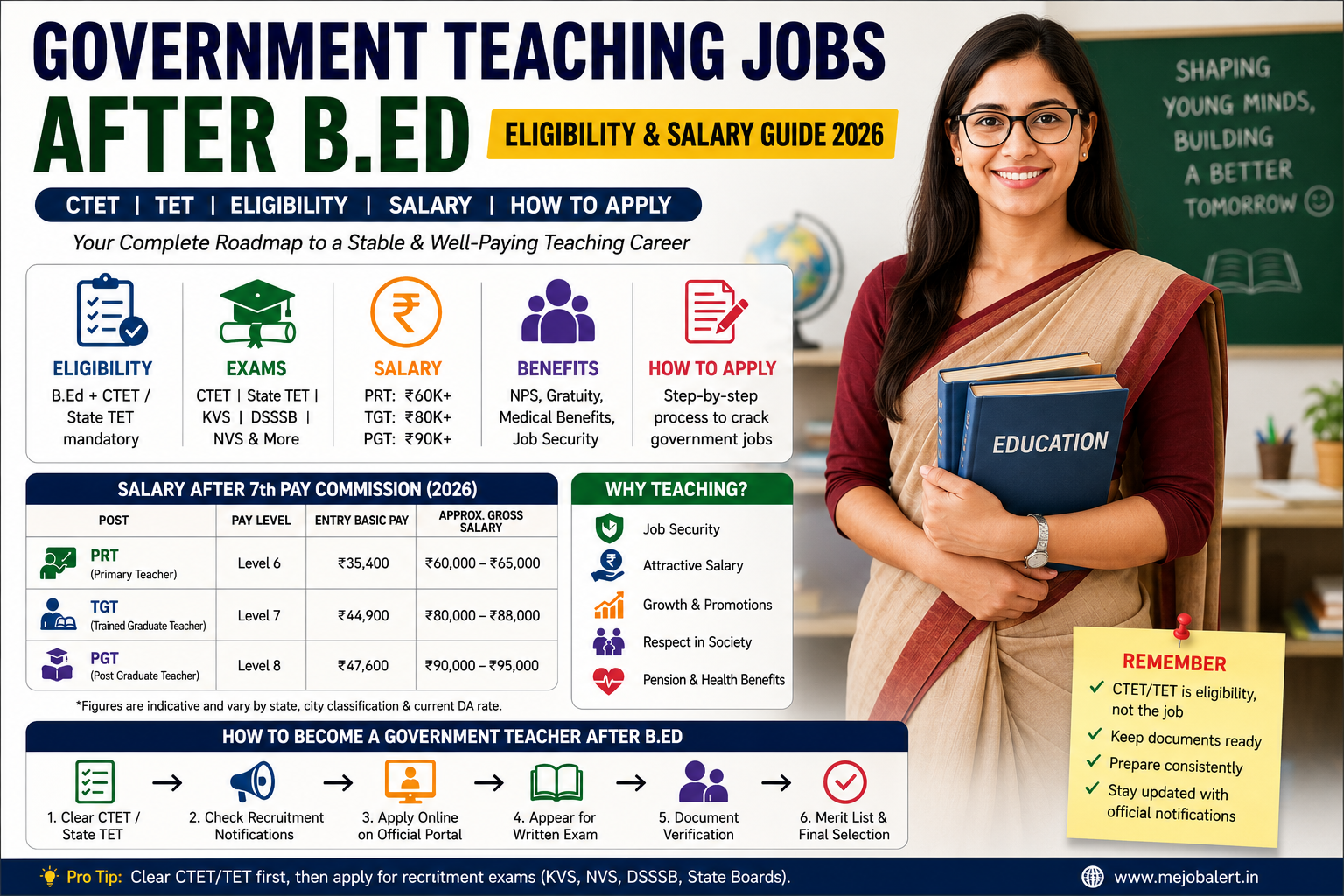
Planning government teaching jobs after B.Ed? Get 2026 CTET/TET eligibility, age limits, TGT-PGT salary, and application steps in one guide. Start today.
Every year, lakhs of B.Ed graduates apply for government teaching jobs after B.Ed, but only a fraction understand the exact eligibility rules before they invest time in the process. Here’s a fact that surprises most first-time applicants: passing CTET or a State TET doesn’t guarantee a job — it only makes you eligible to apply. The actual appointment comes from a separate recruitment exam run by boards like KVS, DSSSB, or your state’s education department.
If you’re holding a B.Ed degree and wondering what comes next, this guide walks you through eligibility criteria, exam patterns, salary structures, and the exact steps to apply — so you don’t waste a recruitment cycle on a mistake you could have avoided. And if teaching is just one path you’re weighing alongside other options, our broader Sarkari Naukri 2026 roundup is a good place to see what else is open right now.
Table of Contents
- Why B.Ed Graduates Need CTET or State TET
- CTET Eligibility for B.Ed Graduates in 2026
- State TET Exam Pattern 2026
- B.Ed vs D.El.Ed for Government Teacher Jobs
- Minimum Percentage Required for B.Ed Teaching Jobs
- Age Limit for Government Teacher Recruitment 2026
- TGT and PGT Eligibility After B.Ed
- KVS, NVS and DSSSB Recruitment 2026
- Government Teacher Salary After 7th Pay Commission
- Pension and Other Benefits
- How to Apply for a Government Teacher Job After B.Ed
- Documents Required for Teacher Government Job
- What to Do While You Wait for Results
- FAQs
Why B.Ed Graduates Need CTET or State TET {#why-ctet-tet}
Under the RTE Act, no one can be appointed as a government school teacher without clearing a Teacher Eligibility Test. As a result, your B.Ed degree opens the door to apply for the exam, but the TET certificate is what actually proves you meet the national teaching standard.
There are two routes:
- CTET (Central Teacher Eligibility Test): Conducted by CBSE, valid for central government schools (KVS, NVS, EMRS) and accepted by most states. You can check live notifications and apply directly on the official CTET portal.
- State TET: Conducted by individual state boards (like UPTET, MPTET, TNTET), mandatory for state government school recruitment in that state.
Takeaway: Clear CTET if you want nationwide flexibility; clear your State TET if you’re targeting a specific state’s recruitment.
CTET Eligibility for B.Ed Graduates in 2026 {#ctet-eligibility}
CTET eligibility for B.Ed graduates depends on which paper you’re targeting. CBSE conducts the exam twice a year, and the September 2026 cycle is scheduled for September 6, 2026.
Paper 1 (Classes I–V): You’ll typically need at least 50% marks in class 12 along with a passed or final-year Diploma in Elementary Education — but B.Ed holders can apply for this paper too. As a B.Ed graduate, you’re eligible here as well, since a B.Ed degree with 50% marks now qualifies candidates for Paper 1 in addition to Paper 2.
Paper 2 (Classes VI–VIII): You’ll need a graduation degree with at least 45% marks and a 1-year B.Ed as per NCTE regulations.
Other important eligibility facts:
- CTET on its own isn’t a job guarantee — it’s an eligibility certificate that qualifies you to apply for teaching jobs at central and most state schools, while the actual recruitment happens separately through KVS, NVS, or state boards.
- B.Ed graduates appointed as primary teachers must complete a bridge course in Elementary Education within 2 years of appointment, since B.Ed is technically designed for upper-primary and secondary levels.
- CTET’s eligibility certificate has been valid for a lifetime since 2021, so you don’t need to reclear it for every recruitment cycle.
Pro Tip: If your B.Ed percentage is borderline, check your specific state’s relaxation rules — reserved categories usually get a 5% concession on the minimum qualifying marks.
If you’re still finishing your degree, it’s worth bookmarking our guide to government jobs for fresh graduates for a wider view of what opens up right after graduation, not just in teaching.
Takeaway: A B.Ed degree qualifies you for both CTET papers, but Paper 1 candidates need the mandatory bridge course after appointment.
State TET Exam Pattern 2026 {#state-tet-pattern}
Every state follows a broadly similar structure, but marking schemes and cut-offs vary. Here’s the general State TET exam pattern 2026 that most boards (UPTET, MPTET, Bihar TET, TNTET) follow:
- Mode: Offline, MCQ-based (some states are shifting to CBT)
- Papers: Paper 1 for primary (I–V), Paper 2 for upper primary (VI–VIII)
- Sections: Child Development & Pedagogy, Language I, Language II, Mathematics, Environmental Studies (Paper 1) or subject-specific papers (Paper 2)
- Total marks: Typically 150 marks, 150 questions
- Duration: 2.5 hours per paper
- Negative marking: Usually none, but always confirm in the official notification
Because state boards set their own qualifying percentage and validity period, it’s worth checking your target state’s latest notification before you register. Since TET recruitment ultimately feeds into your state’s own hiring cycle, our state government jobs 2026 guide is a useful companion for tracking notifications beyond just teaching posts.
Takeaway: State TET syllabus mirrors CTET closely, so preparing for one gives you a strong head start on the other.
B.Ed vs D.El.Ed for Government Teacher Jobs {#bed-vs-deled}
This is one of the most common points of confusion. The B.Ed vs D.El.Ed for government teacher jobs debate really comes down to which grade level you want to teach.
| Factor | B.Ed | D.El.Ed |
|---|---|---|
| Duration | 2 years (after graduation) | 2 years (after class 12) |
| Ideal for | TGT, PGT, upper-primary/secondary roles | Primary teacher (PRT) roles |
| CTET Paper | Paper 2 (also eligible for Paper 1) | Paper 1 |
| Entry point | After a bachelor’s degree | After class 12 |
| Job scope | Broader — subject-specific TGT/PGT posts | Narrower — primary classes only |
If you already hold a B.Ed and want to teach primary classes, you don’t need to go back and complete D.El.Ed — you’re eligible with a bridge course requirement instead. But if you’re just starting out right after class 12, D.El.Ed gets you into the teaching pipeline faster and at lower cost. It’s worth comparing this path against other government jobs after 12th and the broader list of latest government jobs for 12th pass in 2026 before you commit two years to any one route.
Takeaway: Choose D.El.Ed if primary teaching is your only goal; choose B.Ed if you want flexibility across primary, upper-primary, and secondary posts.
Minimum Percentage Required for B.Ed Teaching Jobs {#minimum-percentage}
The minimum percentage required for B.Ed teaching jobs isn’t a single number — it depends on the exam and category:
- CTET Paper 2: At least 45% marks in graduation, plus a 1-year B.Ed
- Reserved category candidates: Typically get a 5% relaxation on the qualifying percentage
- Recruitment exams (KVS/DSSSB/State boards): Most require 50% aggregate in graduation and B.Ed, though this varies by board and post
Beyond the exam eligibility, your B.Ed percentage often matters again at the merit-list stage in several state recruitments, where academic scores carry weightage alongside the written exam. So a stronger B.Ed percentage isn’t just about clearing the eligibility bar — it can genuinely improve your final ranking.
Takeaway: Meet the minimum eligibility percentage first, but aim higher if your state gives academic weightage in the final merit list.
Age Limit for Government Teacher Recruitment 2026 {#age-limit}
Age limit rules vary by recruiting body and state, but here’s the typical range for the age limit for government teacher recruitment 2026:
- Minimum age: 18 years (consistent across most boards)
- Maximum age: Usually 30–40 years for general category candidates
- Relaxation: 3–5 years for OBC, 5–10 years for SC/ST, and additional relaxation for PwD and ex-servicemen candidates
For the CTET exam itself, there’s no upper age limit — the minimum age to apply is 18 years — so age restrictions apply at the recruitment stage, not the eligibility-test stage. Always cross-check the specific notification, since upper age limits for TGT and PGT posts can differ from PRT posts even within the same state.
Takeaway: CTET has no upper age cap, but your actual recruitment exam will — so track individual notifications closely.
TGT and PGT Eligibility After B.Ed {#tgt-pgt-eligibility}
TGT Teacher Eligibility After B.Ed
TGT (Trained Graduate Teacher) posts cover classes 6–10. To be eligible, you generally need:
- A bachelor’s degree with the relevant subject combination
- A B.Ed degree from an NCTE-recognized institution
- CTET Paper 2 or the relevant State TET qualification
- Age typically between 18–35 years (varies by state)
PGT Teacher Recruitment Eligibility
PGT (Post Graduate Teacher) posts cover classes 11–12 and require a step up in qualification:
- A postgraduate degree in the relevant subject with at least 50% marks
- A B.Ed degree
- Some states also require CTET/State TET, though this isn’t universal for PGT — check your target board’s notification
- Age typically between 21–40 years (varies by state)
Pro Tip: If you’re eyeing PGT roles, keep your postgraduate subject aligned with your B.Ed specialization — mismatched subject combinations are a common reason for rejection at the document verification stage.
Takeaway: TGT needs a bachelor’s + B.Ed, while PGT needs a master’s + B.Ed — plan your postgraduate subject accordingly.
KVS, NVS and DSSSB Recruitment 2026 {#kvs-dsssb}
KVS TGT PGT Recruitment 2026: Kendriya Vidyalaya Sangathan recruits TGT and PGT teachers centrally through its official KVS recruitment portal, and candidates need valid CTET scores along with the relevant degree and B.Ed. KVS follows central government pay scales under the 7th Pay Commission directly, making it one of the most sought-after employers for B.Ed graduates. Navodaya Vidyalaya Samiti runs a similar centralized process through its NVS portal, often as a joint recruitment drive with KVS.
DSSSB Teacher Recruitment Eligibility: The Delhi Subordinate Services Selection Board recruits TGT, PGT, and PRT teachers for Delhi government schools. DSSSB recruits TGT teachers alongside KVS, NVS, and various state education departments, and CTET Paper 2 is mandatory for TGT recruitment in KVS, NVS, and many state government schools.
Both boards release notifications separately from CTET/TET, so keep an eye on their official portals for vacancy announcements. Because these are central recruiters, they’re also a good fit if you’re specifically hunting for central government jobs without experience right out of your B.Ed.
Takeaway: KVS and DSSSB are separate recruiting bodies from CTET — clearing CTET only makes you eligible to apply when they release vacancies.
Government Teacher Salary After 7th Pay Commission {#salary-structure}
This is usually the deciding factor for most aspirants, so let’s break down the numbers clearly.
Primary Teacher Salary in India 2026 (PRT)
PRT is placed at Pay Level 6 with an entry basic pay of ₹35,400. A PRT teacher’s take-home pay comes to roughly ₹44,000/month in Delhi, though this varies by state and city classification.
TGT PGT Salary Structure
TGT is placed at Pay Level 7 with an entry basic pay of ₹44,900. With DA at 53%, HRA, and transport allowance, gross salary works out to roughly ₹80,000–88,000 per month depending on the city, with take-home pay around ₹68,000–78,000 after deductions.
PGT is placed at Pay Level 8 with an entry basic pay of ₹47,600, making it the highest-paid of the three core teaching designations.
| Post | Pay Level | Entry Basic Pay | Approx. Gross Salary |
|---|---|---|---|
| PRT | Level 6 | ₹35,400 | ₹60,000–65,000 |
| TGT | Level 7 | ₹44,900 | ₹80,000–88,000 |
| PGT | Level 8 | ₹47,600 | ₹90,000–95,000 |
Figures are indicative and vary by state, city classification, and current DA rate. DA is revised twice a year in January and July based on the AICPI, and stood at 53% as of January 2026.
Pro Tip: Don’t compare only basic pay across states — DA percentage and HRA city classification (X/Y/Z) can shift your actual take-home by ₹10,000–15,000 a month. Since every designation here already clears the ₹50,000 gross mark once DA and HRA are added, you’ll find TGT and PGT roles listed among our government jobs with salary above ₹50,000 picks for 2026.
Takeaway: PGT offers the highest starting salary among the three designations, but TGT roles have significantly more vacancies nationwide, so weigh opportunity against pay level.
Pension and Other Benefits {#pension-benefits}
Government teacher pension benefits today largely run through the National Pension System (NPS) rather than the old defined-benefit pension, following reforms across most states. Key components include:
- NPS contribution: 10% of basic pay plus DA from the employee, with a 14% employer contribution
- Gratuity: Payable after 5 years of continuous service
- Group insurance schemes: State-specific, usually a small monthly deduction with a lump-sum payout on retirement or death
- Medical benefits: Cashless treatment or reimbursement under state/central health schemes
- Job security and pay progression: Automatic increments and periodic pay commission revisions
Some states (like a handful that have reintroduced the Old Pension Scheme) still offer defined-benefit pensions, so check your specific state’s current policy before assuming NPS applies uniformly.
Takeaway: Government teaching offers strong long-term financial security through NPS, gratuity, and health benefits — even though the older guaranteed-pension model has largely been phased out.
How to Apply for a Government Teacher Job After B.Ed {#how-to-apply}
Here’s the step-by-step process most B.Ed graduates follow:
- Clear CTET or your State TET — this is your entry ticket, not the job itself.
- Track recruitment notifications for KVS, NVS, DSSSB, or your state education board.
- Check post-specific eligibility (TGT/PGT/PRT) against your qualification and subject combination.
- Register online on the recruiting body’s official portal before the deadline.
- Polish your application basics — a clean, error-free resume still matters for document screening in many state and board-level drives, even for government posts. Our guide on how to write a resume covers the format recruiters expect.
- Prepare for the written exam — most recruitment exams test subject knowledge, pedagogy, and general awareness.
- Attend document verification and interview, if applicable. If your recruitment process includes a personal interview, it’s worth practicing common questions in advance — our guide on how to answer “tell me about yourself” is a good starting point even for teaching-post interviews.
- Await merit list and counseling/allotment for your final posting.
Furthermore, if you’re a female candidate, several states offer specific vacancy reservations and relaxed age limits — worth checking your state’s notification for government teaching jobs after B.Ed for female candidates specifically, since reservation percentages differ significantly by state.
Takeaway: Treat CTET/TET clearance and recruitment applications as two separate steps — don’t wait for one notification to prepare for the other.
Documents Required for Teacher Government Job {#documents-required}
Keep these ready well before applications open, since document verification is where many candidates lose time:
- Class 10 and 12 mark sheets and certificates
- Graduation and post-graduation mark sheets (as applicable)
- B.Ed degree certificate and mark sheet
- CTET/State TET scorecard
- Category certificate (SC/ST/OBC/EWS), if applicable
- Age proof (birth certificate or class 10 certificate)
- Domicile/residence certificate (for state-specific recruitment)
- Recent passport-size photographs and signature scans
- Disability certificate, if applying under PwD quota
- Experience certificates, if applicable for certain posts
Takeaway: Scan and organize all documents in advance — last-minute document issues are one of the most common reasons applications get rejected.
What to Do While You Wait for Results {#while-you-wait}
CTET and state recruitment cycles can stretch across months between notification, exam, and final posting — and that gap is a real cost if you’re not earning during it. A few practical ways to bridge that time without derailing your teaching prep:
- Pick up short-term or flexible schedule jobs near you that let you block out study hours around a shift.
- If you’d rather work from home, browse remote jobs with no experience required or roles under no-experience remote job listings.
- Students still finishing their B.Ed can also look at online income options without investment or online jobs for students without investment to cover costs during the wait.
Takeaway: A waiting period doesn’t have to be a dead period — use it to earn, save, and keep studying in parallel.
FAQs {#faqs}
1. Can I get government teaching jobs after B.Ed without TET?
Generally, no. TET (CTET or State TET) is mandatory under RTE Act norms for most government teaching posts. A few specific posts, like certain PGT vacancies in some states, may not require TET, but this is the exception, not the rule.
2. CTET vs State TET — which is better for a B.Ed graduate?
CTET gives you eligibility for central schools (KVS, NVS) and is accepted by many states, making it better if you want flexibility. State TET is essential if you’re specifically targeting that state’s government school recruitment, since some states only accept their own TET.
3. What is the minimum percentage required for B.Ed teaching jobs?
Typically 45–50% in your qualifying degree along with B.Ed, though reserved categories usually receive a 5% relaxation. Exact figures vary by exam and recruiting board.
4. What is the age limit for government teacher recruitment in 2026?
Most recruitment exams set the age band between 18–40 years, with relaxations for reserved categories. CTET itself has no upper age limit, but recruitment exams do.
5. How much does a government school teacher earn compared to a private school teacher?
Government teacher vs private school teacher salary comparisons generally favor government roles — PRT, TGT, and PGT posts offer higher basic pay, DA, HRA, pension benefits, and job security than most private schools, which often pay less and offer fewer long-term benefits. If you do get a private-sector offer alongside a government one, our guide on how to negotiate salary can help you weigh and negotiate the offer properly.
6. Which is the best state for government teaching jobs in 2026?
This depends on vacancy volume and pay structure. States with large education departments and frequent recruitment drives — such as Uttar Pradesh, Bihar, Rajasthan, and Madhya Pradesh — tend to release higher vacancy numbers, though competition is also higher.
7. Is a B.Ed degree accepted for CTET Paper 1 (primary teaching)?
Yes. B.Ed graduates can now apply for CTET Paper 1, but they must complete a bridge course in Elementary Education within two years of appointment as a primary teacher.
Conclusion
Landing one of the many government teaching jobs after B.Ed available in 2026 comes down to sequencing your steps correctly: clear CTET or your State TET first, track KVS, DSSSB, and state board notifications closely, and keep your documents recruitment-ready year-round. As a result, when the right vacancy opens, you’re applying with confidence instead of scrambling to catch up. Start by checking your state’s latest TET notification today, and take the first concrete step toward a stable, well-paying teaching career.
Explore More Career Resources
Teaching is one path among many in the government and public-sector space. If you’re keeping your options open, these guides might help:
- Railway Recruitment 2026: Complete Guide for Freshers
- Railway Recruitment 2026 for 10th Pass
- Upcoming Bank Exams Calendar 2026 (PDF)
- 12th Pass Police Recruitment 2026
- Government Jobs for Diploma Mechanical Students
- Best Government Jobs After ITI Electrician
- Jobs That Pay $30 an Hour Without a Degree
- How to Get a Job in Google for Commerce Students
- How to Get a Job in the USA from India: Complete 2026 Guide
- USA Nursing Jobs With Visa Sponsorship for Indians
- USA IT Jobs With Visa Sponsorship for Indians