
Introduction
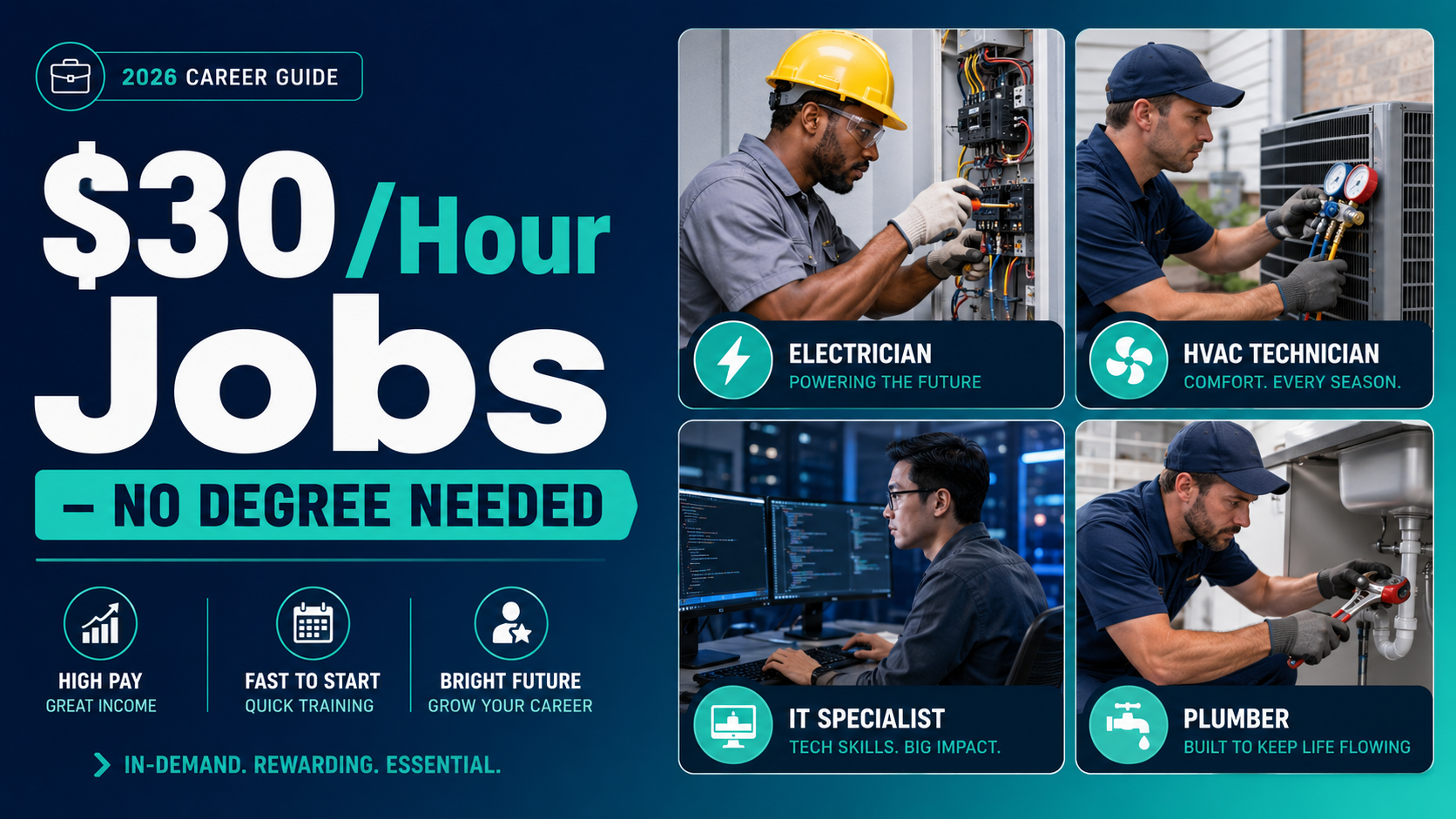
Are you tired of hearing that a college degree is the only path to a good-paying job? Think again. In 2026, dozens of in-demand careers pay $30 an hour or more — and none of them require a four-year degree.
Whether you are fresh out of high school, switching careers, or simply looking for a way to earn more without taking on student debt, this guide is for you. We have researched and compiled the 25 best jobs that pay $30 an hour without a degree, complete with realistic salary data, required skills, and actionable steps to get hired.
At $30 an hour, you are looking at roughly $62,400 per year working full time. That puts you comfortably above the U.S. median household income — without spending four years and tens of thousands of dollars on a college degree.
Let’s get into it.
Why $30/Hour Jobs Are in Demand in 2026
The labor market has shifted dramatically over the past several years. Here is why no-degree, high-paying jobs are more accessible than ever:
1. The Skills Gap Is Real
Millions of skilled trade and technical positions remain unfilled because not enough workers have the hands-on skills employers need. Electricians, HVAC technicians, and welders are in critically short supply across the U.S.
2. Employers Are Dropping Degree Requirements
Major companies including Google, IBM, Apple, and Amazon have publicly removed four-year degree requirements from many of their job listings. What matters now is demonstrable skill.
3. Certifications Are Replacing Diplomas
Short-term certifications from programs like CompTIA, OSHA, and AWS can be earned in weeks to months — and they carry real weight with employers.
4. Wages Are Rising in Trade and Technical Fields
Due to high demand and low supply of skilled workers, wages in trades and technical roles have climbed steadily. Many apprenticeship programs now offer starting wages of $20–$25/hour with rapid advancement to $30–$50/hour.
5. Remote and Hybrid Opportunities Exist
High-paying tech and creative jobs no longer require you to live in an expensive city. Remote IT support, cybersecurity, and digital marketing roles are widely available.
flexible-schedule-jobs-near-me
Top 25 Jobs That Pay $30 an Hour Without a Degree
Below you will find a comprehensive breakdown of each job, including average hourly pay, annual salary, and what it takes to get started.
1. Electrician
Average Hourly Pay: $32–$48/hour
Average Annual Salary: $66,000–$100,000
Electricians install, maintain, and repair electrical systems in homes, commercial buildings, and industrial facilities. This is one of the most in-demand skilled trades in the country.
Requirements:
- Complete a 4–5 year apprenticeship (paid while you learn)
- Pass a journeyman electrician licensing exam
- Obtain a state license
Why It Pays Well: Electricians are essential to every new construction project and infrastructure upgrade, and demand consistently outpaces supply.
2. HVAC Technician
Average Hourly Pay: $25–$42/hour
Average Annual Salary: $52,000–$87,000
Heating, Ventilation, and Air Conditioning (HVAC) technicians install and service climate control systems. With climate change intensifying heat waves and cold snaps, this field has never been more critical.
Requirements:
- HVAC trade school program (6 months to 2 years)
- EPA Section 608 Certification (required for handling refrigerants)
- State licensing varies
Pro Tip: Specializing in commercial HVAC or refrigeration can push your hourly rate to $45+ in major metro areas.
How to Earn Money Online for Students Without Investment from Mobile (2026)
3. Plumber
Average Hourly Pay: $30–$50/hour
Average Annual Salary: $62,000–$104,000
Plumbers install and repair water, gas, and drainage systems. Licensed master plumbers can earn six figures without ever stepping foot in a college classroom.
Requirements:
- 4–5 year apprenticeship program
- Journeyman plumber license
- Master plumber license (for independent work/business ownership)
4. Wind Turbine Technician
Average Hourly Pay: $30–$40/hour
Average Annual Salary: $62,000–$83,000
Wind turbine service technicians (windtechs) are among the fastest-growing occupations in the U.S., according to the Bureau of Labor Statistics. They maintain and repair wind energy equipment, often working at height.
Requirements:
- Technical training program (1–2 years)
- Comfort working at heights
- GWO (Global Wind Organisation) Basic Safety Training
5. Industrial Machinery Mechanic
Average Hourly Pay: $27–$38/hour
Average Annual Salary: $56,000–$79,000
These mechanics maintain and fix factory equipment, automated systems, and manufacturing machinery. As manufacturing modernizes with robotics, these roles are growing rapidly.
Requirements:
- Vocational training or on-the-job training
- Mechanical aptitude
- Some employers prefer an associate degree but many hire based on experience
6. Construction Manager (Field Supervisor)
Average Hourly Pay: $30–$55/hour
Average Annual Salary: $62,000–$115,000
Experienced construction workers often move into supervisory roles without formal degrees. Field supervisors and project foremen manage crews, schedules, and job site safety.
Requirements:
- 5–10 years of hands-on construction experience
- OSHA 30 certification
- Leadership and communication skills
7. Commercial Driver (CDL Truck Driver)
Average Hourly Pay: $25–$38/hour
Average Annual Salary: $52,000–$79,000
Long-haul truck drivers and specialized commercial drivers remain in extremely high demand. Owner-operators and those hauling hazardous materials or oversized loads can earn $80,000–$100,000+ annually.
Requirements:
- Commercial Driver’s License (CDL) — training programs run 3–7 weeks
- Clean driving record
- Pass DOT medical exam
8. IT Support Specialist / Systems Administrator
Average Hourly Pay: $27–$42/hour
Average Annual Salary: $56,000–$87,000
IT support professionals troubleshoot hardware and software issues, manage networks, and keep business systems running. Employers care far more about certifications and demonstrated skills than degrees in this field.
Requirements:
- CompTIA A+ certification (entry level)
- CompTIA Network+ or Microsoft certifications for higher roles
- Self-taught skills and a home lab go a long way
9. Cybersecurity Analyst
Average Hourly Pay: $35–$55/hour
Average Annual Salary: $73,000–$115,000
Cybersecurity is one of the hottest fields in tech, and it has a well-documented shortage of qualified workers. Entry-level analysts can earn $30/hour with the right certifications, even without a degree.
Requirements:
- CompTIA Security+ (the most recognized entry-level cert)
- CEH (Certified Ethical Hacker) for offensive security roles
- Hands-on practice with platforms like TryHackMe or Hack The Box
10. Web Developer
Average Hourly Pay: $30–$55/hour
Average Annual Salary: $62,000–$115,000
Web developers build and maintain websites and web applications. Bootcamps, YouTube tutorials, and platforms like freeCodeCamp have made self-teaching entirely viable.
Requirements:
- Portfolio of projects (more important than any credential)
- Proficiency in HTML, CSS, JavaScript; frameworks like React are a plus
- Coding bootcamp or self-study (3–12 months to job-ready)
11. Solar Panel Installer
Average Hourly Pay: $25–$38/hour
Average Annual Salary: $52,000–$79,000
The solar energy industry is booming, driven by federal tax incentives and falling equipment costs. Installers with electrical or roofing backgrounds are especially valued.
Requirements:
- NABCEP PV Installation Professional certification (preferred)
- OSHA safety training
- On-the-job training often provided
12. Aircraft Mechanic (A&P Mechanic)
Average Hourly Pay: $32–$48/hour
Average Annual Salary: $66,000–$100,000
Airframe and Powerplant (A&P) mechanics maintain and repair aircraft. This is a specialized, well-compensated field that does not require a four-year degree.
Requirements:
- FAA Airframe and Powerplant certificate
- 18 months of technical school or supervised work experience
- Must pass FAA written, oral, and practical exams
13. Dental Hygienist
Average Hourly Pay: $35–$50/hour
Average Annual Salary: $73,000–$104,000
Dental hygienists clean teeth, examine patients for signs of disease, and provide preventive care. This is one of the highest-paying associate degree-level jobs available.
Requirements:
- Associate degree in Dental Hygiene (2 years)
- State license (NBDHE exam)
- Strong patient communication skills
14. Radiation Therapist
Average Hourly Pay: $40–$55/hour
Average Annual Salary: $83,000–$115,000
Radiation therapists administer radiation treatments to cancer patients under the direction of oncologists. With a two-year associate degree or certificate program, you can enter this deeply meaningful and well-paying career.
Requirements:
- Associate degree or certificate program (2 years)
- ARRT (American Registry of Radiologic Technologists) certification
- State licensure in most states
15. Elevator Installer and Repairer
Average Hourly Pay: $40–$60/hour
Average Annual Salary: $83,000–$125,000
Elevator mechanics are among the highest-paid trade workers in the country. They install, maintain, and repair elevators, escalators, and related equipment.
Requirements:
- 4-year apprenticeship through NEIEP (National Elevator Industry Educational Program)
- State license in most states
- Strong mechanical and electrical aptitude
16. Paralegal
Average Hourly Pay: $25–$40/hour
Average Annual Salary: $52,000–$83,000
Paralegals assist attorneys with legal research, drafting documents, and case preparation. While some employers prefer a degree, a paralegal certificate plus experience is often sufficient.
Requirements:
- Paralegal certificate program (several months to 1 year)
- NALA Certified Paralegal (CP) designation preferred
- Attention to detail and strong writing skills
17. Diagnostic Medical Sonographer
Average Hourly Pay: $35–$52/hour
Average Annual Salary: $73,000–$108,000
Sonographers use ultrasound technology to create images of patients’ internal organs, which physicians use to diagnose conditions. This is a high-demand healthcare career with an accessible two-year path.
Requirements:
- Associate degree in Diagnostic Medical Sonography (2 years)
- ARDMS (American Registry for Diagnostic Medical Sonography) certification
- Clinical training hours
18. Real Estate Agent / Broker
Average Hourly Pay: $30–$60+/hour (commission-based)
Average Annual Salary: $62,000–$125,000+
Top-performing real estate agents earn well above $30/hour, especially in competitive markets. The barrier to entry is relatively low compared to other high-income careers.
Requirements:
- Complete a pre-licensing course (40–180 hours depending on state)
- Pass the state real estate exam
- Join a brokerage to get started
19. Commercial Diver
Average Hourly Pay: $30–$65/hour
Average Annual Salary: $62,000–$135,000
Commercial divers perform underwater construction, inspection, and salvage operations. It is physically demanding, specialized work — and it pays accordingly.
Requirements:
- Accredited commercial diving school (6 months–1 year)
- ADCI (Association of Diving Contractors International) certification
- Physical fitness and medical clearance
20. Boilermaker
Average Hourly Pay: $32–$48/hour
Average Annual Salary: $66,000–$100,000
Boilermakers assemble, install, and maintain boilers, tanks, and closed vessels. Most enter the trade through a formal apprenticeship and earn well from day one.
Requirements:
- 4–5 year apprenticeship through the International Brotherhood of Boilermakers
- On-site safety certifications
- Welding skills are a major asset
21. Police Officer / Law Enforcement
Average Hourly Pay: $27–$42/hour
Average Annual Salary: $56,000–$87,000
Most police departments require only a high school diploma plus completion of their police academy program. Salaries, overtime, and benefits make this one of the most financially competitive no-degree careers.
Requirements:
- High school diploma or GED
- Pass physical fitness, psychological, and background checks
- Complete police academy training (14–30 weeks)
22. Power Line Technician (Lineworker)
Average Hourly Pay: $35–$55/hour
Average Annual Salary: $73,000–$115,000
Electrical power line installers and repairers are essential to the nation’s electrical grid. This physically demanding job comes with excellent pay, union benefits, and high job security.
Requirements:
- Line worker apprenticeship (3–4 years)
- OSHA electrical safety certifications
- Physical fitness and comfort with heights
23. Locomotive Engineer
Average Hourly Pay: $32–$50/hour
Average Annual Salary: $66,000–$104,000
Locomotive engineers operate freight and passenger trains across the country. Railroad companies provide on-the-job training and typically do not require a four-year degree.
Requirements:
- High school diploma
- Railroad company training program (typically 1–3 years)
- Federal Railroad Administration (FRA) certification
24. Court Reporter / Stenographer
Average Hourly Pay: $28–$45/hour
Average Annual Salary: $58,000–$93,000
Court reporters create word-for-word transcripts of legal proceedings using stenography machines. The field has a significant talent shortage, creating strong opportunities for trained professionals.
Requirements:
- Court reporting certificate or associate degree (2–4 years of training)
- RPR (Registered Professional Reporter) certification preferred
- Typing speed of 225+ words per minute using stenotype
25. Fire Inspector
Average Hourly Pay: $28–$42/hour
Average Annual Salary: $58,000–$87,000
Fire inspectors examine buildings to ensure compliance with fire safety codes and investigate the causes of fires. This role is typically filled by experienced firefighters or individuals with fire science training.
Requirements:
- Associate degree in Fire Science or equivalent experience (firefighting background)
- NFPA Fire Inspector certification (CFPS)
- State certification requirements vary
Required Skills and Certifications
To land a job paying $30/hour without a degree, the right credentials matter. Here is a breakdown by category:
O*NET OnLine occupational database
Trade & Skilled Labor Certifications
- OSHA 10 and OSHA 30 — required for most construction and industrial jobs
- EPA Section 608 — mandatory for HVAC technicians handling refrigerants
- Journeyman/Master License — required for electricians, plumbers, and similar trades
- CDL (Commercial Driver’s License) — required for truck drivers
Technology Certifications
- CompTIA A+ — entry-level IT support
- CompTIA Security+ — cybersecurity analyst entry point
- CompTIA Network+ — networking roles
- AWS Certified Cloud Practitioner — cloud computing entry point
- Google IT Support Certificate — widely recognized by employers
Healthcare Certifications
- NBDHE — National Board Dental Hygiene Examination
- ARRT — American Registry of Radiologic Technologists
- ARDMS — American Registry for Diagnostic Medical Sonography
Universal Soft Skills That Increase Earning Power
- Problem-solving and critical thinking
- Communication (written and verbal)
- Time management and reliability
- Customer service orientation
- Leadership and team collaboration
How to Get Hired: Step-by-Step
U.S. Department of Labor Apprenticeship Program
Step 1: Choose Your Career Path
Review the 25 jobs above and identify 2–3 that align with your interests, physical capabilities, and local job market. Research job postings in your area on Indeed, LinkedIn, and ZipRecruiter.
Step 2: Research Training Programs
Visit the relevant trade union, community college, or certification body to find accredited training programs near you. Many apprenticeships and trade programs are completely free or subsidized.
Step 3: Earn Your Credentials
Commit to completing the required licensing exams, certifications, or apprenticeship hours. Even the longest paths (4–5 year apprenticeships) are shorter and cheaper than a four-year college degree — and you earn while you learn.
Step 4: Build a Portfolio or Reference List
For tech roles, create a portfolio of projects on GitHub or a personal website. For trade roles, keep a record of projects you have worked on and ask supervisors for letters of recommendation.
Step 5: Apply Strategically
- Use job boards like Indeed, LinkedIn, Glassdoor, and industry-specific boards
- Contact local unions and trade organizations directly
- Network at industry events and professional associations
- Consider staffing agencies that specialize in skilled trades or tech
Step 6: Negotiate Your Salary
Know your worth before you accept an offer. Research current wage rates using the Bureau of Labor Statistics (BLS.gov), Glassdoor, and LinkedIn Salary. Do not be afraid to counter-offer — most employers expect it.
U.S. Department of Labor Apprenticeship Program
Frequently Asked Questions
What jobs pay $30 an hour without a degree?
Many high-paying jobs require no college degree, including electrician, HVAC technician, plumber, IT support specialist, cybersecurity analyst, web developer, elevator mechanic, and power line technician. See our full list of 25 jobs above for complete salary details and requirements.
Is $30 an hour a good wage?
Yes. At $30 an hour working full time (40 hours per week, 52 weeks per year), you earn approximately $62,400 annually — above the U.S. median household income. In lower cost-of-living areas, this is a very comfortable salary.
How long does it take to get a job paying $30 an hour without a degree?
It depends on the career path. Tech certifications like CompTIA A+ or Google’s IT Support Certificate can be earned in 3–6 months. Trade apprenticeships typically take 3–5 years, but you earn a competitive wage from day one. Real estate licensing can be obtained in as little as a few weeks.
What is the highest-paying job without a degree?
Among the jobs on this list, elevator installers and repairers, commercial divers, nuclear power reactor operators, and power line technicians tend to earn the highest wages — often $50–$65+ per hour with experience.
Can I make $30 an hour working from home without a degree?
Yes. Roles in IT support, cybersecurity, web development, digital marketing, and court reporting can all be performed remotely or in hybrid arrangements. Building strong certifications and a portfolio is the key to landing remote work.
Do trade jobs really pay as well as office jobs?
Absolutely — and in many cases, trade workers out-earn white-collar employees. A master electrician or licensed plumber running their own business can earn $100,000–$200,000+ per year.
Are there jobs that pay $30 an hour right out of high school?
Starting at $30/hour straight out of high school is possible but usually requires additional training. Apprenticeships, CDL training, and technical certifications can put you on that path within 3–12 months of graduating.
Conclusion
The idea that you need a four-year college degree to earn a great living is outdated. In 2026, skilled trade workers, healthcare technicians, IT professionals, and dozens of other career paths offer $30 an hour or more — without a diploma.
OSHA safety training and certifications
The jobs listed in this guide are real, in-demand careers with long-term stability and strong income potential. Whether you choose to become an electrician, a cybersecurity analyst, a dental hygienist, or an elevator mechanic, the path forward is clear: earn the right skills and certifications, apply strategically, and negotiate confidently.
Your next move: Choose one career from this list, research the training requirements in your state, and take the first step today. A $30/hour income — and everything that comes with it — is well within your reach.
OSHA safety training and certifications
Sources: U.S. Bureau of Labor Statistics (BLS.gov), ONET OnLine, CompTIA, Department of Labor Apprenticeship Data, 2026 wage survey data.*
8 thoughts on “25 Jobs That Pay $30 an Hour Without a Degree in 2026 (Salary & Requirements)”