
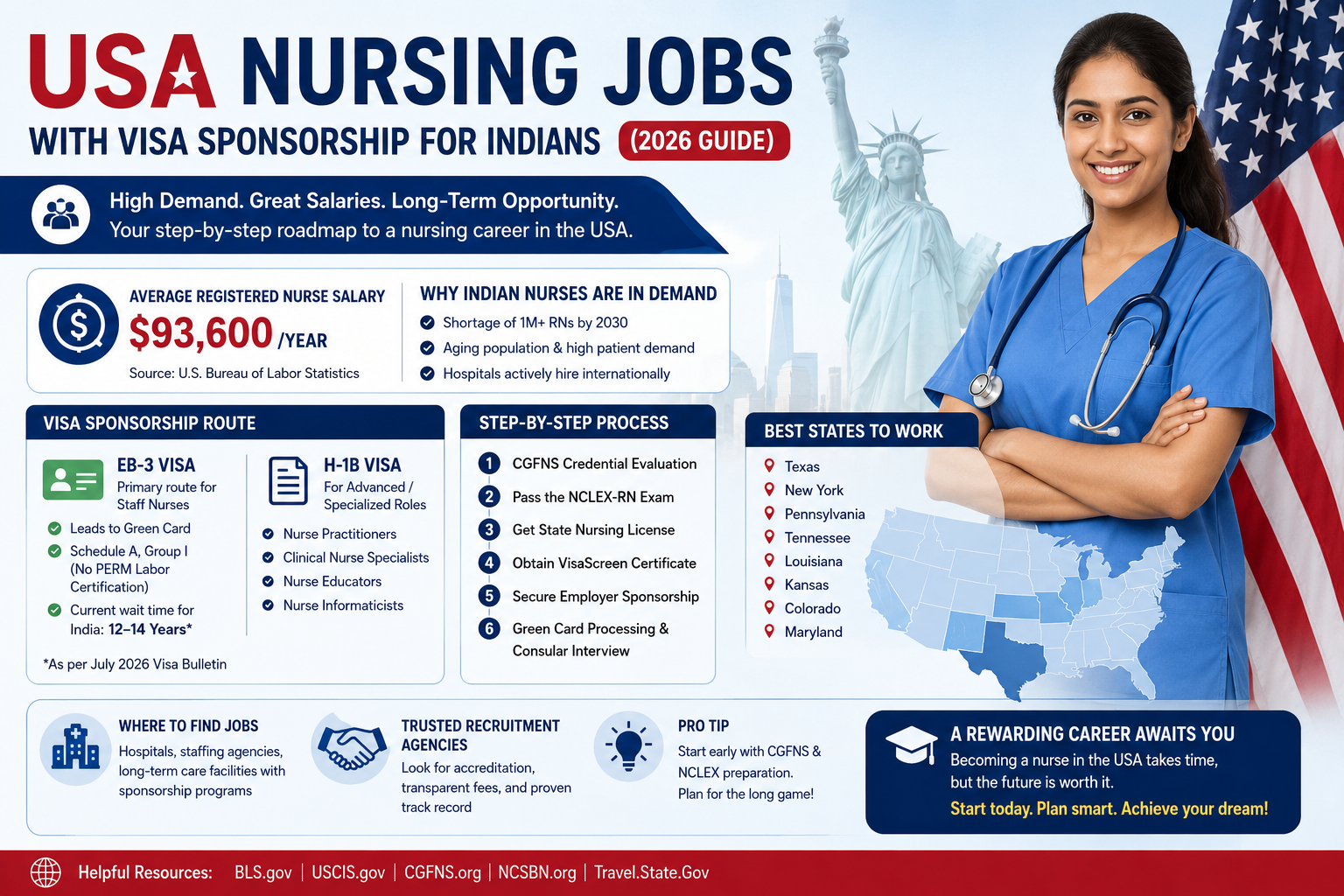
Looking for USA nursing jobs with visa sponsorship for Indians in 2026? Get real EB-3 timelines, NCLEX tips, salaries, and hiring routes. Start planning today.
The average Registered Nurse in the U.S. earns a median of $93,600 a year, according to the U.S. Bureau of Labor Statistics — and hospitals across the country are still short-staffed. That gap is exactly why USA nursing jobs with visa sponsorship for Indians remain one of the most searched career paths in 2026.
Here’s what most guides won’t tell you upfront: the path isn’t a quick H-1B application. For nurses, it’s almost always the EB-3 green card route, and it comes with a real, multi-year timeline you need to plan around. This guide walks you through the honest, step-by-step process — from NCLEX prep to salary expectations — so you know exactly what to expect before you invest time and money. And if the nursing route isn’t your only option on the table, our broader guide to getting a job in the USA from India covers other employment pathways worth comparing.
Table of Contents
- Why USA Nursing Jobs Are in Demand for Indian Nurses
- Visa Sponsorship Routes: EB-3, H-1B, and What Actually Applies to Nurses
- How to Become a Nurse in the USA From India: Step-by-Step
- USA Nurse Salary for Indians: What to Realistically Expect
- Best States for Nursing Jobs in the USA
- Nursing Jobs USA With Visa Sponsorship: Where to Find Them
- Trusted US Nursing Recruitment Agencies for Indians
- Common Challenges and Pro Tips
- FAQs
- Conclusion
1. Why USA Nursing Jobs Are in Demand for Indian Nurses
The U.S. healthcare system relies heavily on internationally educated nurses to fill bedside and specialty roles, especially in ICU, med-surg, and long-term care units. Hospitals in high-turnover regions actively recruit abroad because domestic nursing school graduation rates haven’t kept pace with an aging population.
For Indian nurses specifically, this creates a genuine opening — but it’s a marathon, not a sprint. As a result, understanding the real visa mechanics matters far more than chasing job ads that promise “instant sponsorship.”
Takeaway: Demand is real and growing, but success depends on navigating the licensing and visa process correctly from day one.
2. Visa Sponsorship Routes: EB-3, H-1B, and What Actually Applies to Nurses
This is the part most blog posts get wrong, so let’s be precise.
EB-3 Visa for Nurses (Green Card Sponsorship)
The EB-3 visa is the primary immigration route for staff nurses, not the H-1B. Because RN roles typically require an associate or bachelor’s degree rather than a highly specialized skill set, they fall under the EB-3 “skilled worker” or “professional” category, which leads directly to a green card, not a temporary work visa. Full official eligibility details are published by USCIS on its EB-3 program page.
One detail that works in nurses’ favor: professional nurses are classified under Schedule A, Group I, a designation the Department of Labor uses for occupations with a predetermined shortage of U.S. workers. This means many nurse petitions can skip the standard labor certification (PERM) step that other EB-3 applicants must go through — a real time advantage.
Here’s the honest part: as of the July 2026 Visa Bulletin, the EB-3 filing cutoff for India sits around December 2013, which translates to a wait of roughly 12–14 years for the green card to become current. This happens because no country can receive more than 7% of total employment-based green cards annually, and Indian demand vastly outstrips that cap. You can track your own timeline on the State Department’s official Visa Bulletin and employment-based visa page.
Pro Tip: Your priority date is locked in the moment your employer files your petition — even a small head start matters over a decade-long queue.
H-1B Visa for Nurses — When It Applies
The H-1B is a “specialty occupation” visa, and a standard bedside RN role usually doesn’t qualify because it doesn’t legally require a U.S.-equivalent bachelor’s degree in most states. However, H-1B can apply to advanced roles such as:
- Nurse practitioners and clinical nurse specialists
- Nurse educators or nurse informaticists
- Case managers with specialized credential requirements
If you’re pursuing a standard staff nurse position, plan around EB-3. If you hold or are pursuing an MSN, H-1B becomes a realistic option worth discussing with an immigration attorney.
Other Employment-Based Pathways
- EB-2: Requires a master’s degree or equivalent; wait times for India are also long but occasionally move faster than EB-3.
- Cross-chargeability: If your spouse was born in a country with shorter wait times, you may be able to use their country of birth for priority date purposes.
Takeaway: Plan your career around the EB-3 green card timeline, not a fast H-1B — this single mindset shift saves years of frustration.
3. How to Become a Nurse in the USA From India: Step-by-Step
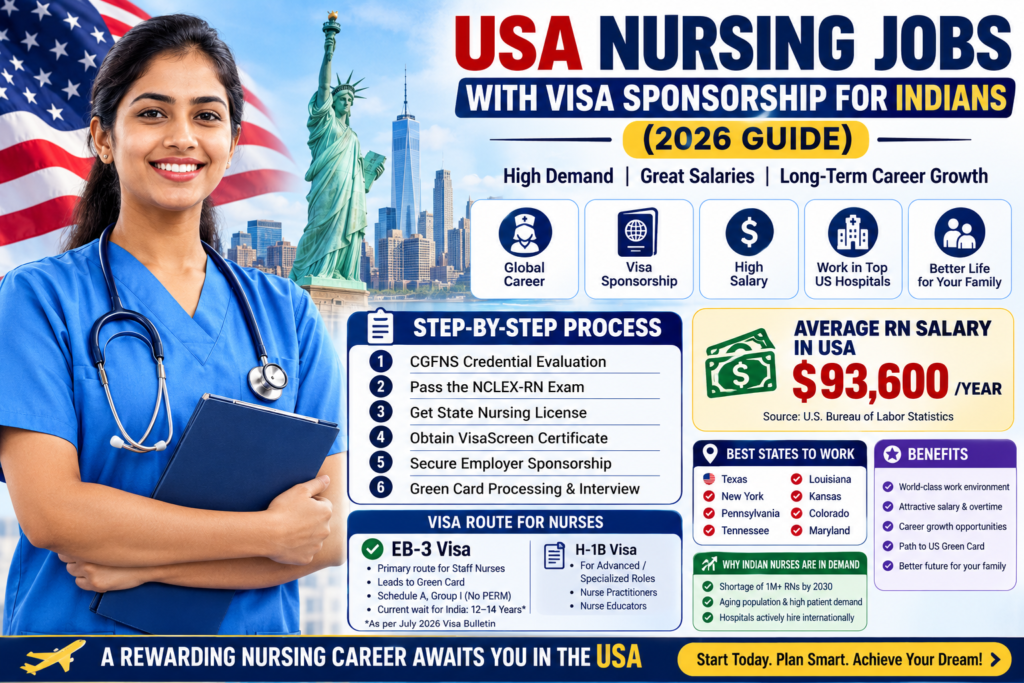
Step 1: Get a Credential Evaluation Through CGFNS
The CGFNS certification verifies that your Indian nursing education and license are equivalent to U.S. standards. CGFNS International is the federally recognized organization for this evaluation, and most U.S. state boards require it before you can even sit for the NCLEX. Processing typically takes several months, so start early.
Step 2: Pass the NCLEX-RN
This is the single biggest hurdle. According to data published by the National Council of State Boards of Nursing (NCSBN), internationally educated nurses overall pass the NCLEX-RN at roughly 54% on the first attempt, compared to over 91% for U.S.-educated candidates — and pass rates for Indian-trained nurses specifically run closer to 40%. The gap isn’t about capability; it’s largely about unfamiliar terminology (like generic drug names) and the exam’s heavy focus on clinical judgment over memorization.
Pro Tip: Dedicate real time to NCLEX-style clinical judgment questions rather than rote review — the exam rewards prioritization and reasoning, not recall.
Step 3: Obtain Your State Nursing License
Each state board of nursing has its own licensure requirements. Some states process out-of-country applications faster than others, which is worth factoring into your job search.
Step 4: Get Your VisaScreen Certificate
A VisaScreen certificate (issued through CGFNS) is mandatory for any nurse immigrating on an employment-based visa. It confirms your license, education, and English proficiency meet federal requirements — this is a distinct step from your NCLEX and state license.
Step 5: Secure Employer Sponsorship
You’ll need a U.S. healthcare employer (hospital, staffing agency, or health system) willing to sponsor your green card petition. A strong, clearly formatted application matters here — our guide on how to write a resume can help you present your clinical experience the way U.S. recruiters expect. Once you land an interview, it also helps to prepare for common opening questions; see how to answer “tell me about yourself” for practical examples.
Step 6: Green Card Processing and Consular Interview
Once your priority date becomes current, you’ll complete consular processing or adjustment of status, including a medical exam and visa interview at the U.S. consulate.
Takeaway: Each step has its own timeline — starting CGFNS and NCLEX prep in parallel, rather than sequentially, can shave months off your overall path.
4. USA Nurse Salary for Indians: What to Realistically Expect
Once licensed and placed, USA nurse salaries for Indians are competitive with those of any other internationally trained RN. Nationally, per BLS data:
- Median RN salary: $93,600/year
- Entry-level to experienced range: roughly $49,000–$120,000+ depending on state and facility type
- Specialty and overtime pay: shift differentials, night/weekend premiums, and overtime can add meaningfully to base pay
Salaries vary significantly by state and cost of living, so a lower base salary in a lower-cost state can still translate to stronger take-home value. When you do get an offer, know your numbers going in — our salary negotiation guide walks through how to counter an offer professionally.
Takeaway: Don’t just compare headline salary numbers across states — factor in cost of living and shift differentials before deciding where to work.
5. Best States for Nursing Jobs in the USA
Several states consistently show strong demand and sponsorship activity for internationally educated nurses, including:
- Texas — large hospital systems with active international recruitment
- New York — high pay scales, especially in NYC metro hospitals
- Pennsylvania — steady demand across urban and rural systems
- Tennessee — growing healthcare hiring with visa-sponsorship programs
- Louisiana, Kansas, Colorado, and Maryland — active placement pipelines for internationally trained RNs
Pro Tip: Ask recruiters directly whether the specific facility — not just the state — has a track record of completing EB-3 sponsorship through to green card approval, not just initial hiring.
6. Nursing Jobs USA With Visa Sponsorship: Where to Find Them
Genuine nursing vacancies USA with sponsorship typically come from:
- Large hospital systems with dedicated international recruitment teams
- Licensed healthcare staffing agencies specializing in EB-3 nurse sponsorship
- Long-term care and skilled nursing facilities facing chronic staffing shortages
Be cautious of listings promising “free visa sponsorship” with no employer name, licensing detail, or verifiable placement history — legitimate sponsorship always involves a documented employer-employee relationship and a filed petition.
Takeaway: Verify any recruiter’s track record of actual green card approvals, not just job placements, before signing an exclusive contract.
7. Trusted US Nursing Recruitment Agencies for Indians
When evaluating US nursing recruitment agencies for Indians, look for these signals of legitimacy:
- Membership or accreditation with recognized healthcare staffing bodies
- Transparent breakdown of fees (or confirmation that the employer, not you, pays sponsorship costs)
- References from nurses who’ve completed the full process, not just early placement
- Clear communication about realistic EB-3 timelines rather than vague promises
8. Common Challenges and Pro Tips
- Challenge: Long EB-3 wait times can feel discouraging.
Pro Tip: Many nurses work in India or a third country while their priority date advances, then travel once it’s current. - Challenge: NCLEX terminology differences trip up first-time test takers.
Pro Tip: Use NCLEX-specific question banks that emphasize U.S. drug naming and clinical judgment models, not general pharmacology review. - Challenge: Recruitment agency reliability varies widely.
Pro Tip: Cross-check any agency’s claims against nurse forums and independent reviews before paying any fees.
FAQ: USA Nursing Jobs With Visa Sponsorship for Indians
1. Is H-1B or EB-3 better for nurses moving to the USA?
For most staff RN roles, EB-3 is the standard and often only viable route, since bedside nursing typically doesn’t meet H-1B’s “specialty occupation” requirement. H-1B is generally reserved for advanced practice or specialized nursing roles.
2. How long does the EB-3 visa process take for Indian nurses?
As of mid-2026, the total wait — including the priority date backlog — runs roughly 12–14 years for India, largely due to per-country caps rather than USCIS processing speed itself.
3. What is the NCLEX pass rate for Indian nurses?
Recent NCSBN data shows Indian-trained nurses pass the NCLEX-RN on their first attempt at a rate of roughly 40%, compared to over 90% for U.S.-educated candidates — mainly due to differences in terminology and exam format, not clinical skill.
4. Do I need CGFNS certification before taking the NCLEX?
Yes, in most states. CGFNS credential evaluation verifies that your Indian nursing education meets U.S. equivalency standards and is typically required before you’re approved to sit for the NCLEX-RN.
5. What is the average USA nurse salary for Indians?
Internationally educated nurses are paid on the same scale as domestic RNs — the national median sits around $93,600 per year, per BLS data, though this varies significantly by state, facility, and specialty.
6. Can I get a nursing job in the USA with free visa sponsorship?
Legitimate employer sponsorship generally means the employer covers filing costs for the petition — but “free” doesn’t mean instant. You should still expect the standard EB-3 wait time.
7. Which states hire the most internationally educated nurses?
Texas, New York, Pennsylvania, Tennessee, and Louisiana are among the most active states for internationally trained nurse recruitment and sponsorship in 2026.
Conclusion
Moving from India to a nursing career in the USA is absolutely achievable in 2026 — but only if you go in with accurate expectations. The real path runs through CGFNS certification, the NCLEX-RN, and the EB-3 green card process, not a quick H-1B application. It takes years, not months, and success depends on choosing the right recruitment partner and preparing strategically for the licensing exam.
If you’re serious about this path, start with your CGFNS credential evaluation today, build a focused NCLEX-RN study plan, and begin researching hospital systems and agencies with a verified sponsorship track record. The nurses who succeed are the ones who start early and plan for the long game — not the ones chasing the fastest-sounding shortcut.
Suggested Tags/Keywords: USA nursing jobs visa sponsorship, EB-3 visa for nurses, NCLEX for Indian nurses, CGFNS certification, nursing jobs USA for Indians 2026, US nurse salary, how to become a nurse in USA from India, nursing recruitment agencies USA, H-1B visa for nurses, green card sponsorship for nurses
1 thought on “USA Nursing Jobs With Visa Sponsorship for Indians (2026 Guide)”