
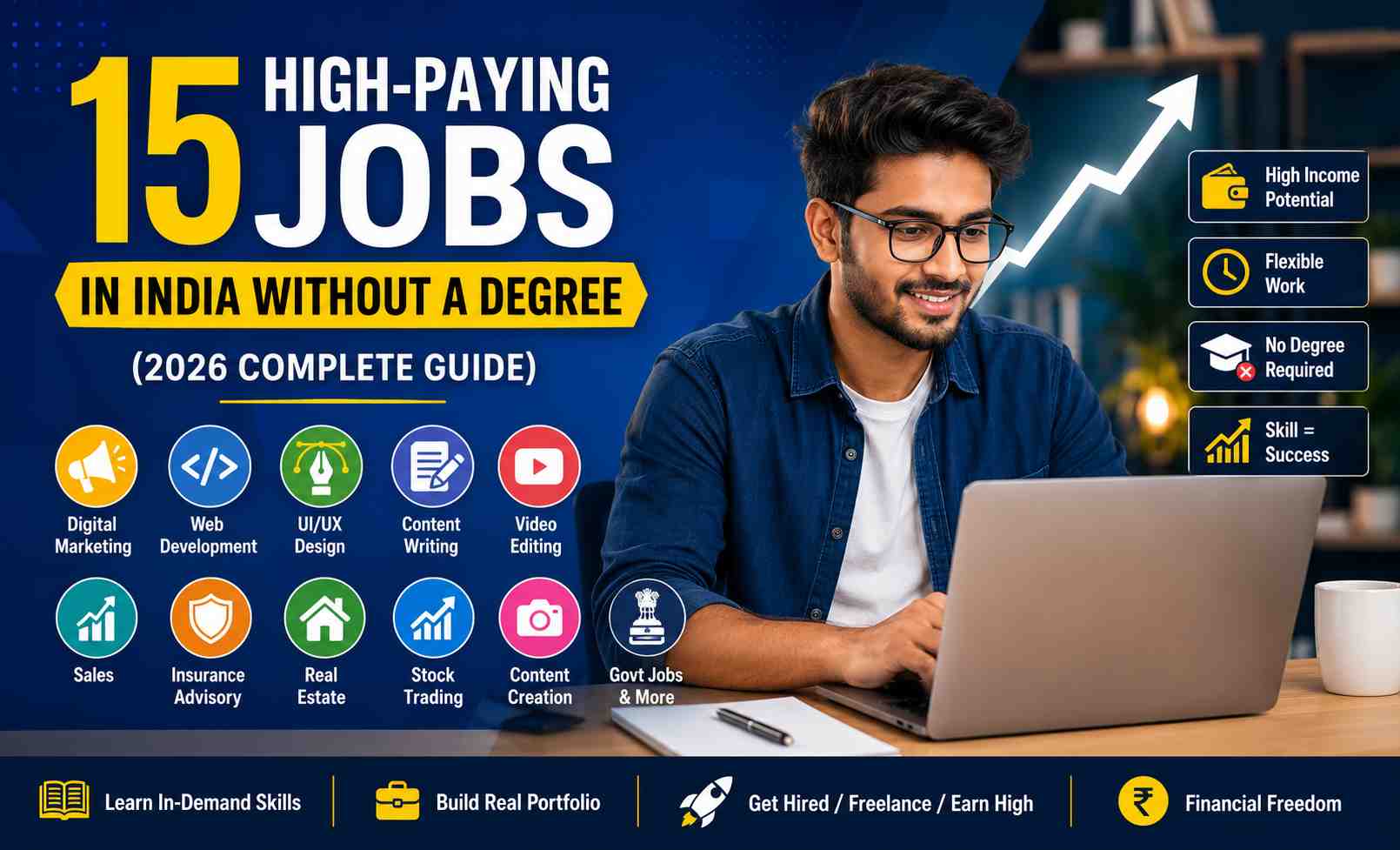
High-Paying Jobs in India Without a Degree
For years, Indian parents and students were told the same thing: get a degree, or get left behind. That belief is losing ground fast. In 2026, thousands of Indians are earning ₹40,000, ₹80,000, even ₹2 lakh+ a month without ever finishing college — because employers and clients have started paying for proof of skill, not proof of enrollment.
If you’re weighing options like jobs that pay ₹30 an hour without a degree or wondering where to even start, this guide breaks down 15 realistic, high-paying career paths open to anyone in India without a degree — school dropouts, 12th-pass students, or working professionals looking for a change. For each one, you’ll find what the job actually involves, what it typically pays, and how to get your first opportunity.
Why Indian Employers Are Hiring for Skills, Not Degrees
A few forces are driving this shift at once:
- Startups and digital-first companies care more about a working portfolio than a transcript.
- Freelance marketplaces (Upwork, Fiverr, Contra) let clients judge you purely on sample work.
- Free and low-cost learning has closed the knowledge gap that degrees used to fill.
- The gig and creator economy has created entirely new job categories, many of which now offer flexible-schedule jobs near you instead of rigid 9-to-6 structures.
None of this means degrees are worthless — fields like medicine, law, and chartered accountancy legally require formal qualification. But outside those regulated professions, a growing share of well-paying work now runs on demonstrated ability.
1. Digital Marketing
Every business with a website needs someone who can bring in customers online. Digital marketers handle SEO, paid ads (Google/Meta), email campaigns, and social media growth.
- Typical pay: ₹25,000–₹80,000/month as an employee; freelancers and agency owners can earn far more.
- How to start: Learn through Google’s free Digital Garage courses, HubSpot Academy, or YouTube. Run a real campaign — even for your own small project — before applying anywhere. If you’re a commerce background candidate specifically eyeing a tech-adjacent employer, this guide on how to get a job at Google for commerce students is worth reading alongside this section.
2. Web Development
Businesses need functioning websites and web apps constantly, and a working GitHub portfolio often carries more weight with hiring managers than a certificate.
- Typical pay: ₹20,000–₹70,000/month for junior roles; experienced freelance developers can bill significantly more per project.
- How to start: freeCodeCamp offers a completely free, structured path in HTML, CSS, and JavaScript. Build three real projects before you apply, and once you’re ready, brush up using how to write a resume so your portfolio actually gets opened.
3. UI/UX Design
As Indian companies compete on user experience, demand for designers who can make apps and websites intuitive has grown sharply.
- Typical pay: ₹25,000–₹75,000/month; strong freelancers charge per-project rates well above that.
- How to start: Learn Figma (free), study existing apps critically, and build a Behance or Dribbble portfolio with 4–5 case studies.
4. Content Writing & Copywriting
Businesses — Indian and international — pay well for people who can write clearly and persuasively. Because payment is often in dollars or pounds for overseas clients, the income-to-cost-of-living ratio can be excellent. If you’re open to working with clients abroad, it’s worth reading up on how to get a job in the USA from India for context on cross-border work options.
- Typical pay: ₹15,000–₹60,000/month starting out; skilled freelance copywriters serving international clients often earn more.
- How to start: Build a small portfolio of sample articles or ad copy, then pitch on Upwork, Fiverr, or directly to small businesses.
5. Video Editing
Every YouTuber, brand, and marketing team needs consistent, well-edited video content — and good editors are in short supply relative to demand.
- Typical pay: ₹18,000–₹60,000/month; per-project freelance rates vary widely by client and turnaround time.
- How to start: Learn CapCut or DaVinci Resolve (both free), then edit sample reels or YouTube videos to build a demo showreel.
6. Graphic Design
From social media creatives to brand identity work, businesses constantly need visual content, and a strong portfolio speaks louder than a design degree.
- Typical pay: ₹18,000–₹55,000/month; freelance and agency work can pay more per project.
- How to start: Learn Canva Pro and Adobe Illustrator basics, then design mock projects for real (even imaginary) brands to showcase range.
7. Sales (B2B and B2C)
Sales is one of the purest examples of skill-over-credentials hiring — performance and incentive structures reward closers regardless of educational background.
- Typical pay: Base pay ₹15,000–₹40,000/month, but incentives can multiply total earnings significantly for high performers.
- How to start: Entry-level sales and business development roles are widely available; strong communication and persistence matter more than qualifications here. Practising your pitch also helps in interviews — see how to answer “tell me about yourself” for examples you can adapt.
8. Insurance and Financial Advisory
Agents with companies like LIC or private insurers earn primarily through commission, including renewal commissions on policies sold years earlier.
- Typical pay: Highly variable — from modest amounts for new agents to lakhs per month for established advisors with a strong client base.
- How to start: Most insurers run their own agent certification and training programs; a degree is not a prerequisite.
9. Real Estate
India’s property market — especially in urban and commercial segments — has kept brokers and consultants in steady demand, with earnings tied to deal value and local network strength.
- Typical pay: Commission-based; strong performers in active markets can earn well above typical salaried roles.
- How to start: Register as an agent, learn local RERA regulations, and build relationships within a specific locality or property segment.
10. Stock Trading and Investing
Platforms like Zerodha and Groww have made market participation far more accessible than it used to be. This path has real upside but also real risk — it rewards discipline and education, not luck.
- Typical pay: No fixed ceiling — and no floor either. Losses are as possible as gains without proper training.
- How to start: Learn through free resources like Zerodha Varsity before committing real capital, and start small.
11. Content Creation (YouTube, Instagram, Podcasts)
Creators earn through ad revenue, brand sponsorships, and affiliate marketing. It’s a genuinely self-employed path — income isn’t guaranteed, but consistent creators with even modest, engaged audiences can build solid income streams. Students specifically exploring low-risk starting points should also check how to earn money online for students without investment from mobile.
- Typical pay: Highly variable — from side-income levels to multi-lakh monthly earnings for top performers.
- How to start: Pick one platform and niche, publish consistently for at least 3–6 months, and study what similar creators in your space are doing well.
12. Government Jobs That Don’t Require a Degree
Several stable government positions are open after 10th or 12th pass, offering job security and pension benefits that private-sector roles often lack.
- Examples and where to check notifications:
- SSC MTS and other 10th/12th-pass posts — SSC official website
- RRB Group D (Railways) — official RRB application portal, or read this complete railway recruitment guide for freshers
- Post Office GDS
- Police Constable and other state-level posts — see state government jobs 2026
- Typical pay: ₹20,000–₹50,000/month depending on role, plus benefits.
- Further reading: If you’re specifically 12th-pass, browse latest government jobs for 12th-pass candidates in 2026 and government jobs after 12th. Freshers with no prior work history can also look at central government jobs without experience and government jobs for fresh graduates for degree-optional and degree-required options side by side.
13. Data Entry and Virtual Assistance
These roles have low entry barriers and are a realistic starting point for people with no prior work experience, often leading into better-paying remote roles over time.
- Typical pay: ₹12,000–₹30,000/month starting out.
- How to start: If you have zero prior experience, start with entry points listed in this guide to no-experience remote jobs — strong attention to detail matters more than a resume history here.
14. Ethical Hacking / Cybersecurity
Cybersecurity roles typically require a certification rather than a degree, and demand has grown as more Indian businesses move critical operations online.
- Typical pay: ₹30,000–₹90,000/month for certified entry-to-mid-level roles.
- How to start: Certifications like Certified Ethical Hacker (CEH) from EC-Council or CompTIA Security+ are widely recognized starting points; many foundational resources are free.
15. Commercial Piloting
This is a notable exception on this list — it doesn’t require a traditional academic degree, but it does require expensive, certified flight training.
- Typical pay: Among the highest on this list once qualified and flying commercially.
- How to start: Research DGCA-approved flying schools and the Commercial Pilot License (CPL) process carefully, including realistic training costs.
Common Mistakes to Avoid
- Chasing only the local market: International clients on Upwork or Fiverr often pay several times domestic Indian rates for the same skill.
- Waiting to feel “ready”: Applying and getting no response teaches you more than waiting ever will.
- Falling for get-rich-quick schemes or MLMs: Skill-based income builds slowly but stays yours — shortcuts rarely do.
- Skipping portfolio-building: In skill-based hiring, your proof of work matters more than any single certificate.
- Ignoring interview prep: Even skill-based hiring involves interviews. A well-practiced answer to common questions like “tell me about yourself” and a clean resume can be the difference between an offer and silence.
Frequently Asked Questions
Can I really get a high-paying job in India without a degree?
Yes. Sectors like digital marketing, tech, sales, and freelancing increasingly hire based on demonstrated skills and portfolios rather than academic qualifications.
Which skill is best for earning money without a degree in India?
Web development, digital marketing, cybersecurity, and high-ticket sales are among the strongest income-generating skills right now, largely because demand outpaces the supply of trained people.
Is freelancing a stable career option?
It can be, once you’ve built a base of repeat clients. It typically takes longer to stabilize than a salaried job, but it removes the income ceiling that many traditional roles have.
Are there government jobs available without a degree?
Yes — roles like SSC MTS, RRB Group D, and Post Office GDS are open to 10th or 12th pass candidates and offer job security along with steady pay. See our full breakdown of state government jobs in 2026 for more options.
How long does it take to start earning ₹1 lakh per month without a degree?
It varies by field and effort, but professionals in web development, sales, and freelancing commonly reach this level within 1–3 years of consistent, focused skill-building.
Final Thoughts
The idea that a degree is the only route to a good income in India is genuinely outdated. What replaces it isn’t luck — it’s a repeatable process: pick one skill, learn it properly using free or low-cost resources, build real proof of your ability, and start applying or pitching before you feel completely ready. Whether that means freelancing, a flexible-schedule role near you, or a stable government post, the market increasingly rewards exactly that.