
Struggling with the expected salary question in interview settings? Get proven scripts, ranges, and mistakes to avoid. Read now and answer with confidence.
Nearly 70% of hiring managers ask about salary expectations in the very first interview round, and how you answer can shape the rest of your negotiation — before you’ve even gotten an offer. If you’re a fresher, this question probably makes your palms sweat. You don’t have past salary history to fall back on, you’re not sure what’s “normal,” and you’re terrified of either pricing yourself out of the job or leaving money on the table.
Here’s the good news: answering the expected salary question in interview settings isn’t about guessing right. It’s about preparation, research, and a few smart phrases that keep you in control.
In this guide, you’ll get word-for-word scripts, common mistakes to avoid, and a simple framework to figure out your number — even with zero work experience.
Table of Contents
- Why Recruiters Ask About Expected Salary
- How to Prepare Before the Interview
- Proven Scripts to Answer the Expected Salary Question
- Common Mistakes Freshers Make
- What to Do If You’re Pushed for an Exact Number
- Salary Negotiation Tips for Freshers
- FAQ Section
- Conclusion
1. Why Recruiters Ask About Expected Salary
Before you craft your answer, it helps to understand what’s actually happening on the other side of the table.
Recruiters ask the expected salary question in interview conversations for a few practical reasons:
- To check budget fit. They want to confirm your expectations align with the role’s approved salary band before investing more time.
- To gauge self-awareness. Your answer signals whether you’ve researched the market and understand your own value.
- To streamline negotiations. An early number gives HR a starting point for internal approvals.
In other words, this question isn’t a trap — it’s a filtering step. As a result, going in prepared puts you ahead of most candidates who freeze up or blurt out a random figure.
If you’re also unsure how to handle other common questions in the same interview, it helps to first get comfortable with how to answer “Tell Me About Yourself” with examples, since a confident opening sets the tone for the entire conversation.
Takeaway: Recruiters ask this question to save time on both sides, not to catch you off guard — so treat it as a chance to show you’ve done your homework.
2. How to Prepare Before the Interview
You can’t confidently answer the expected salary question in interview rounds without doing your research first. Here’s how to prepare in under an hour.
Research the Market Rate
Look up average entry-level salaries for your role, industry, and city using a trusted platform like Glassdoor’s salary database, which lets you filter by job title, company, and location. Location matters a lot — a software fresher role in Bangalore pays differently than the same role in a Tier-2 city.
Factor in Your Specific Situation
Consider:
- Your degree, certifications, and specialized skills
- Internship or project experience (even unpaid ones count)
- Company size and funding stage (startups vs. MNCs often pay differently)
- Cost of living in the job location
If you’re also exploring options beyond traditional office roles, it’s worth checking remote jobs with no experience required, since these often come with different (and sometimes more flexible) salary structures than in-office fresher roles.
Decide on a Realistic Range
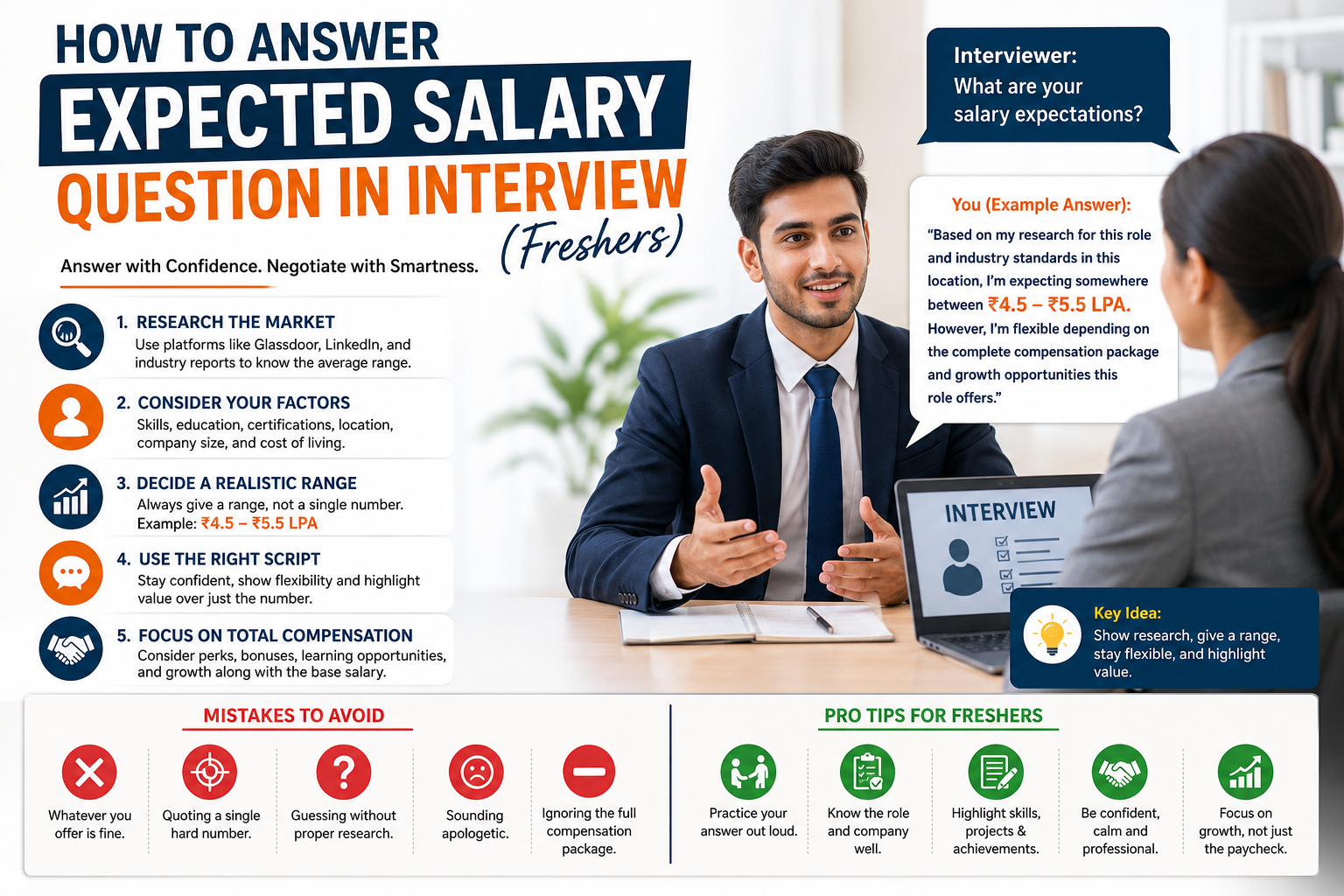
Once you have market data, set a range, not a single number. For example: “₹4.5–5.5 LPA” instead of “₹5 LPA.” A range gives you flexibility while still sounding informed.
Pro Tip: Always anchor your range slightly above what you’d actually accept. Recruiters often negotiate toward the lower end, so starting a bit higher protects your final number.
Takeaway: Solid research turns a scary guessing game into a confident, data-backed answer.
3. Proven Scripts to Answer the Expected Salary Question
Here are ready-to-use scripts for the most common versions of this question. Adjust the numbers and details to fit your research.
Script 1: The Range Approach (Most Recommended)
“Based on my research for this role and industry standards in [city], I’m expecting somewhere between ₹X and ₹Y. However, I’m flexible depending on the complete compensation package and growth opportunities this role offers.”
Script 2: Redirecting to the Company’s Budget
“I’d love to understand the budget you have in mind for this role first, since you likely have more clarity on the internal structure. That said, based on my research, I’d expect something in the range of ₹X to ₹Y.”
Script 3: When You Genuinely Don’t Know the Market Rate
“This is actually my first full-time role, so I’m still calibrating my expectations. From what I’ve researched, I believe a fair range would be ₹X to ₹Y, but I’m open to discussing what’s standard for this position.”
Script 4: Emphasizing Value Over Number
“I’m less focused on a specific figure and more interested in a role where I can grow and contribute meaningfully. That said, I understand entry-level compensation in this field typically ranges from ₹X to ₹Y, which works for me.”
Furthermore, notice that every script does three things: shows you’ve done research, gives a range instead of a rigid number, and signals flexibility. That combination is what makes these answers effective.
Before you walk into the interview, it also pays to make sure your resume backs up the number you’re asking for — a well-structured resume that highlights your skills and projects makes your salary expectation feel justified rather than arbitrary.
Takeaway: A well-structured script keeps you confident and in control, no matter how the question is phrased.
4. Common Mistakes Freshers Make
Avoid these pitfalls when answering the expected salary question in interview settings:
- Saying “Whatever you offer is fine.” This undersells you and removes your leverage entirely.
- Quoting a single hard number. It leaves zero room to negotiate up.
- Guessing without research. Numbers pulled from thin air often clash badly with market reality.
- Sounding apologetic. Nervous phrasing like “I hope this isn’t too much” signals low confidence.
- Ignoring the full compensation package. Base salary isn’t everything — bonuses, ESOPs, and benefits matter too.
As a result, candidates who avoid these mistakes come across as prepared professionals, not anxious job-seekers.
Takeaway: The biggest mistake isn’t asking for “too much” — it’s answering without a strategy at all.
5. What to Do If You’re Pushed for an Exact Number
Sometimes recruiters won’t accept a range and will press you for one figure. Here’s how to handle it gracefully.
- Give a number within your researched range, ideally toward the middle or slightly higher.
- Pair it with a brief justification: “Based on industry benchmarks for this role, ₹X LPA feels appropriate.”
- Add a flexibility clause: “I’m open to adjusting this based on the complete package and growth trajectory.”
If they push further and ask for your absolute minimum, it’s okay to share your floor — just don’t go below what you’ve determined is fair based on your research. According to SHRM’s guidance on salary negotiation, candidates who anchor to a researched range rather than a single fixed figure tend to land closer to their target compensation.
Takeaway: When cornered for a specific number, stay data-backed and calm rather than caving to pressure.
6. Salary Negotiation Tips for Freshers
Once an offer is on the table, negotiation doesn’t stop at your first answer. Keep these tips in mind:
- Never negotiate over email in the first message — always confirm interest first, then discuss numbers.
- Ask about the full package, including bonuses, stock options, insurance, and learning stipends.
- Get everything in writing before accepting verbally.
- Practice out loud with a friend or mentor so your delivery sounds natural, not rehearsed.
In other words, your interview answer is just the opening move — the real negotiation often happens after the offer letter arrives. For a deeper, step-by-step breakdown of this stage, check out our full guide on how to negotiate salary.
If you’re weighing a private-sector offer against something more stable, it’s also worth browsing current openings in our guide to government jobs for fresh graduates, since compensation structures and negotiation flexibility can differ quite a bit between the two paths.
Takeaway: Confidence in salary conversations is a skill you build through practice, not something you’re born with.
FAQ Section
Q1: What should a fresher say when asked about expected salary?
A fresher should give a researched salary range based on market data, industry, and location, while signaling flexibility around the full compensation package.
Q2: Is it okay to say “negotiable” for expected salary as a fresher?
Yes, but pair it with a range. Simply saying “negotiable” without any number can come across as unprepared.
Q3: Should I ever say a salary that’s too low as a fresher?
No. Even without experience, quoting a number well below market rate signals low self-worth and can hurt your negotiating position later.
Q4: How do I find the right salary range for my first job?
Use platforms like Glassdoor or LinkedIn Salary Insights, and cross-check with peers in similar roles and locations.
Q5: What if the recruiter asks for salary expectations before I’ve researched the company?
It’s fine to say: “I’d like to learn a bit more about the role first, but based on general market research, I’m expecting around ₹X to ₹Y.”
Q6: Can I ask the interviewer for their budget instead of answering first?
Yes, politely redirecting is a valid strategy, especially if you’re unsure. Just be ready to follow up with your own range if they insist.
Conclusion
Answering the expected salary question in interview settings doesn’t have to feel like a guessing game. With market research, a well-defined range, and one of the scripts above, you can respond with confidence — even as a first-time job seeker.
Remember: the goal isn’t to have a perfect number memorized. It’s to show recruiters you understand your value and can discuss it professionally. Start practicing your answer today, and walk into your next interview ready to negotiate like a pro.
Suggested Tags/Keywords
- expected salary question in interview
- how to answer salary expectations
- salary negotiation for freshers
- interview questions for freshers
- entry-level salary range
- salary expectation scripts
- fresher job interview tips
- how to negotiate first salary