
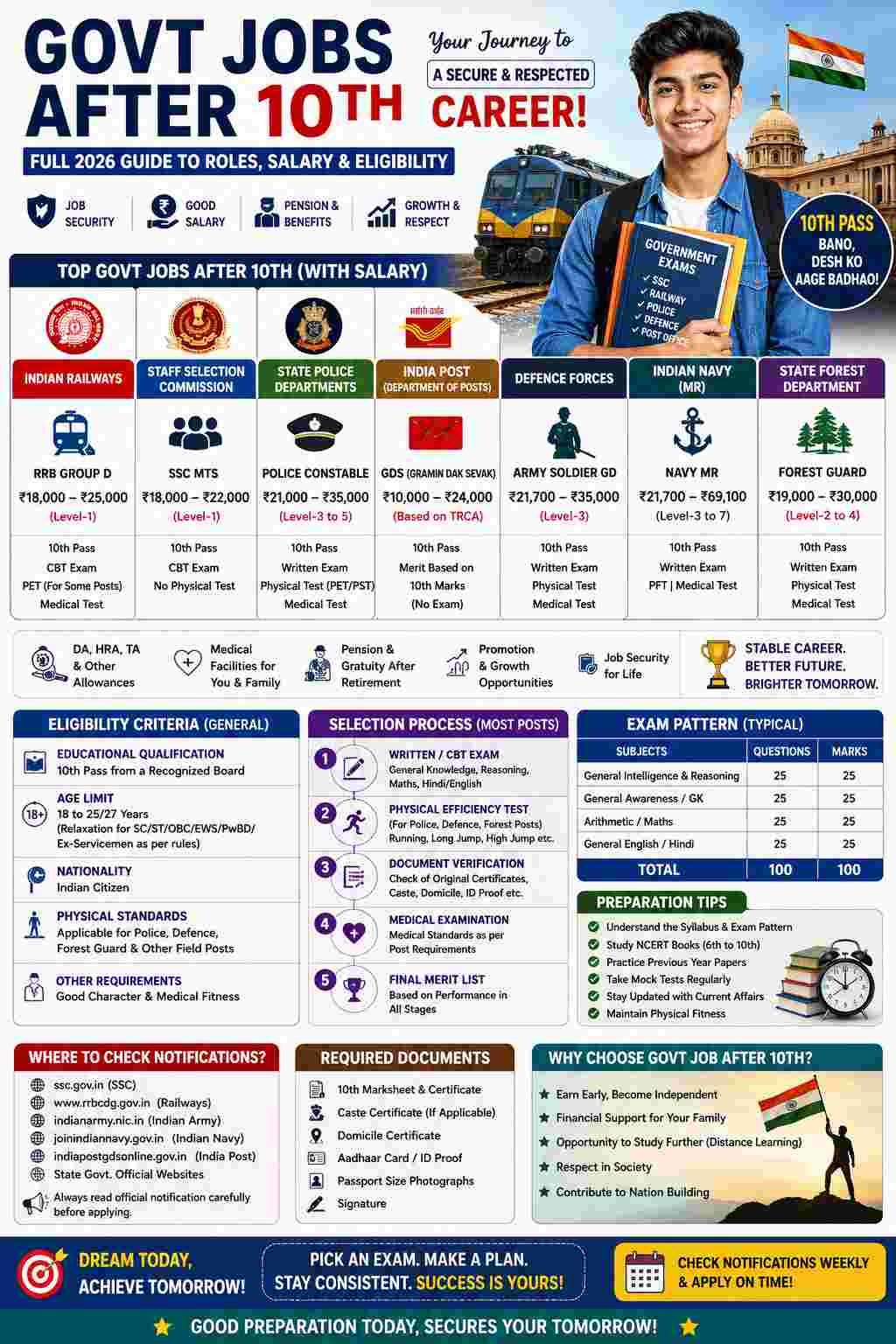
Looking for govt jobs after 10th in 2026? Get the full list of Railway, SSC, Police & Postal openings with salary, eligibility, and how to apply.
Most people assume a government job needs at least a bachelor’s degree. It doesn’t. If you’ve just finished Class 10, there’s already a real path in front of you — Railways alone opened over a lakh Group D vacancies in its last recruitment cycle. That’s not a typo, and it’s not an exception either. It happens almost every year.
If you’re a 10th-pass student trying to figure out what comes next, this guide is written for exactly that question. We’ll walk through the departments that actually hire at this level, what they pay, what the exams look like, and how to prepare without wasting the next six months guessing.
What’s Covered in This Guide
- Why a Govt Job After 10th Is Worth Considering
- Which Departments Actually Hire 10th-Pass Candidates
- Full List of Govt Jobs After 10th (With Salary)
- Eligibility — Age, Qualification, Physical Standards
- How Selection Actually Works
- A Realistic Preparation Plan
- Mistakes That Get Applications Rejected
- FAQs
- Final Word
Why a Govt Job After 10th Is Worth Considering
There’s a reason lakhs of students apply for these posts every single year instead of waiting for a degree. A government job at this stage isn’t a fallback option — for a lot of families, it’s genuinely the smarter move.
Here’s what you actually get:
- A paycheck years earlier than someone still finishing college
- Job security that private-sector entry roles rarely match
- Pension and long-term financial protection
- Room to study further — plenty of people do graduation through distance learning while already working
- Respect in the community, especially outside big metro cities
If you’re weighing this against other early income options, it’s worth comparing what’s out there — some students also explore online jobs for students without investment alongside exam prep to cover expenses while they study.
Which Departments Actually Hire 10th-Pass Candidates
Before jumping into the list, it helps to know where the real volume of hiring happens.
Indian Railways
RRB is, hands down, the biggest recruiter at this level. Group D notifications regularly cross 20,000+ posts in a single cycle, and the pattern repeats almost every year. If this is your target, our detailed railway recruitment guide for 10th pass candidates breaks down the exam stage by stage.
SSC (Staff Selection Commission)
SSC MTS is often called the easiest central government exam to clear — not because it’s simple, but because the syllabus is limited and predictable if you actually study it.
Defence Forces
The Army takes 10th-pass candidates under the Soldier GD category. If you’re also open to shorter-service options, it’s worth looking into Territorial Army recruitment as a parallel path.
Police Departments
State police forces recruit constables straight out of Class 10 in most states, though these posts are among the most competitive because of how many people apply. If you’re in the NCR belt, check region-specific notices like Ghaziabad Police Constable Bharti eligibility.
Postal Department
India Post fills Gramin Dak Sevak (GDS) posts based on your Class 10 marks — no written exam involved, which makes it one of the least stressful options on this list.
State-Level Openings
Don’t ignore your own state. UP alone runs multiple 10th-pass drives through UPSSSC — for instance, UPSSSC Forest Guard eligibility and region-wise vacancy lists like the UPSSSC Meerut Zone vacancy update. It’s also worth bookmarking our broader state government jobs 2026 roundup since new state notices go up throughout the year.
Full List of Govt Jobs After 10th (With Salary)
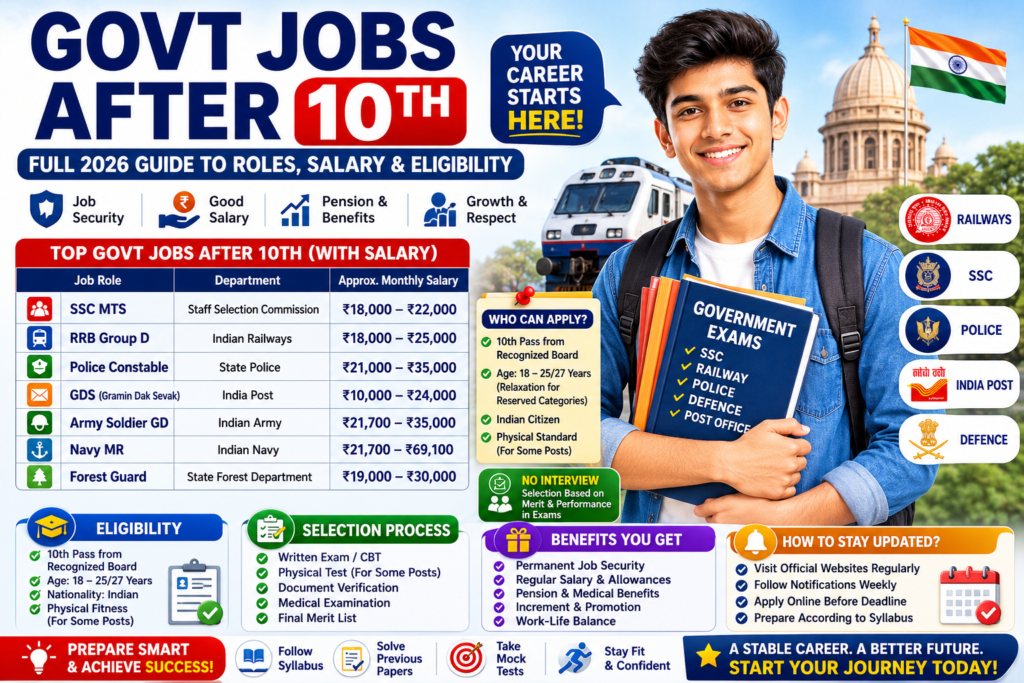
Here’s the honest picture of pay across the major roles, based on 7th Pay Commission levels:
| Job Role | Department | Approx. Monthly Salary |
|---|---|---|
| SSC MTS | Staff Selection Commission | ₹18,000 – ₹22,000 |
| RRB Group D | Indian Railways | ₹18,000 – ₹25,000 |
| Police Constable | State Police | ₹21,000 – ₹35,000 |
| GDS (Gramin Dak Sevak) | India Post | ₹10,000 – ₹24,000 |
| Army Soldier GD | Indian Army | ₹21,700 – ₹35,000 |
| Navy MR | Indian Navy | ₹21,700 – ₹69,100 |
| Forest Guard | State Forest Department | ₹19,000 – ₹30,000 |
A quick note on numbers: these are approximate ranges, and actual figures depend on your posting location, allowances, and the specific notification. Always check the official PDF before you plan your finances around a number you saw on a blog.
If your long-term goal is a higher pay bracket, it’s worth mapping out the route now — our list of government jobs with salary above ₹50,000 shows what’s realistically achievable after a few years of experience or further qualification.
Eligibility — Age, Qualification, Physical Standards
Every post has its own fine print, but the broad rules stay fairly consistent.
Educational Qualification
You need a Class 10 pass certificate from a recognized board. That’s it for most roles — some, like GDS, also want basic computer literacy.
Age Limit
Most notifications set the minimum at 18 years. The upper limit usually sits between 25 and 27, and category-based relaxation (SC/ST/OBC/EWS/PwBD/ex-servicemen) can push that further.
Physical Standards
If you’re going for police, defence, or forest guard roles, expect height, chest, and running requirements. Desk-based posts like SSC MTS and GDS skip this entirely.
One thing worth flagging: eligibility rules genuinely change between notifications, even for the same post in consecutive years. Don’t rely on last year’s numbers.
How Selection Actually Works
Most people overthink this part. The process, stripped down, looks like this:
- Written or computer-based exam — general knowledge, reasoning, basic math, and language
- Physical Efficiency Test — only for police, defence, and field posts
- Document verification — your marksheets and category certificates get checked
- Medical exam — mandatory for physically demanding roles
- Final merit list
There’s usually no interview at this level. That’s actually good news — it means your entire result rides on how well you perform on the written test, not how you present yourself in a room. Prepare for the paper, and the rest tends to fall into place.
A Realistic Preparation Plan
Cracking these exams isn’t about studying harder than everyone else. It’s about studying the right things, consistently, for long enough.
- Pick one exam and commit to it first. SSC MTS and RRB Group D don’t share the exact same syllabus — don’t prep for both at once until you’ve built a base.
- Pull the official syllabus PDF. Not a summary from some random site — the actual document from the recruiting body.
- Set a daily routine. Math, reasoning, GK, and language, in fixed blocks, every day.
- Work through previous papers. This is where you actually learn the question patterns, not from theory alone.
- Take timed mock tests. Speed under pressure is a separate skill from knowing the answer.
- Start fitness training early if you’re aiming for police or defence. Running stamina takes months to build, not weeks.
- Check notifications weekly. Vacancies don’t wait for you to be ready.
Once you’re closer to actually applying and interviewing (some state-level posts still involve a short interaction), it helps to have your basics sorted — things like how to write a resume and how to answer “tell me about yourself” come in handy even for government roles that involve any kind of verification interview.
Mistakes That Get Applications Rejected
A lot of rejections have nothing to do with ability. They happen because of avoidable errors:
- Applying without actually reading the full notification
- Missing category-based age relaxation you were eligible for
- Skipping physical fitness prep and failing the PET despite clearing the written exam
- Studying from an outdated syllabus after a pattern revision
- Missing the application deadline because you weren’t tracking it
Read the notification twice before you fill the form. It sounds basic, but it’s the single biggest reason people get disqualified at the eligibility stage.
For the official word on any of these exams, always cross-check against the source directly — the Staff Selection Commission’s official website and the Indian Railways recruitment portal publish every notification, syllabus update, and result before anyone else does.
FAQs
1. What are the best govt jobs after 10th right now?
SSC MTS, RRB Group D, Police Constable, Army Soldier GD, and Post Office GDS remain the most accessible and highest-volume options for 10th-pass candidates.
2. Is there a govt job after 10th with no exam?
Yes — GDS selection runs purely on your Class 10 marks, no written test needed. Some Anganwadi Worker posts follow a similar merit-based process; check our Anganwadi recruitment guide for details.
3. What’s the minimum age for these jobs?
Usually 18 years, with upper limits between 25 and 27, and further relaxation for reserved categories.
4. Can girls apply for govt jobs after 10th?
Yes. SSC MTS, Post Office roles, Coast Guard Navik GD, and several state police vacancies are open to female candidates, with specific posts marked in each notification.
5. Which 10th-pass govt job pays the most?
Navy MR (Matric Recruit) posts tend to offer the strongest long-term pay growth among 10th-pass roles.
6. Do I need paid coaching to clear these exams?
Not really. Self-study with NCERT basics, previous papers, and free mock tests works for most people — what matters more is consistency than the money spent.
7. What if I want to wait for 12th instead?
That’s a fair call too, and it opens up more options. Take a look at our guide on government jobs after 12th or the state-specific 12th pass jobs in Uttar Pradesh list to compare.
Final Word
A government job after 10th isn’t a lesser path — for a huge number of people, it’s the fastest route to a stable income and a respected career. The departments are hiring, the vacancies are real, and the syllabus for most of these exams is manageable if you actually put in structured time.
Pick one exam this week. Download its syllabus. Set a study schedule you can realistically stick to. That’s genuinely how most successful candidates started — not with some special advantage, just with a decision to begin.
govt jobs after 10th, 10th pass government jobs, SSC MTS eligibility, RRB Group D vacancy, police constable recruitment 2026, Indian Army Soldier GD, Post Office GDS, sarkari naukri after 10th, state government jobs 2026, railway recruitment 2026