
Introduction
Most people leave money on the table simply because they never ask. Studies on salary negotiation consistently show that the majority of people who negotiate their pay or benefits end up getting at least some of what they requested — yet less than half of workers actually try.
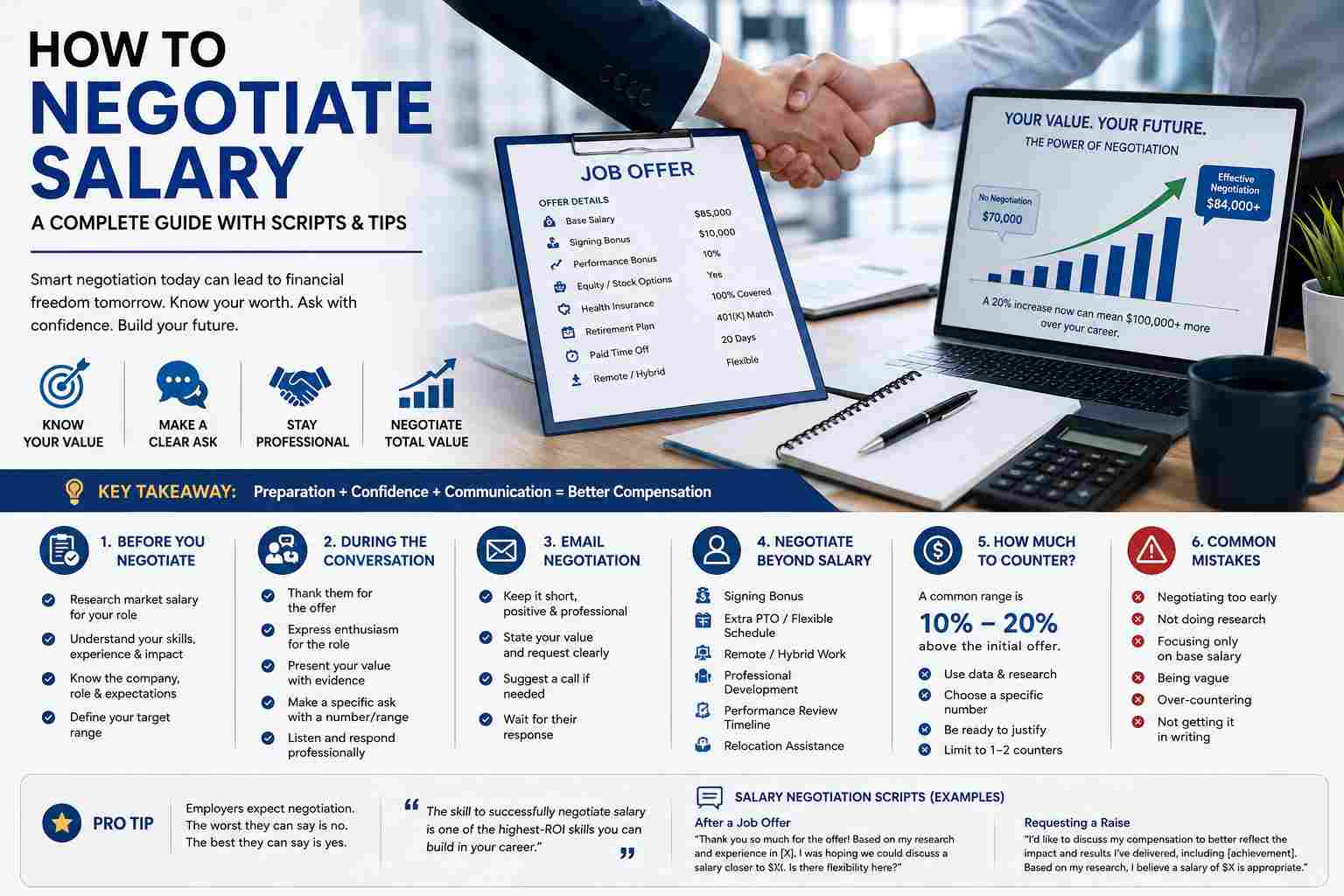
If you’ve ever wondered how to negotiate salary without sounding pushy, awkward, or ungrateful, you’re not alone. Whether you’re responding to a new job offer, emailing HR, working with a recruiter, or asking for a raise in your current role, the process follows the same core principles: know your worth, make a clear ask, and stay professional.
Before you even get to the negotiation stage, though, you need a strong application and interview to land the offer in the first place. If you haven’t polished those yet, start with our guides on how to write a resume and how to answer “Tell Me About Yourself” — they’ll set you up to negotiate from a position of strength.
This guide walks you through exactly what to say, when to say it, and how to handle pushback — with real scripts you can copy and adapt.
Table of Contents
- Why Salary Negotiation Matters
- How to Negotiate Salary After a Job Offer
- How to Negotiate Salary via Email (With Templates)
- How to Negotiate Salary With a Recruiter
- How to Negotiate Salary for a Raise
- What to Do When Salary Is “Non-Negotiable”
- Negotiating Beyond Base Pay: Total Compensation
- How Much Should You Counter?
- Salary Negotiation Questions to Ask
- Common Mistakes to Avoid
- FAQ
- Conclusion
Why Salary Negotiation Matters
A single successful negotiation can be worth far more than one paycheck. Because raises, bonuses, and future offers are often calculated as a percentage of your current salary, a lower starting number compounds year after year.
As a result, learning how to negotiate salary early in your career — and every time you get an offer — pays off exponentially over time. Employers generally expect it, too. Most hiring managers build some flexibility into their initial offer specifically because they anticipate a counter.
For a deeper look at how negotiation experts approach this from the employer’s side, Harvard Law School’s Program on Negotiation has a detailed breakdown worth reading: How to Negotiate a Higher Salary After a Job Offer.
Takeaway: Not negotiating isn’t “playing it safe” — it’s a decision that quietly costs you money for years.
How to Negotiate Salary After a Job Offer
Timing is everything. The best time to negotiate is after you have a written offer — this is when you have the most leverage, because the company has already decided you’re the right fit.
Step-by-Step Process
- Say thank you first. Express genuine enthusiasm before discussing numbers.
- Ask for time. A simple “Can I take 24–48 hours to review this?” is completely normal.
- Do your research. Check salary data for your role, experience level, and location.
- Lead with value, not need. Explain why you deserve more based on skills and impact — not personal expenses.
- Give a specific number or narrow range. Precise numbers (e.g., $82,500) tend to be taken more seriously than round ones.
- Get the final agreement in writing.
Sample Script
“Thank you so much for the offer — I’m genuinely excited about this role. Based on my research into similar positions and my experience with [specific skill], I was hoping we could discuss a salary closer to $X. Is there flexibility here?”
Pro Tip: Never negotiate before you have an offer in hand. Doing so too early can anchor the conversation lower than the employer intended.
If this offer is for a government role, keep in mind that pay scales work differently — check our guides on government jobs for fresh graduates and state government jobs 2026 to understand how those pay structures are typically set.
How to Negotiate Salary via Email
Email negotiation gives you time to word things carefully — and creates a paper trail. It works well when you’re not comfortable negotiating live, or when the offer was sent in writing.
Salary Negotiation Email Sample
Subject: Following Up on [Job Title] Offer
Hi [Name],
Thank you again for offering me the [Job Title] position — I’m excited about the opportunity to join [Company].
After reviewing the offer and researching market rates for similar roles in [location/industry], I’d like to discuss the base salary. Given my [X years] of experience and background in [specific skill/achievement], I was hoping we could find a number closer to $X.
I’m confident I can bring strong value to the team, and I’m happy to jump on a call if that’s easier to discuss.
Thanks again for your consideration.
Best,
[Your Name]
Takeaway: Keep the email short, specific, and positive — save the detailed justification for a live conversation if they ask.
How to Negotiate Salary With a Recruiter
Recruiters are not your opponents — they typically want you to accept the job, too, because it reflects well on them. Use this to your advantage.
- Be upfront about your target range early in the process.
- Ask the recruiter directly: “Is there room to negotiate on this offer?”
- Let them advocate for you — they often know more about internal flexibility than you’d expect.
- Avoid inflating your current salary; many companies verify this, and it can damage trust.
Pro Tip: Recruiters can often unlock non-salary perks (signing bonus, extra PTO, remote flexibility) even when base pay is fixed. If flexible or remote work matters most to you, browse flexible schedule jobs near me or no-experience remote jobs to see what’s realistic to ask for in your industry.
How to Negotiate Salary for a Raise
Negotiating with a current employer is different from negotiating a new offer — you already have a relationship and a track record to lean on.
When to Ask
- After completing a major project
- During or shortly after your annual review
- After taking on new responsibilities
- After earning a certification or advanced skill
What to Say
“I’d like to discuss my compensation to better reflect the scope of my current responsibilities and the results I’ve delivered, including [specific achievement]. Based on my research, I believe a salary in the range of $X would be appropriate.”
Takeaway: Document your wins as they happen — you’ll need concrete, measurable examples when the conversation happens.
What to Do When Salary Is “Non-Negotiable” {#non-negotiable-salary}
Some employers — especially government agencies, unionized roles, or large corporations with strict pay bands — genuinely can’t move on base salary. This is common in roles like railway recruitment, central government jobs, and government jobs after 12th, where pay follows a fixed scale. That doesn’t mean the conversation is over.
Ask about:
- Signing bonus negotiation
- Additional PTO or flexible scheduling
- An accelerated performance review (e.g., a 90-day raise review instead of waiting a year)
- Remote work or hybrid flexibility
- Professional development budget or tuition reimbursement
- Placement at a higher step within a fixed pay scale
Takeaway: When the number is fixed, shift the conversation to total value, not just the paycheck.
Negotiating Beyond Base Pay: Total Compensation {#total-compensation}
Thinking only about base salary is one of the most common negotiation mistakes. A complete compensation package includes:
- Signing and performance bonuses
- Equity or stock options
- Health insurance and retirement contributions
- Paid time off
- Remote/hybrid work arrangements
- Relocation assistance
- Professional development support
Comparing two offers on base salary alone can be misleading — a slightly lower salary with better long-term perks or equity can be worth more over time. If you’re weighing an hourly role against a salaried one, our breakdown of jobs that pay $30 an hour without a degree can help you compare apples to apples.
Takeaway: Always ask “Is this base salary or total compensation?” before comparing offers.
How Much Should You Counter? {#how-much-to-counter}
There’s no universal answer, but a common approach is countering 10–20% above the initial offer, then settling somewhere in the middle. To land on the right number:
- Use a salary negotiation calculator or salary comparison tool (Glassdoor, Payscale, Levels.fyi) to find your market range.
- Factor in your experience, location, and specialized skills.
- Choose a specific number, not a round one — it signals you’ve done real research.
- Prepare a maximum of two counters; going back and forth repeatedly can frustrate the employer.
Indeed’s career advice team has a solid step-by-step breakdown of this process if you want a second reference point: How to Negotiate Salary After a Job Offer (Indeed).
Salary Negotiation Questions to Ask {#questions-to-ask}
Asking the right questions shows you’re informed and engaged — not just chasing a bigger number.
- “Is this figure base salary or total compensation?”
- “Is there flexibility in the base salary?”
- “What does the bonus structure look like, and how is it calculated?”
- “When is the first performance and pay review?”
- “Are there other levers we can pull, like signing bonus or PTO?”
- “Is the salary range for this role public or available upon request?”
Takeaway: Good questions often reveal flexibility you wouldn’t have known to ask for directly.
Common Mistakes to Avoid {#common-mistakes}
- Negotiating too early, before you have a written offer
- Skipping research and guessing at your market value
- Focusing only on base pay instead of total compensation
- Being vague (“I was hoping for more”) instead of specific
- Over-countering more than once or twice
- Not getting the final agreement in writing
- Lying about competing offers or your current salary
Takeaway: Most negotiation failures come from poor preparation, not poor delivery.
FAQ
1. What’s the best way to start a salary negotiation conversation?
Thank the employer for the offer, express enthusiasm, then ask if there’s flexibility before naming your target number.
2. Is it okay to negotiate salary over email?
Yes. Email is appropriate, especially if the original offer was sent in writing — just keep it concise and follow up with a call if needed.
3. How do I know if a company’s “final offer” is really final?
Ask directly: “Is there any room to revisit this?” If they say no, pivot to negotiating non-salary benefits instead.
4. Can negotiating salary cost me the job offer?
It’s rare if you’re professional and reasonable. Employers generally expect some negotiation and won’t rescind an offer over a respectful counter.
5. How much more should I ask for than the initial offer?
A common range is 10–20% above the initial number, adjusted based on your research and the employer’s likely flexibility.
6. What if I don’t have a competing offer to leverage?
You can still negotiate based on market research, your specific skills, and the value you bring — a competing offer helps, but it isn’t required.
7. Should I negotiate salary for an internal promotion the same way?
Yes, though you can lean more heavily on your track record and specific results within the company rather than external market comparisons alone.
Conclusion
Knowing how to negotiate salary isn’t about being aggressive — it’s about being prepared, specific, and professional. Whether you’re countering a job offer, sending a negotiation email, working with a recruiter, or asking for a raise, the same formula applies: research your value, ask clearly, and be ready to talk about total compensation, not just the base number.
The conversation might feel uncomfortable for five minutes. The result can benefit you for years. Start preparing your ask today — your future paycheck will thank you.
If you’re still job hunting before you even get to the negotiation table, check out our related guides: latest government jobs for 12th pass in 2026, how to get a job in Google for commerce students, and how to get a job in the USA from India.
Suggested Tags/Keywords:
how to negotiate salary, how to negotiate salary after a job offer, how to negotiate salary via email, how to negotiate salary with a recruiter, how to negotiate salary for a raise, salary negotiation scripts, salary negotiation examples, salary negotiation tips, salary negotiation email sample, what to say when negotiating salary, how much to counter a salary offer, salary negotiation questions to ask, negotiating salary and benefits, salary negotiation strategies, how to ask for a higher salary, salary counteroffer examples, how to negotiate a raise, signing bonus negotiation, total compensation negotiation, salary negotiation calculator
4 thoughts on “How to Negotiate Salary: A Complete Guide With Scripts & Tips”