
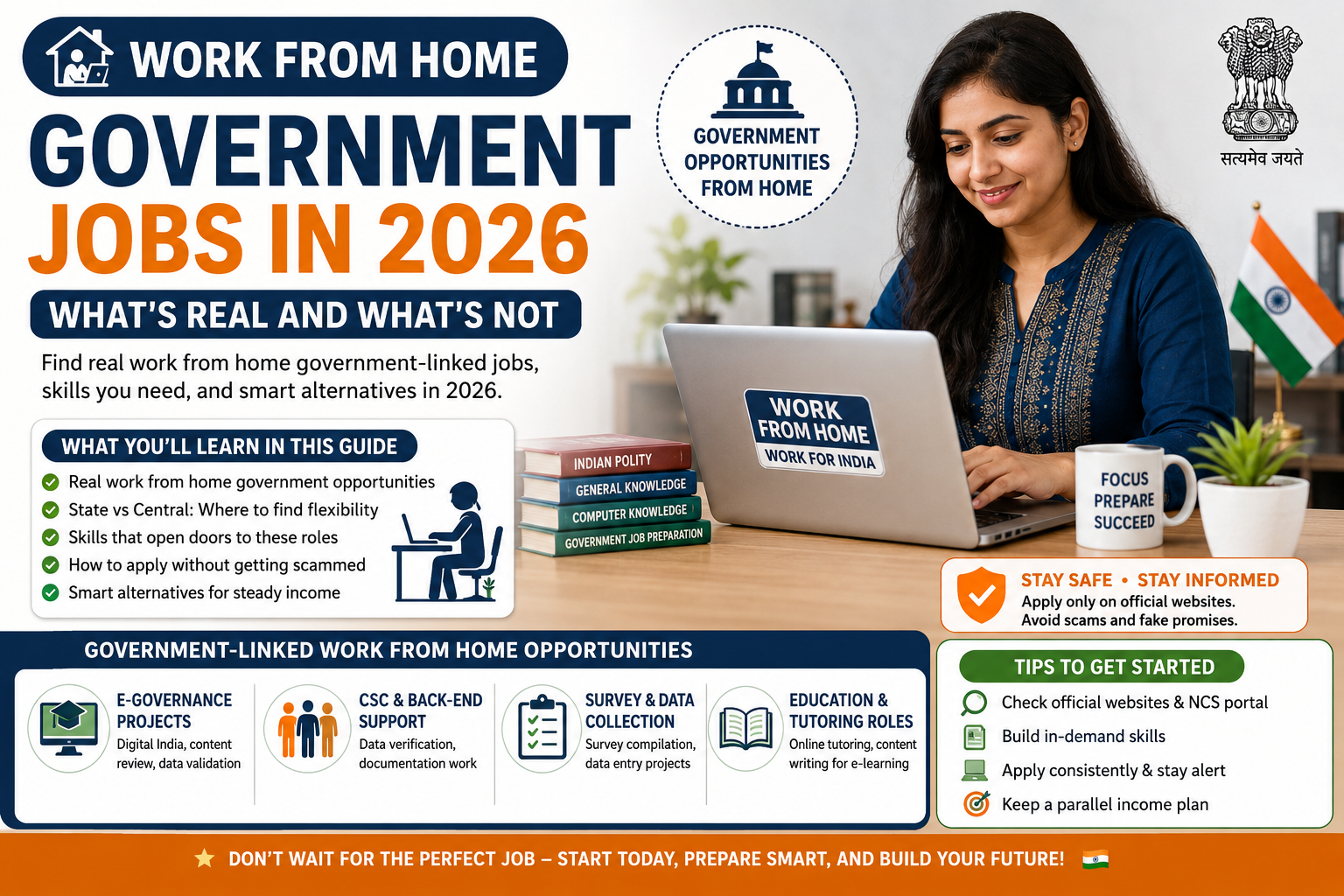
Confused about work from home government jobs in India? Here’s the honest truth, real alternatives, and where to actually find them in 2026.
If you’ve typed “work from home government jobs” into Google recently, you’ve probably landed on a dozen pages promising thousands of remote sarkari vacancies. Then you click through and… nothing. No listings, no apply link, just ads.
Here’s the truth nobody likes to say upfront: fully remote, permanent government jobs are still rare in India. Most sarkari posts require you to sit for an exam, attend an interview in person, and report to a physical duty station once selected — whether that’s a bank branch, a railway zone, or a government office. That’s just how recruitment through UPSC, SSC, IBPS, and state PSCs works right now.
But that doesn’t mean your search is a waste of time. There’s a real, working middle ground — government-linked schemes, digital initiatives, and semi-government roles that genuinely let you work from home, plus a whole category of remote jobs that pay just as well and don’t ask you to wait for an exam calendar. This article walks you through both, honestly, so you stop wasting time on pages that lead nowhere.
Table of Contents
- Why “Work From Home Government Jobs” Search Results Are Misleading
- Government-Linked Jobs That Actually Offer Remote or Home-Based Work
- State vs Central: Where You’re More Likely to Find Flexibility
- Skills That Open Doors to These Roles
- How to Apply Without Getting Scammed
- Smart Alternatives If Sarkari Naukri Isn’t Working Out Yet
- FAQ
- Conclusion
Why “Work From Home Government Jobs” Search Results Are Misleading
Let’s get this out of the way first, because it’ll save you a lot of frustration.
Most large sarkari job portals openly admit there are no active work-from-home government vacancies at any given time. That’s not a glitch — it reflects how Indian government recruitment is actually structured. Central government jobs go through UPSC, SSC, RRB, and IBPS, and almost all of them are tied to a physical office, branch, or field posting once you clear the exam and interview.
So when you see a headline promising “5000+ remote government jobs,” treat it the way you’d treat any clickbait — with a healthy dose of doubt. Genuine notifications are published only on official department websites and on the National Career Service portal run by the Ministry of Labour and Employment. If a listing isn’t there or on the hiring department’s own site, it isn’t real.
None of this means government-adjacent remote work doesn’t exist. It just means you need to know exactly where to look — which is what the rest of this guide is for.
Government-Linked Jobs That Actually Offer Remote or Home-Based Work
A handful of categories genuinely let you work from home while being connected to a government scheme, project, or department. They’re not glamorous, and they’re usually contractual rather than permanent, but they’re real.
Digital literacy and e-governance projects. Programmes run under initiatives like Digital India occasionally hire trainers, content reviewers, and data validators who work remotely on a project basis. These roles are usually posted by the implementing agency, not by a central recruitment board, so you have to track the specific project rather than a single portal.
Common Service Centre (CSC) linked work. CSC operators handle a mix of government services, and some back-end roles — like data verification or documentation support — can be done from home once you’re empanelled, though the front-facing CSC work itself typically needs a physical centre.
Government survey and data collection projects. Ministries occasionally outsource data entry, survey compilation, or content moderation for public portals to contractual staff. These postings show up under specific project names, not under a general “remote jobs” tag, so free data entry jobs from home type searches combined with the department’s name tend to work better than generic search terms.
Online tutoring and content roles under education schemes. State education departments and PSUs sometimes bring in home-based content writers, subject matter experts, or online tutors for e-learning platforms, particularly around exam season.
Pro Tip
Don’t wait for a job board to label something “work from home.” Go directly to the careers or tenders page of the specific ministry, PSU, or state department you’re interested in. Most home-based government-linked work is posted as a short-term tender or project hire, not as a standard recruitment notification.
State vs Central: Where You’re More Likely to Find Flexibility
Central government recruitment through UPSC, SSC, and Railways is rigid by design — postings are pan-India, and physical presence is almost always required. State governments, on the other hand, sometimes have more room to experiment, especially for roles tied to digital service delivery, health data, or education outreach.
If you’re open to state-level opportunities, it’s worth tracking state government jobs for 2026 closely, since individual states publish their own notifications and eligibility criteria separately from central boards. Some states have also started running home-based helpline and grievance-redressal roles for citizen services, particularly for women and persons with disabilities — worth checking your state’s official employment or e-governance department page directly.
Skills That Open Doors to These Roles
Whether you’re chasing a government-linked contractual role or a private-sector remote job with a public-service flavour, the same core skills come up again and again:
- Typing speed and data accuracy — most home-based government-linked work involves data entry, verification, or documentation
- Basic computer literacy — MS Office, Google Workspace, and simple database tools
- Regional language proficiency — a major advantage for content, survey, and helpline roles
- Communication skills — especially for tutoring, helpline, or citizen-support positions
If you’re still building these up, it’s worth spending time on the fundamentals — a properly written resume matters just as much for a government contractual role as it does for a private job, so don’t skip learning how to write a resume that actually gets shortlisted.
How to Apply Without Getting Scammed
This space attracts scammers precisely because “government job” sounds trustworthy. A few rules will keep you safe:
- Never pay a fee for a government application, admit card, or “guaranteed selection.” Legitimate recruitment is free or charges a small, official exam fee only through the department’s own payment gateway.
- Cross-check every listing on the hiring department’s official website before applying anywhere else.
- Be suspicious of urgency — messages that pressure you to “apply within 2 hours” or “pay now to lock your seat” are almost always fake.
- Don’t share your Aadhaar, bank details, or OTPs with anyone claiming to process your application over WhatsApp or a phone call.
If in doubt, search the exact job title along with the department’s name and “official notification” before you do anything else.
Smart Alternatives If Sarkari Naukri Isn’t Working Out Yet
While you keep an eye on government openings, it makes sense to build a parallel plan — especially if income matters right now, not just eventually.
Plenty of legitimate remote jobs don’t require government exam clearance and are open to freshers. If you’re just starting out, browsing remote jobs with no experience required is a far faster route to actual income than waiting on a sarkari result. Students and early-career candidates juggling studies can also look at ways to earn online from a mobile phone without any investment, which won’t replace a government salary but can bridge the gap while you prepare.
If your priority is flexibility rather than a government tag specifically, it’s worth exploring flexible schedule jobs near you — many private employers now offer hybrid or output-based work that’s easier to combine with exam preparation than a rigid 9-to-5.
And if you’re a fresher targeting government roles specifically, don’t limit yourself to remote listings alone — government jobs for fresh graduates and central government jobs that don’t require prior experience open up a much wider pool, and many of these come with strong long-term stability even if the first year or two isn’t remote.
Takeaway: Treat remote government work as one lane in your job search, not the only one — the fastest path to income right now might be a hybrid or private-sector role while you keep applying for sarkari posts in parallel.
FAQ
Are there any 100% work from home government jobs in India right now?
Very few, and they tend to be short-term, contractual, or project-based rather than permanent sarkari posts. Most permanent government recruitment still requires you to work from a physical office or duty station.
Where can I check if a work-from-home government job listing is genuine?
Check the official department or ministry website directly, or the National Career Service portal. If a listing only appears on a random blog with no official notification link, treat it as unverified.
Do state governments offer more remote roles than central government?
Sometimes. States occasionally run home-based helpline, education, or data-related roles tied to specific schemes, so it’s worth tracking your own state’s notifications separately from central boards.
Can I do data entry work for a government department from home?
Occasionally, yes — usually through contractual or project-based hiring rather than a standing vacancy. These are typically posted under the specific project name rather than a general “remote jobs” category.
Is it safe to pay a fee for a work-from-home government job application?
No legitimate government job ever charges a fee for “guaranteed selection” or fast processing. If you’re asked to pay outside the department’s official exam fee gateway, it’s a scam.
Should I stop applying to office-based government jobs and wait for a remote one?
Not a good strategy. Genuine remote government openings are limited and unpredictable, so continuing to apply for standard sarkari vacancies — while exploring remote private-sector options on the side — gives you a much better shot at steady income.
Conclusion
The honest picture is this: dedicated, permanent work from home government jobs are still uncommon in India, and most of what ranks for that search term online is either outdated or misleading. What does exist is scattered across contractual e-governance projects, state-run digital initiatives, and CSC-linked back-end work — and finding it takes checking official department pages directly, not relying on generic job boards.
Your best move right now is a two-track approach: keep applying to standard sarkari vacancies through verified sources, and build a parallel income stream through legitimate remote work while you wait. Start today — pick one government department’s official careers page and one remote job board from this guide, and apply to something from each within the week.
Suggested Tags/Keywords
work from home government jobs, remote sarkari naukri, government jobs from home India, state government jobs 2026, central government jobs without experience, remote jobs no experience, data entry jobs from home 2026, sarkari naukri 2026, government jobs for freshers, CSC work from home