
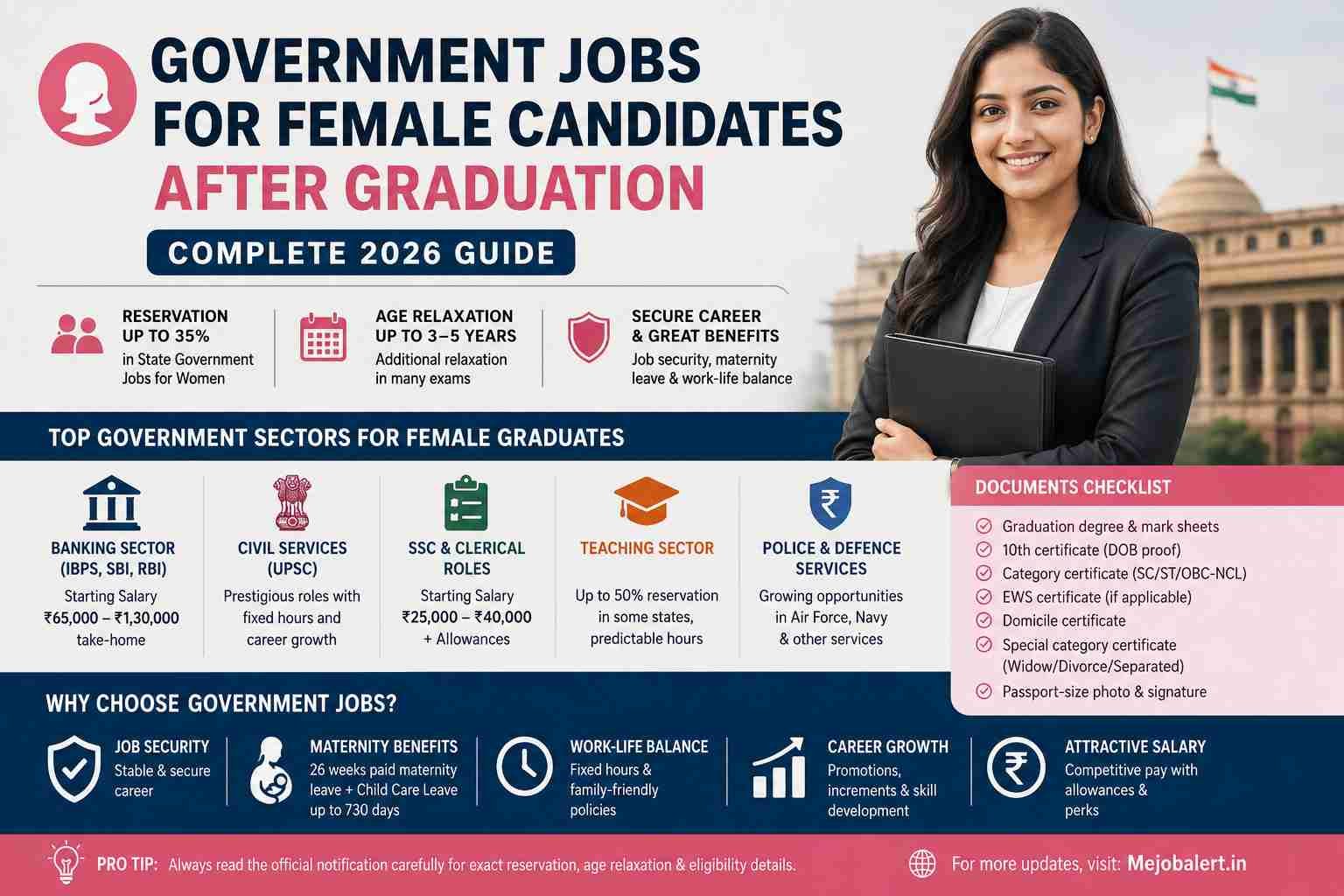
If you’ve just finished your graduation and are wondering where to start your government job search, here’s some good news: several states now offer up to 35% reservation for women in state-level services, and central departments continue expanding women-only recruitment drives every year. Government jobs for female candidates after graduation aren’t just about stability anymore — they’ve become one of the fastest-growing career paths for Indian women.
You probably have specific questions: Which departments actually reserve seats for women? What age relaxation applies to you? Which sector pays well and offers real work-life balance? This guide walks you through all of it, with real numbers and a clear action plan.
Table of Contents
- Why Government Jobs Are a Smart Choice After Graduation
- Reservation and Quota Benefits for Women
- Age Relaxation Rules You Should Know
- Top Government Sectors for Female Graduates
- Documents and Eligibility Checklist
- How to Choose the Right Path for You
- Common Mistakes to Avoid
- FAQs
- Conclusion
Why Government Jobs Are a Smart Choice After Graduation
Government jobs for female candidates after graduation offer something most private-sector roles simply can’t match: predictable hours, legal job security, and structured career growth. Beyond traditional roles, the current recruitment cycle emphasizes technical and leadership positions, supported by welfare schemes and special age relaxations for women in many competitive exams.
Furthermore, most central government roles come with generous benefits. Central government women employees get 26 weeks (180 days) of fully paid maternity leave under the Maternity Benefit Act, plus Child Care Leave of up to 730 days cumulative until the child turns 18 — one of the most generous policies globally.
In other words, this isn’t just about a paycheck. It’s about building a career that can genuinely coexist with the rest of your life. If you’re still weighing your options, our guide to government jobs for fresh graduates is a good starting point before you narrow down a sector.
Takeaway: A government career after graduation gives you security, benefits, and growth that are hard to replicate in most private jobs.
Reservation and Quota Benefits for Women
This is where most graduates get confused, so let’s break it down clearly.
State-Level Reservation
As of 2026, states like Bihar and Madhya Pradesh lead with 35% reservation for women in most state-level government jobs, and some states reserve 50% of seats for women in the teaching sector. As a result, if you’re open to state government roles, your odds improve significantly compared to central-only applications. Browse our full roundup of state government jobs 2026 to see which states currently offer the strongest women’s quotas.
Central-Level Reality
Here’s something important to understand: for most central services — UPSC, SSC, Banking, Railway, Income Tax — there is no women-specific reservation, and selection is purely merit-based. However, dedicated reservation does exist in specific roles like police constable posts (30–33% in most states) and Mahila Anganwadi Worker positions (100% reserved for women). If central roles interest you regardless of quota, check our guide to central government jobs without experience for entry points that don’t require prior work history.
Special Sub-Categories
Certain SSC and state PSC exams also offer age relaxation and reservation sub-quotas for widows, divorced women, and women judicially separated and not remarried — a benefit many candidates don’t know exists.
Pro Tip: Don’t assume “women’s reservation” applies everywhere. Always read the reservation section of the specific notification line by line — the rules genuinely differ by exam and state.
You can verify current reservation rules directly through the Department of Personnel and Training’s official guidelines, which govern central recruitment policy.
Takeaway: State government jobs currently offer far stronger reservation benefits for women than most central-level exams.
Age Relaxation Rules You Should Know
Age relaxation and reservation are two separate systems, and mixing them up is one of the most common mistakes graduates make.
Standard Relaxation for Women
Women candidates receive age relaxation in several government exams — generally, women get an additional 3 years’ relaxation in exams like UPSC CSE, SSC CGL, and various state government examinations. This is on top of any category-based relaxation (SC/ST get 5 years, OBC-NCL gets 3 years) you may already be entitled to.
Combined Relaxation Example
If a general category woman gets 3 extra years and she also belongs to the OBC category (which adds another 3 years), she may be able to combine both — but this must be confirmed in the specific notification, since combined relaxation rules vary by exam body.
Special Categories
The Department of Personnel and Training provides a specific guideline allowing age relaxation up to 35 years (38 for SC/ST candidates) for widows, divorced women, and women judicially separated and not remarried, applicable for Group C and Group D central government posts. You can cross-check exact figures on the Staff Selection Commission’s official website, which publishes category-wise relaxation tables with every notification.
Takeaway: Always check your exact age relaxation eligibility against the specific notification — never assume a blanket rule applies across all exams.
Top Government Sectors for Female Graduates
Now let’s get practical. Where should you actually apply?
1. Banking Sector (IBPS, SBI, RBI)
Banking is one of the most women-friendly government sectors. RBI Grade B, SBI PO, NABARD Grade A, and IBPS PO all see strong women applicant pools, with pay starting at ₹65,000–₹1,30,000 take-home depending on the bank. Branch banking work typically has fixed hours and transfers every 3–5 years, making it easier to plan long-term.
2. Civil Services (UPSC)
This remains the most prestigious entry, open to all women graduates aged 21–32 with standard reservation relaxations. Recent UPSC batches have averaged around 32% women, and the role itself accommodates women well with fixed office hours and transferable maternity benefits.
3. SSC and Clerical Roles
For graduates seeking quicker entry, SSC CGL and SSC CHSL remain popular, offering roles across ministries and departments with starting salaries generally between ₹25,000–₹40,000, plus HRA and medical allowances. For a broader list of current openings, our Sarkari Naukri 2026 hub is updated regularly.
4. Teaching Sector
With some states reserving up to 50% of teaching seats for women, this sector combines strong reservation benefits with predictable working hours — ideal if you’re also planning around family responsibilities.
5. Police and Defence Services
All Indian Air Force branches, including fighter flying, are now open to women, and the Navy has opened submarine duty for women officers as well. However, combat arms like Infantry, Armoured Corps, and Artillery remain men-only as of now. Railways is another strong option worth exploring — our complete railway recruitment guide for freshers covers eligibility and posts across zones.
Pro Tip: Don’t skip physical preparation if you’re targeting police or defense roles. Even with relaxed standards for women, these exams include mandatory physical tests, and candidates who ignore running and fitness training often fail at this stage.
Takeaway: Banking and teaching currently offer the best blend of women-friendly policies and strong entry-level pay for fresh graduates.
Documents and Eligibility Checklist
Before you start applying, keep these ready:
- Graduation degree/provisional certificate and mark sheets
- 10th certificate (used as the only accepted proof of date of birth for most exams)
- Category certificate (SC/ST/OBC-NCL), if applicable — note that OBC-NCL certificates must be renewed annually
- EWS certificate, if applicable (remember: EWS gets reservation but no age relaxation)
- Domicile certificate for state-level recruitment
- Widow/divorce/judicial separation certificate, if claiming that specific relaxation
- Passport-size photographs and signature in prescribed format
Takeaway: Keeping your category and domicile documents renewed and ready saves you from last-minute rejection during document verification.
How to Choose the Right Path for You
With so many options, here’s a simple decision framework:
- List your non-negotiables first — fixed location vs. willingness to transfer, family planning timeline, physical fitness comfort level.
- Match sectors to your priorities. Want fixed hours and urban postings? Banking. Want prestige and leadership impact? Civil services. Want strong reservation odds? State government and teaching.
- Research maternity and posting policies specifically — if you’re planning a family in the next 5–7 years, check the exact service’s maternity policy and spouse-posting provisions before committing, since IAS, IPS, and banking all differ.
- Treat “women-friendly” as one factor, not the only one. Pick a path that fits your skills and interests first, then optimize for supportive policies — a successful career genuinely trumps a merely comfortable one.
Once you’ve shortlisted your target roles, make sure your application materials are strong. Our guides on how to write a resume and how to answer “tell me about yourself” apply just as well to government interviews as private ones, and if you clear multiple offers, our salary negotiation guide can help you make the right final call.
Takeaway: The best government job for you balances your career ambitions with your real-life priorities — not just reservation percentages.
Common Mistakes to Avoid
- Ignoring physical prep for police/defence roles — relaxed standards still require training.
- Assuming reservation exists everywhere — most central services are merit-based; verify each notification.
- Using an expired OBC-NCL certificate — it must be renewed every year.
- Missing the domicile-bonus opportunity — some states stack domicile relaxation on top of category relaxation, but only if the notification permits it.
- Not verifying your DOB proof — only your 10th certificate date of birth is accepted, regardless of what your Aadhaar shows.
Takeaway: Most rejections happen from documentation errors, not lack of qualification — double-check every certificate before applying.
Frequently Asked Questions
1. Is there reservation for women in all government jobs?
No. For most central services like UPSC, SSC, and Banking, selection is purely merit-based with no women-specific reservation. Reservation exists mainly in state government roles, police constable posts, and specific positions like Mahila Anganwadi Worker.
2. How much age relaxation do women get in government exams?
Women generally get an additional 3 years’ relaxation in exams like UPSC CSE and SSC CGL, on top of any category-based relaxation they may already qualify for.
3. Which government sector is best for female graduates seeking work-life balance?
Banking and teaching are considered the most family-friendly, offering fixed hours, predictable transfers, and strong maternity support.
4. Do divorced or widowed women get special benefits in government recruitment?
Yes, many SSC and state PSC exams allow age relaxation up to 35 years (38 for SC/ST) for widows, divorced women, and judicially separated women who haven’t remarried.
5. What is the starting salary for government jobs after graduation?
Entry-level government positions typically range from ₹25,000 to ₹40,000 per month, while banking officer roles can start between ₹65,000 and ₹1,30,000 take-home.
6. Can women apply for defence and police services?
Yes. Nearly all branches of the Air Force and Navy, including fighter flying and submarine duty, are now open to women officers, though certain combat arms remain restricted.
7. What if I don’t have a graduation degree yet — are there other government options?
Yes. If you’re still completing your degree or only have a 12th pass certificate, explore government jobs after 12th or latest government jobs for 12th pass in 2026 to start building experience early.
Conclusion
Government jobs for female candidates after graduation in 2026 offer more genuine opportunity than ever before — from expanding state reservation quotas to women-friendly banking roles and open defence branches. Your next step is simple: shortlist two or three sectors that match your priorities, verify the exact reservation and age relaxation rules for each, and start preparing with a documentation checklist in hand.
Ready to take the next step? Explore current openings on our Sarkari Naukri 2026 hub , verify your eligibility against official notifications, and start your application today.